
News
The Afonja in Niger Republic

By Lasisi Olagunju
(Published in the Nigerian Tribune on Monday, 31 July, 2023)
Six contiguous states across Africa, from Guinea on the Atlantic Ocean to Sudan on the Red Sea, have suffered eight military coups since 2020. The United States Institute for Peace (USIP) noted and wrote the above in relation to last week’s coup in Niger Republic.
It described the situation as depressing. It is. Depressing means upsetting and distressing, painful. It also means disheartening, heartbreaking and heart-rending. Each of those words will fit an experience of betrayal where trust is invested. Ousted President Mohamed Bazoum would use those words too, especially when it was announced that the head of his guards was the one who sacked him. The violent process is called coup d’etat; Napoleon Bonaparte did it after his Egyptian military campaign in October 1799; it crowned him emperor, a virtual dictator in 1804.
Coups are sometimes redemptive and corrective; they are many times ruinous. The December 1, 1983 issue of the Nigerian Tribune carried a front page story headlined: ‘Metroline takes off in 1984.’ It was about Lagos State and the UPN government there thinking ahead. Exactly one month after that report, a coup d’etat killed the metroline dream; the result is the intractable snarled-up Lagos traffic we feel today. When the Nigerien coup story broke last week, I asked a reporter in his late 20s what he knew about coups de’tat. He started ‘blowing’ grammar but I understood his limited knowledge of what I asked. To him, coup was a mere subject of discussion; to my generation, it is a lived experience, a permanent scar. I told the young man of our experience in the 1970s, 1980s and the ’90s when we slept under a ‘regime of hope’ and woke up with ‘renewed hope’ under another regime without having a say in who ruled us and for how long.
The last time we experienced a coup was November 1993, about thirty years ago. ‘Impunity’ and ‘arbitrariness’ were the words the young man used to qualify what I described. He was right. What rules coups is not the law as we know it. It has its own rule, its own morality – might is right, what Charles Darwin (and Herbert Spencer) called “survival of the fittest…an overthrowing of the moving equilibrium wherever it presents the least opposing force…” It is a capricious supplanting of the Rule of Law with the rule of men in its crudest form.
Edward Luttwak, in chapter 2 of his ‘Coup D’etat: A Practical Handbook’ (first published in 1968, republished in 1979, updated and republished in April 2016), identifies what he calls conditions that predispose countries to a violent change of government. He lists “a passivity of enforced silence, not inertia”, economic distress, and insecurity among such vulnerabilities (page 22). Were those conditions present in Niger Republic before last week? If they were, how innocent were the coup leaders in the making of the deterioration which now summoned their intervention?
The new leader has been an inner part of the system since 2011. He is on record as “a staunch ally” of Bazoum’s mentor and predecessor, Mahamadou Issoufou; he is still very close to him. He was very close to Bazoum until recently. When you are complicit in the making of a problem, would you not be insulting the intelligence of your audience if you advertise and hold yourself out as the solution?
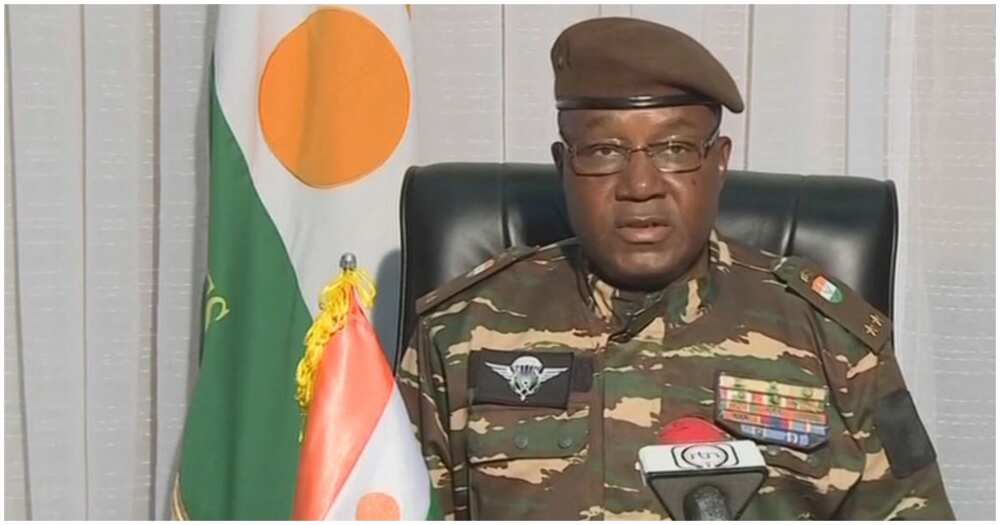
Coup is the political equivalent of armed wife snatching, an act that knows no friend because it is war. In that zero-sum game of power, every actor is a serpent and the closest is always the most poisonous. General Abdourahamane Tchiani, Niger’s coup leader, was the commander of the elite presidential guard. His job was to protect the man he sacked and detained in an apparent preemptive strike. The coupist had an ancestor in Nigeria: Colonel (later Brigadier) Joseph Nanven Garba was made the commander of the Nigerian elite Brigade of Guards at Dodan Barracks in Lagos in the middle of the Nigerian Civil War. He was in charge of the personal security of the then Head of State, General Yakubu Gowon. Like Tchiani, Garba did the work admirably for almost a decade. Then on May 29, 1975, General Gowon was overthrown in a military coup announced by his chief guard – the same Joe Garba.
In Mali, a certain Colonel Assimi Goita was in the news on August 18, 2020 for seizing power which he soon ceded to transitional President Bah Ndaw. Goita was back nine months later in May 2021 announcing that he had seized power from President Ndaw and Prime Minister Moctar Ouane. He proceeded to detain the duo and became interim president and has remained in power since.
What is the meaning of interim? The September 2022 coup in Burkina Faso threw up Captain Ibrahim Traore who was a key participant in the January 2022 coup that enthroned the man he sacked, Lt-Col Paul Henri Sandaogo Damiba. That act of a comrade toppling another comrade was consistent with the political history of the Burkinabe. On Thursday, 15 October, 1987, the leader who renamed the country Burkina Faso, Captain Thomas Sankara, was shot dead outside the central parliament building in Ouagadougou. It was his best friend, colleague and comrade, Blaise Compaore, who was behind his death. Someone reviewed the Sankara tragedy and warned: beware of best friends.
It is not really strange that the man who sacked his president in Niger was in fact the man in charge of the president’s life and throne. Sadly, it is the way of life, and especially of power. You can’t slap someone unless you are close to the person. I counsel all leaders to choose their men with their mind’s eyes open. Whenever events like the Nigerien ‘betrayal’ happen, the Yoruba would quickly remember a head of their army, Aare Ona Kakanfo Afonja of Ilorin, who staged a coup against his lord, the Alaafin, in 1817, forced him out of power and out of life. Like the Arab Spring, the Afonja rebellion serially infected the whole of the Yoruba country with convulsions; the nation caved in to a pandemic of revolts and coups. But Afonja himself soon became a victim of his ambition.
Like Afonja, like Tchiani. The new man in Niger Republic is said to be very brave and popular among his soldiers. He holds himself out as a people’s General. Reports describe him as a veteran pro-democracy officer “who has foiled similar uprisings” in his country in recent past. He was, in fact, the one who foiled a plot to prevent Bazoum from being sworn in in April 2021. Ambitious people always speak the language of freedom. Afonja was a ‘freedom fighter’ hailed initially for standing up to the excesses of Alaafin Aole. He later built a formidable army of forcibly freed Oyo slaves of northern origin. He encouraged the enslaved to desert their owners, gave them freedom, courage and arms. He needed them for his protection but, like he did to the Alaafin, those he cultivated for his defence turned out his nemesis. Afonja fell six years after his coup at the mutinous hands of his soldiers. He was attacked, assailed, defeated and killed one very bad afternoon in 1823 by his ex-men. His attackers were not satisfied with just killing him; they burnt his corpse, denying him a decent burial. What happened to Afonja was a coup that has endured till tomorrow.
Death that is serially killing one’s age mates is dropping a sneaky heads-up in deep proverbs. We should understand the blue-murder cries across Africa’s presidential palaces over the coup in Niger. Rebellion is like yawning; it is contagious. When Gowon was removed in July 1975, the New York Times noted that he was “the seventh African head of government to be deposed in two years.” The newspaper reported that “the previous changes in government had come in Rwanda, Upper Volta, Niger, Ethiopia, Madagascar and Chad.”
Two American political scientists, Nathan Danneman and Emily Hencken Ritter, in 2014 looked at the Arab Spring and came out with a paper they entitled ‘Contagious Rebellion and Preemptive Repression.’ They noted that “rebellions in Tunisia (which was) followed soon after by challenges in Egypt, Syria, and Libya” suggested “the contagious nature of civil conflict.”
Rebellion in the neighborhood, they held, “make citizens more likely to rebel at home.” In politics, as in revolutions, one thing almost always leads to another. We saw it with the 1776 American revolt against British rule; it was followed in 1789 by the French battle for independence. The fall of the Berlin Wall in 1989 ignited a chain of events which altered the course of events in Eastern Europe. That is why the USIP (United States Institute for Peace) is alarmed that eight African countries in 2023 share not just common borders and insecurity but also anti-democratic behaviour.
If you’ve been bitten by a snake before, every twerking, slithering creature would be treated as a snake. French president, Emmanuel Macron, looked deeply at what happened and declared that “this coup is completely illegitimate and profoundly dangerous for Nigeriens, for Niger and for the whole region.” If an earthworm moves like a snake, kill it as you will kill a snake.
Lovers of democracy in Africa should pay attention to these events. The Yoruba have many words of warning; one of them tells the careless to watch out for the dangers which pointed sticks pose to their eyes (igi ganganran má gún mi l’ójú, òkèèrè l’ati í lòó). You escape being blinded by being proactive.
A stich in time saves nine. The ousted Nigerien leader appeared never to have heard that saying before his sack. The coup leader, Tchiani, had reportedly developed a cold war with Bazoum, his Commander-in-Chief, repeatedly “shunning official ceremonies and activities” where the president was present.
He was sending his deputy, Colonel Ibroh Amadou Bacharou, who is now solidly with him in this coup. What did the toppled president do? He was reportedly considering a sack of the General. He went to sleep with a python in his rafters. The sensible would tell him that very few have ever put a date to their enemy’s death and lived to carry it out.
War chiefs can be very uncontrollable and subversive. A particular Balogun some 200 years ago controlled Ilorin and resisted his Emir as it pleased him. It took the direct intervention of the British to put him and the other Baloguns down for the emir to breathe. There were several of such men in Ibadan history. In Ilorin, it was worse. The war chiefs actively competed for power and influence with the emirs, even demanding their removal and death – exactly as Afonja did with Alaafin Aole. But Lugard at a point resolved to address the question of the powers of the Baloguns in Ilorin. Colonial records say that in September 1900, Lugard wrote to the Resident in Ilorin on the need to deal with “the most ill-disposed” of the Baloguns as a lesson to others: “I should be glad if you would accumulate a case against (Balogun) Alanamu (or whoever is the worst) without letting it be known that you are so doing”…then ‘arrest and probably deport him” (See Danmole and Falola’s ‘The Documentation of Ilorin by Samuel Ojo Bada’. 1993: 9). What Lugard said he would do, he did to that Balogun. My people say when you kill iji in the presence of ìjì, ìjì will know its place and how much it weighs.
ECOWAS on Sunday slammed border closure on Niger because of the coup there. Let us look at the political map of that country. It is bordered in the north by non-ECOWAS members, Libya and Algeria. It is bordered by Benin and Nigeria in the south where local people along the borders share farms and streams with their kin on Niger’s side. Niger also shares borders with Burkina Faso in the southeast, with Mali in the west, and with Chad in the east. Is ECOWAS aware that all these countries are, like Niger, under military rule? So, how effective will the closure be?
It is gratifying to see the whole world rejecting what happened in Niger. Niger’s old master, France, has stopped all aids to the country; the European Union has halted all help; the United States has talked tough in support of democracy even as it threads the needle with utmost care. It has to; otherwise, the bad child will run out into the warm bosom of seductive Russia.
The big lesson in the whole tragedy is that democracies will endure only when it serves the people and serves them well.
Coup-endorsing videos of street jubilation and attacks on politicians, their property and symbols of democracy in Niger Republic are a distressing spectacle.
Democracy may be painfully problematic in Africa, but it is still the strongest bulwark against the buffettings of arbitrariness and misrule.
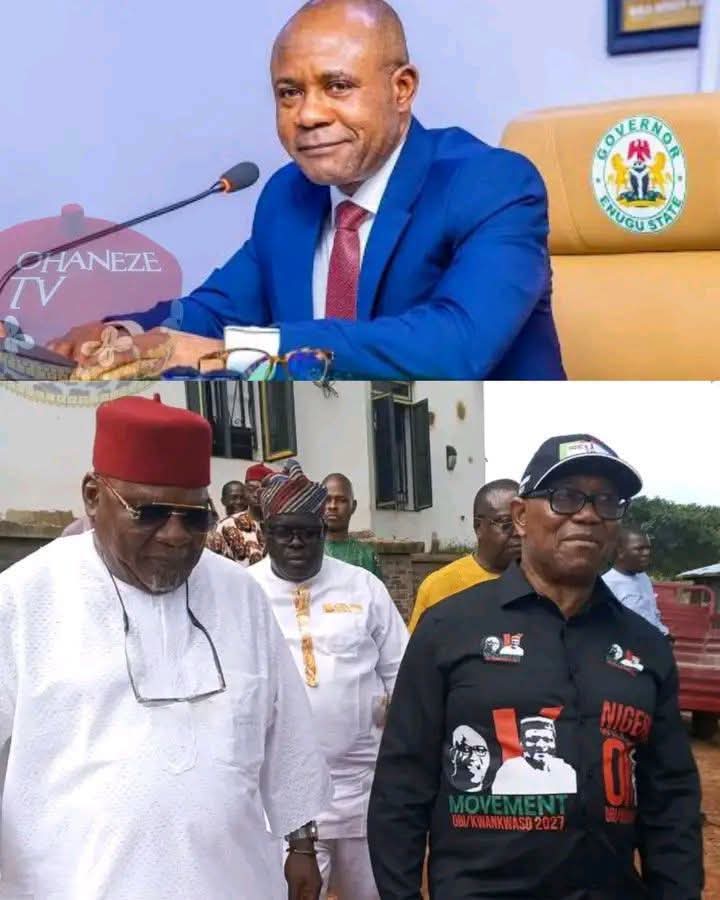
The Enugu State Government has suspended His Royal Majesty, Igwe Eze William Ezugwu, the traditional ruler of Ibagwa Ogbozalla Opi Autonomous Community, in Nsukka Local Government Area of Enugu state.
The state government accused Igwe Ezugwu of violating provisions of the state’s Traditional Rulers Law.
In a letter of suspension dated September 24, the Enugu State Government cited his alleged failure to constitute his cabinet, failure to establish a Town Union governing body, and persistent conduct deemed inconsistent with the laws governing traditional rulers in the state.
The suspension comes barely three weeks after Igwe William Ezugwu received NDC presidential candidate Peter Obi at his palace in Opi, Nsukka LGA, where he reportedly blessed Obi’s presidential ambition.
The Deputy Commander of Operation Rainbow, CSP (Chief Superintendent of Police) Dennis David Babale, has been killed after gunmen suspected to be Fulani Bandits ambushed personnel of the security outfit along the Bokkos-Barkin Ladi road in Barkin Ladi Local Government Area of Plateau State.
Operation Rainbow is a State-backed community security and intelligence-gathering outfit in Plateau State, Nigeria, originally established in 2010 under former Governor Jonah Jang and recently revamped by Governor Caleb Mutfwang to combat rural violence and beef up grassroots security.
The incident reportedly occurred at about 4:06 p.m. on Tuesday, September 22, 2026 when the personnel, travelling in a Toyota Hilux vehicle, came under attack by unidentified gunmen.
Troops of Sector 4, Operation ENDURING PEACE (OPEP), responded to a distress report and moved to the location of the attack.
Sources told reporters that Babale sustained gunshot wounds during the ambush and was evacuated to the General Hospital, Barkin Ladi, for medical attention.
Following the attack, troops, working alongside personnel of other security agencies, launched offensive operations and a manhunt for the assailants within the general area.
Security forces have intensified efforts to track the attackers and prevent further attacks along the route.

Director General/CEO of the Nigerian Meteorological Agency (NiMet) and Nigeria’s Permanent Representative at the World Meteorological Organization, Prof. Charles Anosike and other Chief Executive Officers of similar agencies across the world, have concluded a one week high level dialogue on Climate Science Information for Climate Finance and the 53rd Senior Official Field Exchange (SOFE) in Beijing, China.
The event which was hosted by World Meteorological Organization (WMO), took place from September 14 to 18, 2026 and featured discussions on: strengthening the role and leadership development of National Meteorological and Hydrological Services (NMHSs) in mobilizing climate finance; aligning scientific and technical capabilities with risk-informed, people-centred early warning systems; shifting from technical assistance to sustainable investments by expanding practical cooperation between meteorological frameworks and multilateral financing entities; and support to NMHSs leadership on strengthening strategic thinking and fostering productive partnerships.
Held back-to-back with the High-level dialogue was the 53rd Senior Official Field Exchange to Fujian Province for first-hand exposure to the implementation of Multi-hazard, Alert, Zero-gap and Universal (MAZU) platform – China’s AI-driven meteorological early warning solution in support of the Early Warnings for All (EW4All) initiative and disaster risk reduction practices through technical exchanges, field visits and peer learning.
-

 News2 years ago
Senate to speed up conclusion of Nigeria Forest Security Service Bill
-
 News1 year ago
The Many Lies Against Bashir Haske
-

 News3 years ago
Breaking: Tinubu’s authentic ministerial nominees
-
 News3 years ago
“Anytime we want to kill terrorists, President would ask us to take permission from France but they were killing our soldiers-” Niger Republic coup leader
-
 News3 years ago
“I’m leaving the Catholic church because Bishop Onah is oppressing me,” says Okunerere
-

 News3 years ago
My nude photo leak was a mistake- lawyer Ifunanya
-
 News4 months ago
See your state governor’s performance ranking
-

 News3 years ago
Radio Nigeria’s veteran broadcaster Kelvin Ugwu dies three months after retirement from service