
News
You are sick, hand over to your deputy, SDP tells Akeredolu

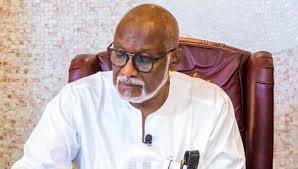
The Social Democratic Party, SDP, has urged Governor Rotimi Akeredolu of Ondo state to hand over his office to his deputy because of his ill health.
Governor Akeredolu had been indisposed for many months due to an undisclosed ailment.
The SDP said the Governor should formally hand over to his deputy in an acting capacity until he is fit and capable of handling state matters.
The SDP had recently described the silence from the governor’s camp and the party, the All Progressives Congress (APC) in the State as concerning and alarming.
The party’s state chairman, Stephen Adewale, in a statement issued in Akure, the state capital, implored the governor “to safeguard his hard-earned reputation by handing over to his deputy, saying- ” This is a duty and responsibility that Governor Akeredolu owes to himself, his party members, his family, and the good people of Ondo State.
The statement reads that ” Ondo State and Ondo State friends must speak out on the increased level of uncertainty that hovered around the governance of our dear Sunshine State before it is too late.
“What began as a candlelight blaze is quickly snowballing into a sizable forest fire.
“And if we do not act quickly, history will not be kind to all of us who knew the incredible power of voice but chose silence.
“The Social Democratic Party (SDP) in Ondo State understands Governor Oluwarotimi Akeredolu’s health condition, for which we have been praying for a speedy recovery.
“However, the state should not and cannot be left without a constitutional head in an acting capacity while he is away attending to his health.
“As we write this, our dear governor has refused to hand over to his deputy in an acting capacity while his whereabouts remain unknown.
” In the past seven days, President Tinubu has met with the APC Governors’ Forum twice.
” During each of those meetings, matters of national importance were discussed.
“Nearly all the governors were in attendance, and those who could not make it had their deputies fill in for them.
” The only state that was conspicuously missing in terms of representation at the two meetings is our dear Ondo State.
” While he recuperates, therefore, we call on Governor Akeredolu to immediately hand over to constitutionally delegate power to the deputy in an Acting capacity so as to keep the state running effectively.
“And if he is strong enough to preside over the affairs of the state as his people claimed, then it is well past time for Governor Akeredolu to show up and prove the doubting Thomases wrong.
“We also call on every relevant stakeholder and patriot in the state to ensure that unnecessary and avoidable constitutional crisis in the management and functioning of the State Government did not ensue.
“This is not the time for them to hide in their cocoon of imperturbability.
” This is not the time for the “Governor is getting better and everything is going on smoothly in the Ondo State” nonsense spewed by APC apologists and many politicians who are abetting the governor to shirk his constitutional responsibility.
“Unknown to these praise singers and those who have chosen silence over talking, no one suffers adversity alone and misery often seeks new neighbourhoods to occupy.
“No matter how these silent stakeholders in Ondo might feel, we will all be touched in varying degrees should this issue be allowed to deteriorate.
“A prolonged uncertainty over the administration of Ondo State will cost the state untoward setback.
“There is no doubt about this. And that is why silence is dangerous now.
” Ondo State is in a rare moment in time when only genuine, exhaustive, and wide-ranging conversations can save the impending storm.
“This is the time to start the constitutional conversations.
Adewale added that ” It is disturbing that a man who once sat atop the highest chair at the Nigeria Bar Association, who actively participated in denouncing an ailing head of state when the latter refused to hand over to his deputy, and who has devoted his entire life to defending the constitution of the land would blatantly and deliberately flout that very constitution.”
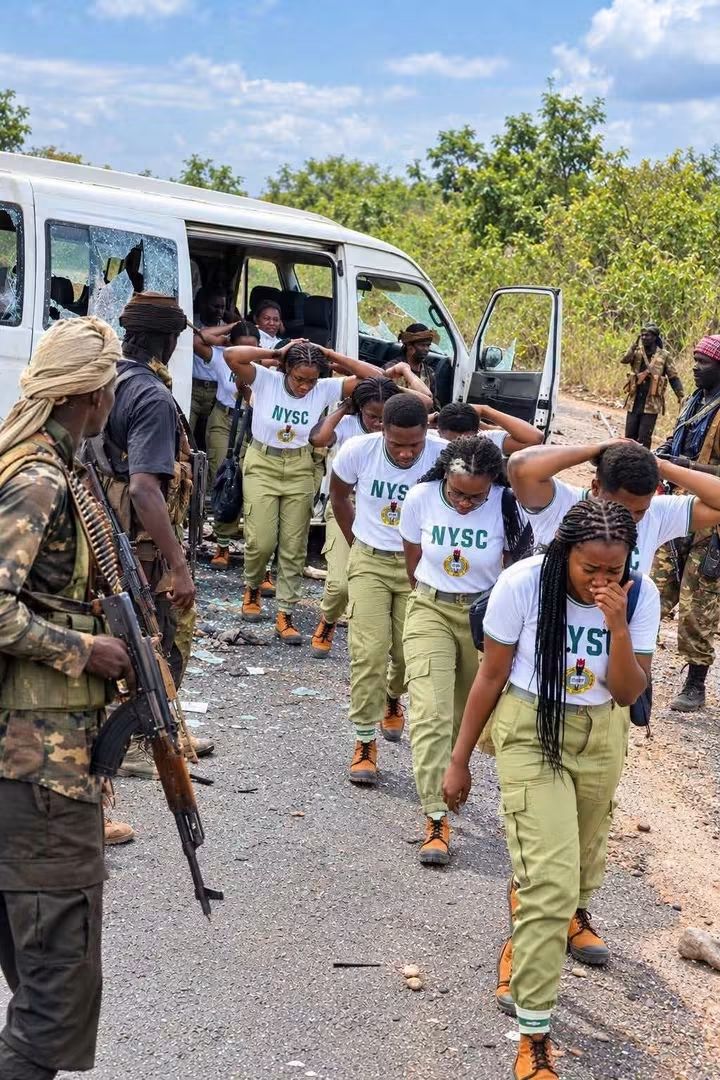
The Inspector General of Police (IGP) Olatunji Disu, has deployed the Deputy Inspector-General of Police (DIG) in charge of Operations, Shehu Umar Nadada, to Imo State to provide operational leadership and strengthen ongoing efforts to rescue the 20 prospective National Youth Service Corps (NYSC) members and other passengers abducted along the Owerri-Onitsha Road at Umunoha on October 1, 2026.
Force Public Relations Officer, Force Headquarters, CSP Anietie Iniedu, disclosed in a statement on Friday that DIG Nadada arrived Imo State alongside two Commissioners of Police and immediately carried out an on-the-spot assessment of the security situation and the search-and-rescue operations being coordinated by the Imo State Police Command.
During the visit, the DIG reviewed operational strategies, personnel deployments, and the utilization of security assets. He also issued fresh directives aimed at enhancing the effectiveness of the coordinated rescue mission.
The assessment was conducted in the company of the Commissioner of Police, Imo State Command, CP Audu Garba Bosso; the Commissioner of Police, Federal Operations, CP Akpan Anifiok; the Commissioner of Police in charge of the Police Mobile Force, CP Nendel Joseph Gomwalk; other service commanders; and members of the Imo State Police Command management team.
According to Iniedu, the police have intensified the search operation, deploying additional tactical teams and operational resources to identified locations.
He said the operation was being reinforced through intelligence-led efforts to track the abductors, alongside coordinated operations with other security agencies.
Nadada, according to the statement, assured members of the public that the police would continue working to secure the safe release of those abducted.
“The Nigeria Police Force is committed to securing the safe rescue of the 20 abducted persons and will sustain the operation until the mission is successfully concluded,” Iniedu quoted Nadada as saying.
The DIG appealed to members of the public and the media to remain calm and vigilant, while urging anyone with credible information that could assist the rescue operation to report to the police or the nearest security formation.
“All information received will be treated with strict confidentiality,” he said.
The police said further information on the rescue operation would be made available as developments unfold.
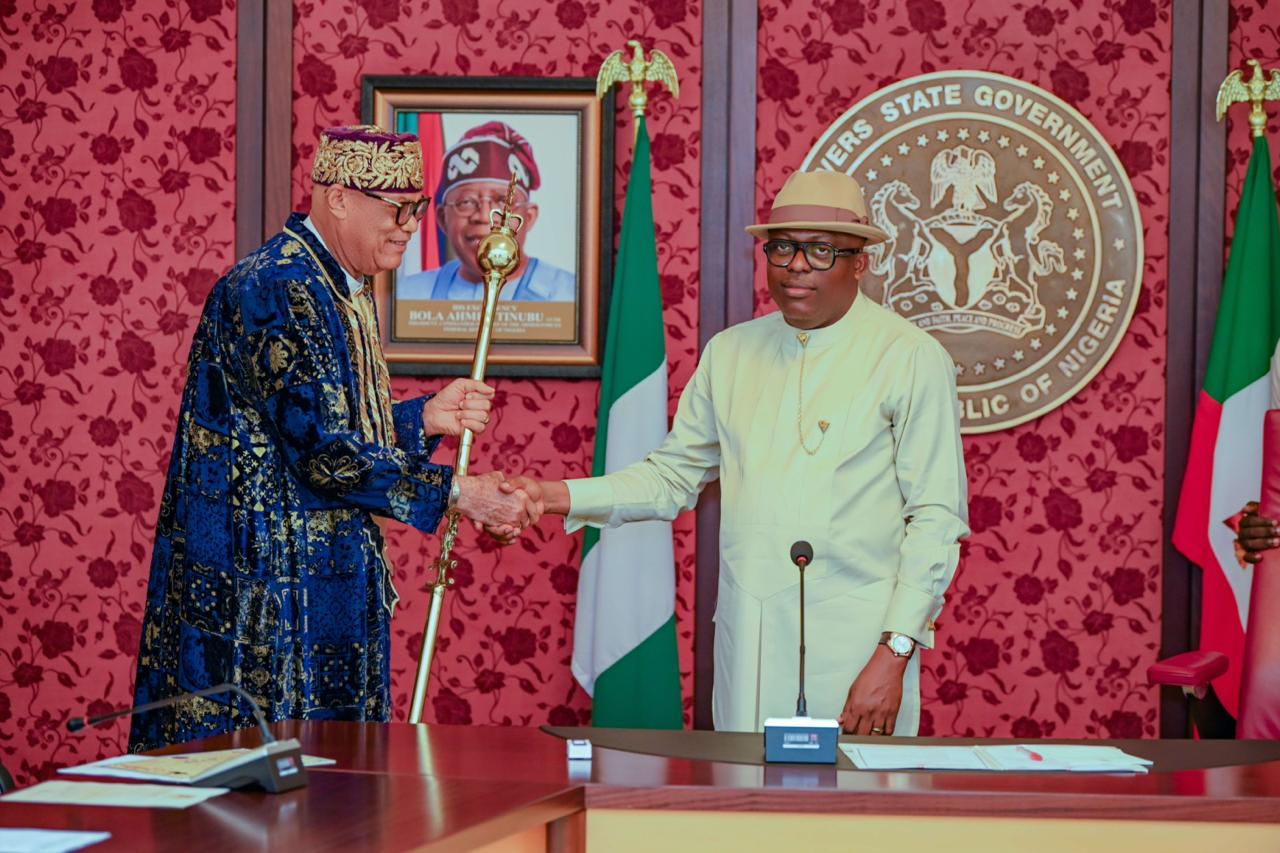
Photo caption: Governor of Rivers State, His Excellency, Sir Siminalayi Fubara (right) presenting the Staff of Office to His Majesty King Charles Douglas Mac-Pepple Jaja Jeki VI (left),the newly crowned Amanyanabo of Opobo Kingdom at Government House Port Harcourt on Friday.
Governor of Rivers State , His Excellency, Sir Siminalayi Fubara, on Friday formally presented the Certificate of Recognition and Staff of Office to the new Amanyanabo of Opobo Kingdom, His Majesty King Charles Douglas Mac-Pepple Jaja, Jeki VI, urging the new monarch to promote peace, unity and inclusiveness in the kingdom.
The governor while congratulating the new monarch, for successfully scaling the hurdles of selection and coronation, urged the royal father to see contenders who lost out of the selection process, not as victims but as comrades who must be carried along for the kingdom to move forward during his reign.
Speaking during the presentation ceremony in Government House, Port Harcourt, Governor Fubara apologized for his absence at the coronation, explaining that it was due to a call to higher national service, but that his spirit and soul were fully with the kingdom throughout the process.
He declared that history will remember his administration for peacefully laying to rest the late King, Douglas Dandeson Jaja, and mid-wifing the emergence of a new monarch without litigation.
The Governor, who said he remains one of the proudest persons on earth for the success of the transition, disclosed that the late king’s stool was enmeshed in a legal battle that lasted over 27 years, and that it took the wisdom and deliberate intervention of his administration to manage the selection process to avoid another round of court cases.
He emphasized that contrary to insinuations by mischief makers who tried to politicise his absence, his government was fully responsible for the entire process from burial of the late king to the coronation and recognition.
“Our presence was not just in that process alone. Every logistics that were required, there is nobody that can say he’s the one that did it. We did it. So, that is also a key issue in the process. So, for those people who like using everything for politics, my absence was not an intentional thing; it was a call to service. So the fact that I was unable to make it doesn’t mean that I do not value, appreciate or support the process,” Governor Fubara said.
He said the true test of kingship is in the management of success, and prayed that the new reign will usher in greater development in education, healthcare and small businesses, which he said remain the only sustainable antidotes to the growing criminality among youths.
The Governor, who described Opobo as one of the most peaceful Local Government Areas in the State, charged the new king to maintain zero tolerance for criminality, to be intentional and decisive in protecting the kingdom, and not to compromise on security on the grounds of kinship.
Governor Fubara assured the monarch of the continuous support of his administration both in and out of office, while also charging the Alapu Council to guide the king and the titled citizens to redirect their purpose from mere ceremonial uniformity to initiating tangible development projects that will be visible in the kingdom within the next one year.
In an acceptance speech, the newly installed Amanyanabo of Opobo Kingdom, His Majesty King Jaja Jeki VI, pledged to build Opobo on the pillars of service, inclusion and vision, in honour of the legacy of the great King Jaja who founded the kingdom 156 years ago with trade and diplomacy.
Describing the Staff of Office as more than a symbol of authority, the monarch said it represents a sacred trust from the government and people of Rivers State to lead with justice, peace and dignity.
In a statement, Onwuka Nzechi, Chief Press Secretary to Governor Fubara, quoted the monarch to have expressed deep gratitude to God, the ancestors, Governor Fubara, the Opobo Council of Alapu, titled citizens, elders, women and youths for the confidence reposed in him to lead Opobo into its Sixth Chapter.
The new king assured the Rivers State Government that under his reign, Opobo Kingdom will remain a dependable partner for peace, development and unity of Rivers State.
Gunmen have abducted 20 corps members serving under the National Youth Service Corps (NYSC) along the Owerri–Onitsha Road by Umunoha community in the Mbaitoli, Imo State, South East Nigeria.
Confirming the unfortunate incident, in a telephone conversation, the Police Public Relations Officer of the Imo State Police Command, Henry Okoye, said the corps members were reportedly travelling in a commercial bus from Ibadan, Oyo State, to different orientation camps in the South-East and South-South states when they were intercepted by the gunmen.
He said the Commissioner of Police, Audu Bosso, visited the scene for an on-the-spot assessment, while the police and other security agencies have intensified efforts to rescue the victims unhurt and unconditionally.
Okoye added that security operatives were currently combing surrounding bushes, while a Rapid Response Team (RRT) had also been deployed to track down the kidnappers and secure the safe release of the corps members.
The incident came weeks after the police said that 11 people, including an unidentified number of corps members serving under the National Youth Service Corps (NYSC), were rescued after gunmen attacked vehicles along the Aloma–Egane Expressway.
-

 News2 years ago
Senate to speed up conclusion of Nigeria Forest Security Service Bill
-
 News1 year ago
The Many Lies Against Bashir Haske
-

 News3 years ago
Breaking: Tinubu’s authentic ministerial nominees
-
 News3 years ago
“Anytime we want to kill terrorists, President would ask us to take permission from France but they were killing our soldiers-” Niger Republic coup leader
-
 News3 years ago
“I’m leaving the Catholic church because Bishop Onah is oppressing me,” says Okunerere
-
 News4 months ago
See your state governor’s performance ranking
-

 News3 years ago
My nude photo leak was a mistake- lawyer Ifunanya
-

 News3 years ago
Radio Nigeria’s veteran broadcaster Kelvin Ugwu dies three months after retirement from service