News
UNDP, GJF collaboration and promise of rethinking governance, building trust in the Sahel

By Wealth Ominabo Dickson
The quest for solutions to the daunting challenges in the Sahel is poised to receive a significant boost. In a region long plagued by political instability, insecurity, and economic hardship, the Sahel Governance Forum has emerged as a vital platform for reshaping the narrative. The inaugural edition of this landmark initiative, being hosted by The Gambia on July 30-31, 2025, in collaboration with the Goodluck Jonathan Foundation (GJF), the United Nations Office for West Africa and the Sahel (UNOWAS), the Office of the Special Coordinator for Development in the Sahel (OSCDS), and the United Nations Development Programme (UNDP), signals a pivotal moment for governance in the Sahel region. It will not just be a meeting of minds, it is billed to be a strategic intervention in the fragile democratic fabric of the subregion.
The Sahel is no doubt at a crossroads. From Mali to Burkina Faso and from Chad to Niger, democratic institutions are under severe strain. Military coups, insurgent violence, disinformation campaigns, and the marginalization of youth and women have combined to undermine peace and good governance. In this context, the Forum was convened not merely as a conference but as an incubator for resilience, a platform where leaders, civil society, and international partners could collectively chart a path forward.
Crucially, the Forum has come to serve as a convener of dialogue at a time when dialogue is under constraint. With rising authoritarian tendencies and waning trust in electoral processes, forums such as this become sanctuaries for democratic discourse. The Sahel Governance Forum, therefore, is more than an event, it is a defiant stand for inclusive governance, institutional strengthening, and sustainable peace.
This is knowing that at the heart of the governance conundrum in the Sahel lies a deeper legitimacy crisis. When citizens lose faith in the state’s ability, or willingness to deliver justice, security, and opportunity, governance becomes fragile, and the potential for unrest multiplies. This is why the Forum’s focus on social cohesion and trust is not only timely but essential.
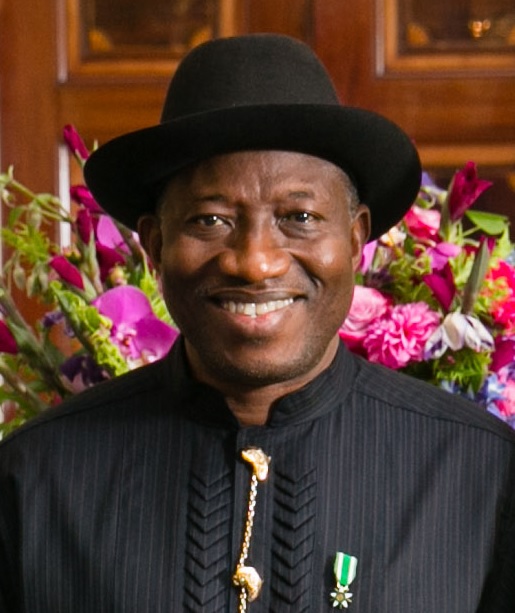
The conference is being availed further weight by the enduring legacy of Dr. Goodluck Ebele Jonathan, former President of Nigeria and a globally recognized champion of peace and democracy. Through the Goodluck Jonathan Foundation, he has consistently advanced the ideals of democracy, reconciliation, and good governance, particularly in conflict-prone societies. His presence and active leadership at the Forum underscores his deep commitment to these values.
Dr. Jonathan’s post-presidency has become a case study in transformative leadership. Rather than retreat into quiet retirement, he has thrown his weight behind peace mediation efforts, electoral integrity missions, and democratic reforms across Africa. His role in helping to peacefully resolve political crises in The Gambia (2016-2017), Mali, and elsewhere, attests to his diplomatic clout and unwavering belief in democracy as a tool for development.
The Foundation he leads has become a respected pan-African institution, convening stakeholders, producing research, and advocating for policies that deepen democratic practice, especially in leading mediation missions during elections in order to prevent election related crises in the nations of the subregion. Through its work, GJF has built a bridge between theory and practice, between policymakers and the people, and between conflict and consensus.
What makes the Sahel Governance Forum especially significant is its collaborative DNA. The GJF, in joining forces with the UNDP, UNOWAS, OSCDS, underscores the necessity of multilateral approaches to the region’s complex governance challenges. Each partner brings to the table a wealth of experience, institutional capacity, and local knowledge. UNOWAS offers political insight and regional strategy. OSCDS brings in development-oriented perspectives crucial to tackling root causes of fragility. The UNDP contributed its global development lens, with special attention to inclusive governance and capacity building.
The GJF which hosts the West African Elders Forum (WAEF) brings to bear on the process, the wealth of experience and wisdom of the subregion’s former Presidents and statesmen who populate the body as members.
Together, these institutions forged a coalition of intent; intent on restoring citizen trust, empowering local governance structures, and promoting peaceful political transitions.
Hosting the inaugural Forum in The Gambia is a symbolic masterstroke. Once under autocratic rule, The Gambia has emerged in recent years as a hopeful example of democratic renewal. Its peaceful transition of power in 2017, in which Dr. Jonathan played a mediating role, highlighted the power of dialogue over violence. By returning to Banjul to host this Forum, the region was reminded of what is possible when democracy is protected and nurtured.
President Adama Barrow’s administration, in hosting the Forum, affirms its commitment to regional leadership on governance.
The success of the Sahel Governance Forum must not be measured solely by the speeches delivered or communiqués released. Its real legacy will lie in how effectively its recommendations are implemented, how robustly its networks are maintained, and how consistently its spirit of dialogue is kept alive. Forums come and go, but institutions and movements must endure.
This is where the Goodluck Jonathan Foundation can play a unique role. With its growing influence, it can serve as a moral compass and a strategic convener, helping to translate forum outcomes into real-world impact. Its independence and credibility position it well to act as a bridge between governments, civil society, and international partners.
The Sahel Governance Forum is a model worth replicating across Africa, a model rooted in inclusive dialogue, multilateral collaboration, and African leadership. It is a timely reminder that Africa’s governance challenges, while formidable, are not insurmountable.
Dr. Goodluck Jonathan’s vision of “democracy as a tool for peace” continues to resonate across the continent. His Foundation, through initiatives like this Forum, is helping to build the scaffolding for a more stable, democratic, and prosperous Sahel.
The work is far from over, but the journey has begun. And thanks to the Sahel Governance Forum, it is a journey that now has direction, allies, and renewed hope.
· Mr. Dickson is a media officer, Goodluck Jonathan Foundation (GJF)
….Writes NMDPRA, Engages Marketers to Stabilise Fuel Market
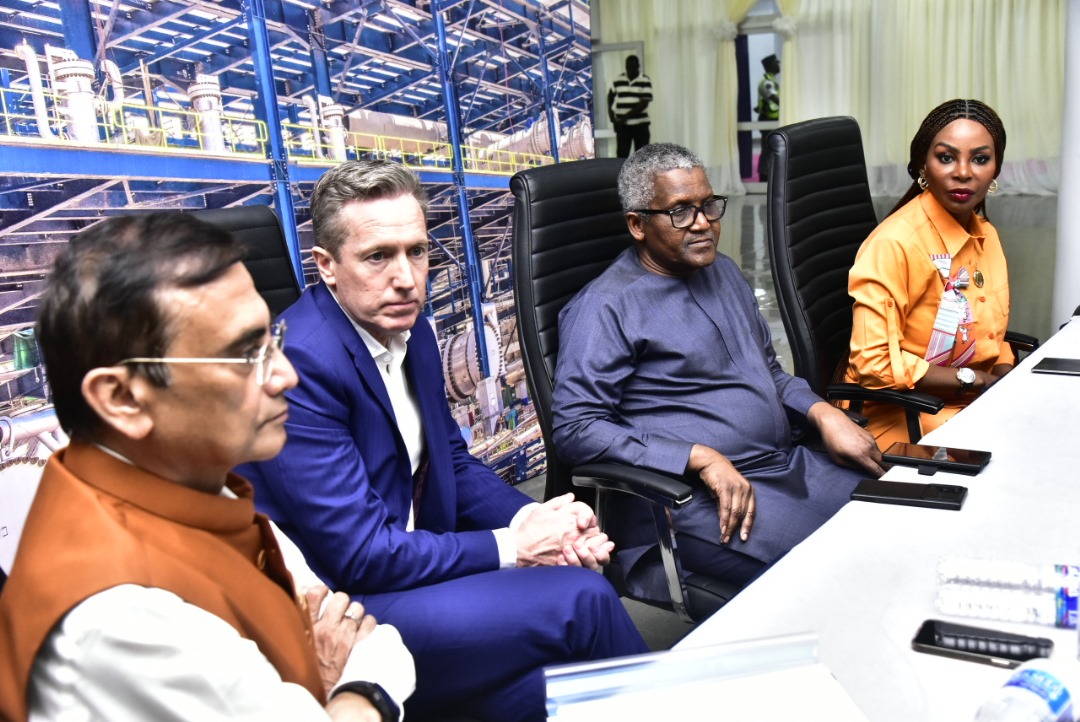
Photo caption: L R: Chief Executive Officer, Dangote Fertiliser Limited, Vishwajit Sinha; Chief Executive Officer and Managing Director, Dangote Petroleum Refinery, David Bird; President and Chief Executive, Dangote Industries Ltd, Aliko Dangote; Managing Director and Chief Executive Officer, South South Development Commission, Usoro Akpabio, during the visit of SSDC members to the Dangote Petroleum Refinery and Fertiliser Plant in Lagos on Sunday, November 30, 2025.
Dangote Petroleum Refinery has announced plans to supply one billion five hundred million litres of Premium Motor Spirit (PMS) monthly to the Nigerian market in December 2025 and January 2026, a move aimed at ensuring uninterrupted nationwide fuel availability through the festive season and into the New Year.
President and Chief Executive of Dangote Industries Limited, Aliko Dangote, disclosed the plans at the weekend, noting that the refinery will make available 50 million litres of PMS daily beginning December 1.
“In line with our commitment to national wellbeing, and consistent with our track record of ensuring a holiday season free of fuel scarcity, the Dangote Petroleum Refinery will supply 1.5 billion litres of PMS to the Nigerian market this month. This represents 50 million litres per day. We are formally notifying the Nigerian Midstream and Downstream Petroleum Regulatory Authority (NMDPRA) of this commitment. We will supply another 1.5 billion litres in January and increase to 1.7 billion litres in February, which translates to about 60 million litres per day,” Dangote said.
Photo caption: L R: President and Chief Executive, Dangote Industries Ltd, Aliko Dangote; Managing Director and Chief Executive Officer, South South Development Commission, Usoro Akpabio, during the visit of SSDC members to the Dangote Petroleum Refinery and Fertiliser Plant in Lagos on Sunday, November 30, 2025.
Speaking during a visit by the South-South Development Commission (SSDC) to the refinery and the Dangote Fertiliser complex, he stated that the facility currently has adequate stock and is producing between 40 and 45 million litres of PMS daily. He added that the daily supply of 50 million litres should dispel long-standing claims that domestic refineries lack the capacity to meet national demand.
Dangote also revealed ongoing engagement with petroleum marketers to strengthen distribution systems, including expanding the use of CNG-powered haulage.
“Our priority is to ensure Nigeria receives the products it needs. This is not driven by profit motives; it is about guaranteeing the availability of essential energy products. It is similar to the transformation we delivered in the cement sector,” he added.
He further noted that the refinery is progressing with its expansion plan to reach a capacity of 1.4 million barrels per day. More than 100,000 workers are expected to be involved in the expansion of both the refinery and the fertiliser complex. Dangote emphasised that the Group remains committed to its vision, driven by the strong public support for the company’s role in shaping Nigeria’s economic development.
During the visit, the Managing Director of SSDC, Usoro Offiong Akpabio, commended Dangote’s leadership and his continued contribution to strengthening Nigeria’s industrial capability, national energy security and long-term economic competitiveness.
She described the South-South region as Nigeria’s natural energy corridor, with vast crude oil reserves, gas infrastructure, maritime assets, agro-industrial activity and emerging industrial clusters. She noted that deeper collaboration between the region and the Dangote Group could unlock opportunities in product distribution, CNG infrastructure, petrochemicals, agriculture, and employment creation.
Akpabio added that such partnerships would advance the Federal Government’s energy stability agenda and position the South-South as a strategic growth hub for the Dangote Group.
“As the statutory development body for the South-South, SSDC is mandated to drive regional economic development, infrastructure integration, human capital advancement, and private-sector–led growth. In this regard, we stand prepared to support State-level policy and regulatory support for Ease-of-doing-business across our six states. Enabling environments for Dangote Group’s expansion into strategic sectors such as gas processing, agro-industrial value chains, renewable energy, logistics, and export-oriented manufacturing,” she said.
In a letter from the refinery’s Managing Director, David Bird, to the Authority Chief Executive of the NMDPRA, the company reaffirmed its readiness to host NMDPRA officials onsite at the refinery from December 1st to verify and publish its daily supply volumes. The refinery also sought the Authority’s support to ensure unhindered importation of crude, feedstocks and blending components, as well as smooth vessel loading for product evacuation.
“In the spirit of full transparency to the public we are willing to publish our daily production and stock volumes (online and print media),” Bird stated. “We seek the full support of NMDPRA to allow Dangote refinery to import our crude, feedstocks and blending components unhindered as well as support the lifting of our products by vessel. We continue to experience delays in vessel clearance which impacts not only the refinery operations but also our customers, adding unnecessary costs and inefficiencies”.
By Bonaventure Phillips Melah
Photo caption: L R: Chief Executive Officer, Dangote Fertiliser Limited, Vishwajit Sinha; Chief Executive Officer and Managing Director, Dangote Petroleum Refinery, David Bird; President and Chief Executive, Dangote Industries Ltd, Aliko Dangote; Managing Director and Chief Executive Officer, South South Development Commission, Usoro Akpabio, during the visit of SSDC members to the Dangote Petroleum Refinery and Fertiliser Plant in Lagos on Sunday, November 30, 2025.
Dangote Petroleum Refinery has announced plans to supply one billion five hundred million litres of Premium Motor Spirit (PMS) monthly to the Nigerian market in December 2025 and January 2026, a move aimed at ensuring uninterrupted nationwide fuel availability through the festive season and into the New Year.
President and Chief Executive of Dangote Industries Limited, Aliko Dangote, disclosed the plans at the weekend, noting that the refinery will make available 50 million litres of PMS daily beginning December 1.
“In line with our commitment to national wellbeing, and consistent with our track record of ensuring a holiday season free of fuel scarcity, the Dangote Petroleum Refinery will supply 1.5 billion litres of PMS to the Nigerian market this month. This represents 50 million litres per day. We are formally notifying the Nigerian Midstream and Downstream Petroleum Regulatory Authority (NMDPRA) of this commitment. We will supply another 1.5 billion litres in January and increase to 1.7 billion litres in February, which translates to about 60 million litres per day,” Dangote said.

Photo caption: LR: President and Chief Executive, Dangote Industries Ltd, Aliko Dangote; Managing Director and Chief Executive Officer, South South Development Commission, Usoro Akpabio, during the visit of SSDC members to the Dangote Petroleum Refinery and Fertiliser Plant in Lagos on Sunday, November 30, 2025.
Speaking during a visit by the South-South Development Commission (SSDC) to the refinery and the Dangote Fertiliser complex, he stated that the facility currently has adequate stock and is producing between 40 and 45 million litres of PMS daily. He added that the daily supply of 50 million litres should dispel long-standing claims that domestic refineries lack the capacity to meet national demand.
Dangote also revealed ongoing engagement with petroleum marketers to strengthen distribution systems, including expanding the use of CNG-powered haulage.
“Our priority is to ensure Nigeria receives the products it needs. This is not driven by profit motives; it is about guaranteeing the availability of essential energy products. It is similar to the transformation we delivered in the cement sector,” he added.
He further noted that the refinery is progressing with its expansion plan to reach a capacity of 1.4 million barrels per day. More than 100,000 workers are expected to be involved in the expansion of both the refinery and the fertiliser complex. Dangote emphasised that the Group remains committed to its vision, driven by the strong public support for the company’s role in shaping Nigeria’s economic development.
During the visit, the Managing Director of SSDC, Usoro Offiong Akpabio, commended Dangote’s leadership and his continued contribution to strengthening Nigeria’s industrial capability, national energy security and long-term economic competitiveness.
She described the South-South region as Nigeria’s natural energy corridor, with vast crude oil reserves, gas infrastructure, maritime assets, agro-industrial activity and emerging industrial clusters. She noted that deeper collaboration between the region and the Dangote Group could unlock opportunities in product distribution, CNG infrastructure, petrochemicals, agriculture, and employment creation.
Akpabio added that such partnerships would advance the Federal Government’s energy stability agenda and position the South-South as a strategic growth hub for the Dangote Group.
“As the statutory development body for the South-South, SSDC is mandated to drive regional economic development, infrastructure integration, human capital advancement, and private-sector–led growth. In this regard, we stand prepared to support State-level policy and regulatory support for Ease-of-doing-business across our six states. Enabling environments for Dangote Group’s expansion into strategic sectors such as gas processing, agro-industrial value chains, renewable energy, logistics, and export-oriented manufacturing,” she said.
In a letter from the refinery’s Managing Director, David Bird, to the Authority Chief Executive of the NMDPRA, the company reaffirmed its readiness to host NMDPRA officials onsite at the refinery from December 1st to verify and publish its daily supply volumes. The refinery also sought the Authority’s support to ensure unhindered importation of crude, feedstocks and blending components, as well as smooth vessel loading for product evacuation.
“In the spirit of full transparency to the public we are willing to publish our daily production and stock volumes (online and print media),” Bird stated. “We seek the full support of NMDPRA to allow Dangote refinery to import our crude, feedstocks and blending components unhindered as well as support the lifting of our products by vessel. We continue to experience delays in vessel clearance which impacts not only the refinery operations but also our customers, adding unnecessary costs and inefficiencies”.

Some women in Ezimo community, Udenu Local Government Area of Enugu State, on Saturday, staged a protest over the alleged kidnap of five residents and the shooting of another during an attack on the community.
The protesters, who marched through major parts of the community, said the incident had heightened fear and insecurity in the area.
One victim of the attack is currently receiving treatment in the hospital.
A social media influencer, ‘Sen.’ Chijinkem Ugwuanyi, made this known via Facebook on Saturday.
Ugwuanyi revealed that resident who confirmed the incident said recent cases of abductions and shootings had left the community unsafe, prompting the women to demand urgent government intervention.
In a video shared on Ugwuanyi’s Facebook page, the protesters called on the Enugu State Government and security agencies to step in and restore peace, warning that residents could no longer live under constant fear of attacks.
-

 News2 years ago
Breaking: Tinubu’s authentic ministerial nominees
-

 News9 months ago
Senate to speed up conclusion of Nigeria Forest Security Service Bill
-
 News2 years ago
“Anytime we want to kill terrorists, President would ask us to take permission from France but they were killing our soldiers-” Niger Republic coup leader
-

 News2 years ago
“I’m leaving the Catholic church because Bishop Onah is oppressing me,” says Okunerere
-

 News2 years ago
Radio Nigeria’s veteran broadcaster Kelvin Ugwu dies three months after retirement from service
-
 News2 years ago
Dokpesi and the Gazebo Mystique
-

 News2 years ago
Tsunami: Tinubu orders dissolution of managements, boards of MDAs, to sack all Buhari’s political appointees
-

 News2 years ago
Persons against Allagoa’s reforms behind protests at NSITF