
News
Plane crash that killed COAS Attahiru was not accident but sabotage, says Gen. Ali Keffi


A new twist has been added over the May 2021 plane crash that killed the then Chief of Army Staff, COAS, Lt Gen Ibrahim Attahiru and 11 other senior military officers.
Retired Major General Danjuma Ali-Keffi, a former General Officer Commanding (GOC) of 1 Division of the Nigerian Army, who stated this, also called on President Bola Tinubu to investigate the incident with a view to unravelling the circumstances behind the crash and those behind it.
In an interview he granted THISDAY which Nationwide Reports is following, Ali-Keffi contends that the crash is intricately linked to terror financiers, urging President Bola Tinubu to launch an immediate investigation into the incident.
He expressed his reservations about the official investigation and alleged a deliberate suppression of critical details surrounding the crash.
The retired General emphasized that the full report of the investigation has not been disclosed to the public, adding an air of suspicion to the circumstances leading up to the tragic incident.
The retired general asserts that Attahiru was pivotal in formulating strategies to eradicate terrorism in Northern Nigeria and contended that the late army chief’s efforts to tackle terrorism extended to exposing and neutralizing terror financiers.
In a detailed account of the events leading to the crash, Ali-Keffi raises questions about the abrupt changes in the scheduled trip, alterations in the choice of aircraft, and modifications in the landing airport.
He pointed to a sequence of unusual events, including the aircraft’s descent in stormy weather, a delayed departure, and an ear-shattering explosion before the crash, casting doubt on the official narrative.
Ali-Keffi explained, “About 2100 hrs on Thursday 20 May 2021, I spoke on phone with the Chief of Staff (COS) to the late COAS regarding their impending trip to Kaduna the following day (21 May 2021).
I had earlier spoken with General Attahiru on the same issue. We ended our conversation on the note that the late COAS and entourage would come by flight at about 1000 hrs the following day.
“About 0630 hrs the following morning, I called the COS to the late COAS to confirm if their travel plan was as we discussed the night before, as I needed to make arrangements for the Mosque that the COAS would attend Jummu’at (Friday) prayers.
“The COS informed me that there was a change of plan. He said after we finished speaking last night, they received a message that the late COAS was to attend a meeting either at the Honourable Minister of Defence (HMOD) office or at the Presidential Villa at about 1000 hrs on Friday 21 May 2021 and that the late COAS was to attend in person and not send a representative.
“It is important to note that the late COAS’ trip to Kaduna was part of his visit to Zaria to attend the Passing Out Parade at the Depot NA slated for Saturday 22 May 2021.
“It is worth noting that the movement of service chiefs out of station (Abuja) is with the prior knowledge of the Chief of Defence Staff (CDS), the Honourable Minister of Defence (HMOD), and the presidency.
“So, why was a meeting scheduled for about the same time that the late COAS was to have departed for (or arrived) Kaduna and why the insistence that he (COAS) should not be represented?
“In any case, the COS informed me that in view of the meeting, they would depart the Flag House (official residence of the COAS) at about 1530 hrs (after attending the meeting and also after the Jummu’ at prayers) for the airport.
“They expected to arrive the airport at about 1600 hrs, board the aircraft at about 1610 – 1615 hrs and depart for Kaduna. At about 1600 hrs, I was informed that they had arrived the Presidential Wing of the Airport. I then set off from the Stallion House (official residence of the GOC) with my entourage in a convoy and arrived the Air Force Base at about 1615 hrs.
“For reasons that I cannot understand till today, the flight was delayed for over an hour and did not take off until 1730 hrs or there about. The reason for the delay, as I was informed, was that there was issue with the aircraft that was initially assigned for the mission (to convey the COAS and his entourage) and that it had to be changed.”
Ali-Keffi also disclosed, “Meantime, there was a meteorological alert that Kaduna airspace was going to experience heavy rainfall accompanied with the storm (wind shear), and it was advised. Already, the cloud had formed in Kaduna, which was visible to us at the airport.
“As a matter of fact, the cloud was so thick, which was indicative of a massive storm. I began to nurse doubts about the flight. At some point, I voiced my doubts to Air Commodore Iyamu and Air Commodore Ilo, who were with me to receive the COAS.
“I even suggested that they should advise Abuja of weather conditions with a view to having the flight cancelled. At that point, I was informed that the aircraft was airborne (at about 1745 hrs). I became concerned as to whether the aircraft would be able to land at the airport in such a heavy rainfall, storm (the rain had started falling then).
“Thus, I was not surprised when Air Commodore Ilo informed me that we had go to the Civil (International Airport) as the NAF runway was not long enough to enable the aircraft land under the atrocious weather condition. We then set off for the International Airport but at a snail speed due to the heavy rainfall, which was accompanied with shale (ice particles).”
The former GOC said, “When we got to the vicinity of the airport, there was a thunderous sound, which I thought was the sound of thunder. We had earlier cited what I believed was the aircraft descending to land on the runway. When we turned the bend to enter the tarmac, the thought on my mind was that the aircraft had touched down and was taxing to the parking area.
“I couldn’t see any aircraft on the runway. I frantically looked around, and by the far side of the runway, there was a fireball. It was the aircraft conveying General Attahiru! We got out the vehicles, crossed the runway and approached the burning aircraft. Fire fighters were on hand to put out the blaze. At some point we had to pull back due to the fear of exploding cylinders.
“We later recovered the corpses of the 10 passengers on board the ill-fated plane far from where the plane wreckage was. Apparently, their bodies, which were on fire, were flung from the aircraft before it came down (already in flames). Furthermore, the aircraft (or what was left of it), at least what I could recollect, was on a relatively flat grassland.
“There was no crater. This was indicative of a mid-air explosion. So, what caused the aircraft to explode? I wonder what the Air Safety and Accident Investigation Bureau report says about the incident.”
Ali-Keffi further queried, “Was the flight deliberately delayed in order to be caught up in the rainstorm? Was the aircraft sabotaged, which caused it to explode mid-air? Was the explosion caused by explosives? Was a bomb planted in the aircraft or contained in a parcel, which a passenger unknowingly (or knowingly) carried?” he questioned.

A former employee of Air Peace, who simply identified herself as Tade, has made a social media post on her recent encounter with the Chairman/CEO of the airline, Dr. Allen Onyena and praised him for his exceptional goodwill, benevolence and kind word of encouragement.
Tade who said she resined from Air Peace last year to set up a fashion outfit, after receiving blessings from Allen Onyena, quoted the airline’s CEO to have commended her for establishing her own business, said the encounter took place on Wednesday when the Air Peace boss paid a visit to her business premises
The obviously excited lady said- “It was such a beautiful moment having my boss visit my factory. And honestly, I still struggle to call him my former boss. Some people may be former bosses by designation, but the place they occupy in your life does not change simply because you no longer work in the same organisation.
“Two days ago, when he told me he wanted to come see the factory, I honestly wondered if he would be able to make it. I had seen how incredibly busy his schedule was, meetings, guests, engagements, one thing after another, and some of those meetings stretched well into yesterday evening.
“But around 7pm, after what I can only imagine was an incredibly long and stressful day, he still came.
“And he didn’t just come in, take a quick look around and leave. The entire house came alive.
“We received him warmly, and his presence brought such a beautiful energy into the building. He took time to speak with the staff, interacted with my friend, Mr. Jire, and his wife about their business, and then came into my office and sat with me.
“And for a while, it was just my boss being my boss.
“We talked about entrepreneurship, people management, business management, governance, leadership, and the challenges that come with growing a business, including some of the challenges I cannot even see yet. He reminded me, in his own way, that growth does not mean the challenges stop. They simply change.
“And then came that moment:
“You are now an employer of labour yourself, Tadé.”
She continued – “I don’t think he knows what those words meant to me. October will make it a year since I resigned from Air Peace and left with his blessing.
“And here I was yesterday, almost a year later, standing in my own factory, surrounded by people who now work for the fashion company I am building, while the man I once reported to was standing there looking at what has grown from that decision.
“There was something deeply emotional about it. Because when I met this man in 2023, I could not have known all that the years ahead would hold.
“Meeting you, sir, and working with you was never a coincidence. It was a necessary chapter in my life. A needed season. A significant part of the journey that brought me here. And I will always cherish it.
“Thank you, sir, for your leadership. Thank you for the opportunities, the lessons, the corrections, the wisdom, and most especially, for your consistent belief in me.
“Thank you for showing up. And thank you for coming to see what that little girl who once worked with you is building today. It meant more to me than I can properly put into words.
“And on behalf of the entire TADÉ house, thank you for the generous gift. We are deeply grateful.
“Some moments are bigger than the moment itself. Yesterday was one of them.,” she concluded.
All pictures were taken in the moment

Chairman of the Nigeria Democratic in Congress (NDC), Fiidi Council Ward in Makurdi Local Government Area of Benue State, Igbu Terhemen, has reportedly been killed by unknown assailants.
Terhemen was said to have been attacked and left unconscious in a bush near his residence around the NNPC Depot, along the Makurdi-Otukpo Road, on the outskirts of Makurdi, the state capital.
A friend of the deceased, who spoke on condition of anonymity, said Terhemen left his residence on Tuesday evening to watch a local football match in the Kanshio axis of the town but did not return home.
According to him, family members and friends became worried after the deceased failed to return and subsequently began searching for him.
He said, “He left home to watch the match Tuesday evening and he was expected back home, but nobody saw him. It was while people were looking around for him that he was discovered around 2am Wednesday in a bush near his residence unconscious.
“Unfortunately, he died before he could get medical attention. Strangely, his attackers did not take his phone, which was discovered on him when he was taken to the morgue.
“There was also a needle-like injury on his body, indicating that he could have been injected with a substance by his attackers, dumped in the bush and left to die.
“All that is left for the police to uncover in the course of their investigation because this is a sad development in the state.”
The incident has sparked concern among members of the NDC, with the state chapter condemning the alleged killing and calling on security agencies to investigate the circumstances surrounding Terhemen’s death.
In a statement issued by the party’s State Publicity Secretary, Agile Bem, the NDC described the deceased as a committed member who contributed significantly to the growth of the party in the state.
The statement said, “The Nigeria Democratic Congress (NDC), Benue State Chapter, has condemned the gruesome murder of Hon. Igbu Terhemen, who, until his death, was the NDC Chairman of Fiidi Council Ward in Makurdi Local Government Area.
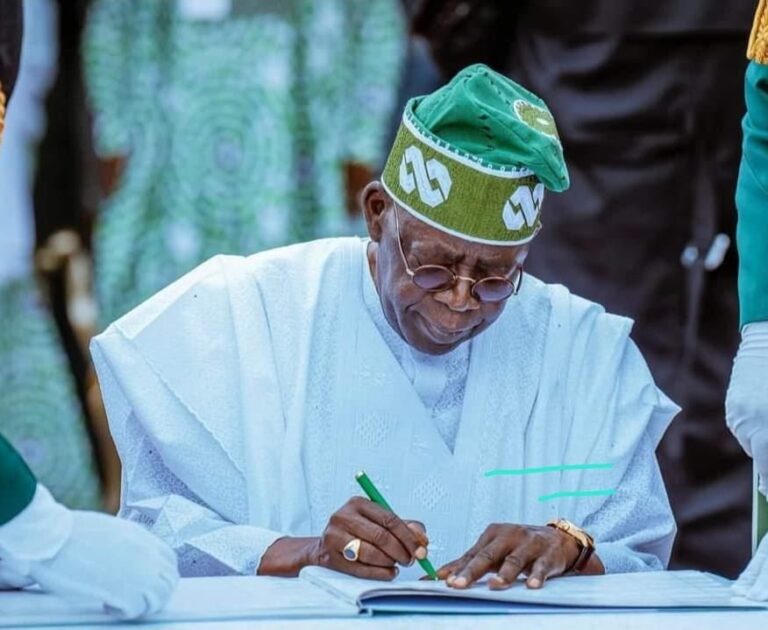
President Bola Ahmed Tinubu has signed into law the Appropriation (Amendment) (No.4) Bill, 2025, extending the implementation period of the 2025 budget from September 30, 2026 to December 31, 2026.
Presidential spokesman, Bayo Onanuga stated this in a press release on Wednesday, saying the president’s assent followed the amendment’s swift passage by both the Senate and the House of Representatives on Tuesday, September 29, 2026.
According to Onanuga, the extension gives Ministries, Departments and Agencies more time to complete ongoing capital projects. It ensures that funds already appropriated are fully put to work for Nigerians, without disrupting critical programmes.
“The President commended the leadership and members of the National Assembly for their prompt consideration of the bill, a further sign of the cooperation between the Executive and the Legislature in the service of the nation,” Onanuga said.
-

 News2 years ago
Senate to speed up conclusion of Nigeria Forest Security Service Bill
-

 News1 year ago
The Many Lies Against Bashir Haske
-

 News3 years ago
Breaking: Tinubu’s authentic ministerial nominees
-
 News3 years ago
“Anytime we want to kill terrorists, President would ask us to take permission from France but they were killing our soldiers-” Niger Republic coup leader
-

 News3 years ago
“I’m leaving the Catholic church because Bishop Onah is oppressing me,” says Okunerere
-

 News3 years ago
My nude photo leak was a mistake- lawyer Ifunanya
-
 News4 months ago
See your state governor’s performance ranking
-

 News3 years ago
Radio Nigeria’s veteran broadcaster Kelvin Ugwu dies three months after retirement from service