
News
PDP: Ghost of Ibadan Convention Vs Legal Reasoning

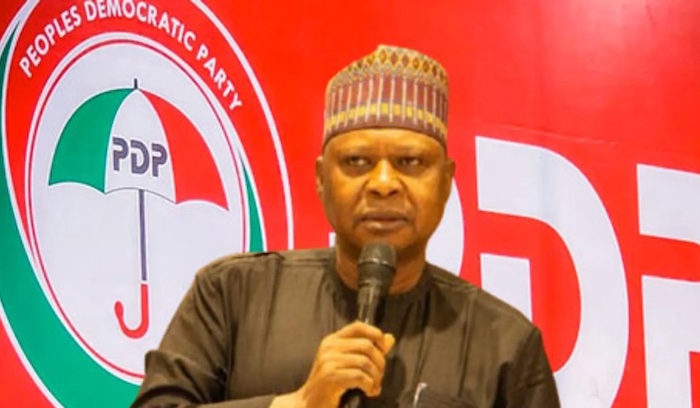
By Umar Sani
The article titled “The Ghosts of Ibadan and the Finality of Supreme Court Judgments,” written by Dahiru Yusuf Yabo, suffers from a fundamental contradiction. While the author repeatedly invokes the doctrine of finality of Supreme Court judgments, he seems unwilling to accept the actual implications of the judgments given by both the Supreme Court and the Court of Appeal regarding the leadership dispute within the People’s Democratic Party (PDP).
The main question isn’t whether Supreme Court judgments are final; they are. The real question is: What exactly did the Supreme Court decide, and what legal consequences followed from that decision? The author skips this crucial question.
In a unanimous decision, the Supreme Court dismissed the cross-appeal upon which the Wike-backed faction had based much of its claim to legitimacy. More importantly, after the Court nullified the Ibadan Convention, it affirmed that the actions of the suspended officers, whose authority underpinned that faction’s claim to leadership, were abrogated. The legal consequence is simple. Once the foundation collapses, everything built on it falls with it.
The Court of Appeal reaffirmed this principle in the subsequent proceedings related to the Ibadan Convention dispute. The appellate court questioned the basis on which certain individuals claimed re-election and specifically challenged the failure to establish where, when, and how this purported re-election took place.
Even more significantly, the Court of Appeal argued that the various structures that emerged after the Ibadan Convention could not survive the invalidation of the convention itself. These structures existed only because of the convention. Once the convention was legally nullified, everything stemming from it became legally unsustainable. This is basic law. You cannot declare the root dead and then insist the branches remain alive.
Curiously, the author urges respect for judicial finality while advocating recognition of structures whose legal foundation has already been removed by the courts. This stance is not a defense of judicial authority; it’s a selective view of judicial authority.
The article also criticizes the decision of the PDP Board of Trustees and the National Executive Committee to seek legal clarification and enforcement against INEC. Yet this criticism reveals a misunderstanding of the legal process.
When a constitutional body like INEC refuses, delays, or fails to act on judicial rulings, the lawful remedy is not street protests, media campaigns, or self-help. The proper action is to return to court for interpretation, clarification, and enforcement orders that compel compliance. That is exactly what the PDP’s lawful organs have done.
Indeed, if the author truly believes in the supremacy of law, he should applaud rather than condemn the recourse to courts.
The claim that seeking judicial interpretation is a way of relitigating settled issues is also misplaced. Courts regularly interpret their own judgments when disputes about meaning, scope, or enforcement arise. These procedures do not reopen the case; they ensure compliance.
Another false concern is the focus on the names displayed on INEC’s portal. INEC isn’t constitutionally empowered to decide who leads political parties. Many judicial authorities have confirmed that leadership disputes should be resolved according to party constitutions and court decisions. Recognition by INEC doesn’t create legitimacy. Legitimacy comes from the law.
The electoral commission can’t give validity to arrangements without a legal basis, nor can a temporary administrative listing on a portal override court rulings.
The author also treats the PDP’s problems as if they are unique. They are not. Many opposition parties have faced interference, inconsistent regulation, and political pressure recently. The PDP isn’t facing a new or unusual situation but is part of a broader pattern in Nigeria’s politics.
Perhaps the most ironic part of the article is its repeated use of the ghost metaphor. If any ghosts are involved here, they are not the PDP’s lawful organs seeking legal enforcement. The real ghosts are the remnants of structures whose legal foundation has already been dismantled by courts but which still appear to seek legitimacy.
The Supreme Court has spoken. The Court of Appeal has spoken. The legal effects of these decisions are clear. The challenge for the PDP isn’t whether they should obey the courts but how to fully implement court judgments.
That is exactly what the Board of Trustees, the National Executive Committee, and other lawful organs of the party are attempting.
Those who genuinely respect judicial finality should support, not oppose, that effort.
For those whose political ambitions depend on positions and structures no longer backed by law, the harsh reality remains: no amount of rhetoric can revive what the courts have already laid to rest.

The Enugu State Government has suspended His Royal Majesty, Igwe Eze William Ezugwu, the traditional ruler of Ibagwa Ogbozalla Opi Autonomous Community, in Nsukka Local Government Area of Enugu state.
The state government accused Igwe Ezugwu of violating provisions of the state’s Traditional Rulers Law.
In a letter of suspension dated September 24, the Enugu State Government cited his alleged failure to constitute his cabinet, failure to establish a Town Union governing body, and persistent conduct deemed inconsistent with the laws governing traditional rulers in the state.
The suspension comes barely three weeks after Igwe William Ezugwu received NDC presidential candidate Peter Obi at his palace in Opi, Nsukka LGA, where he reportedly blessed Obi’s presidential ambition.
The Deputy Commander of Operation Rainbow, CSP (Chief Superintendent of Police) Dennis David Babale, has been killed after gunmen suspected to be Fulani Bandits ambushed personnel of the security outfit along the Bokkos-Barkin Ladi road in Barkin Ladi Local Government Area of Plateau State.
Operation Rainbow is a State-backed community security and intelligence-gathering outfit in Plateau State, Nigeria, originally established in 2010 under former Governor Jonah Jang and recently revamped by Governor Caleb Mutfwang to combat rural violence and beef up grassroots security.
The incident reportedly occurred at about 4:06 p.m. on Tuesday, September 22, 2026 when the personnel, travelling in a Toyota Hilux vehicle, came under attack by unidentified gunmen.
Troops of Sector 4, Operation ENDURING PEACE (OPEP), responded to a distress report and moved to the location of the attack.
Sources told reporters that Babale sustained gunshot wounds during the ambush and was evacuated to the General Hospital, Barkin Ladi, for medical attention.
Following the attack, troops, working alongside personnel of other security agencies, launched offensive operations and a manhunt for the assailants within the general area.
Security forces have intensified efforts to track the attackers and prevent further attacks along the route.

Director General/CEO of the Nigerian Meteorological Agency (NiMet) and Nigeria’s Permanent Representative at the World Meteorological Organization, Prof. Charles Anosike and other Chief Executive Officers of similar agencies across the world, have concluded a one week high level dialogue on Climate Science Information for Climate Finance and the 53rd Senior Official Field Exchange (SOFE) in Beijing, China.
The event which was hosted by World Meteorological Organization (WMO), took place from September 14 to 18, 2026 and featured discussions on: strengthening the role and leadership development of National Meteorological and Hydrological Services (NMHSs) in mobilizing climate finance; aligning scientific and technical capabilities with risk-informed, people-centred early warning systems; shifting from technical assistance to sustainable investments by expanding practical cooperation between meteorological frameworks and multilateral financing entities; and support to NMHSs leadership on strengthening strategic thinking and fostering productive partnerships.
Held back-to-back with the High-level dialogue was the 53rd Senior Official Field Exchange to Fujian Province for first-hand exposure to the implementation of Multi-hazard, Alert, Zero-gap and Universal (MAZU) platform – China’s AI-driven meteorological early warning solution in support of the Early Warnings for All (EW4All) initiative and disaster risk reduction practices through technical exchanges, field visits and peer learning.
-

 News2 years ago
Senate to speed up conclusion of Nigeria Forest Security Service Bill
-

 News1 year ago
The Many Lies Against Bashir Haske
-

 News3 years ago
Breaking: Tinubu’s authentic ministerial nominees
-

 News3 years ago
“Anytime we want to kill terrorists, President would ask us to take permission from France but they were killing our soldiers-” Niger Republic coup leader
-

 News3 years ago
“I’m leaving the Catholic church because Bishop Onah is oppressing me,” says Okunerere
-

 News3 years ago
My nude photo leak was a mistake- lawyer Ifunanya
-
 News4 months ago
See your state governor’s performance ranking
-

 News3 years ago
Radio Nigeria’s veteran broadcaster Kelvin Ugwu dies three months after retirement from service