
News
Nigeria’s Unique Tripartite Distribution System Under the Acts Authentication Act and its Role in Resolving Alleged Post-Passage Alternations in the 2025 Tax Reform Legislation


By Agabaidu Chukwuemeka Jideani
I was once again invited by some colleagues and PhD Scholars of Legislative Studies and members of the Nigerian Association of Legislative Practice Professionals, to proffer a view on the directives to the Clerk of the National Assembly to re-publish the authenticated copy of the ‘Tax Reform Legislation.’
A sound starting point for delving into the above is to pronounce, because it is unknown to many including scholars, that Nigeria has a, unique one-of its-kind in the world, tripartite distribution system for the authentication and publication of federal legislation.
The Acts Authentication Act[1] institutes a singular tripartite distribution mechanism for the authentication of federal legislation. Section 2 of the Act, mandates that, upon presidential assent, the Clerk to the National Assembly shall authenticate the enacted text and distribute identical authenticated copies in three directions as follows: one retained in the permanent records of the National Assembly, one delivered to the President, and one transmitted to the Chief Justice of Nigeria for formal enrollment in the records of the Supreme Court.
When this tripartite distribution is done, all subsequent reproductions, including those published in the Official Gazette of the Federation, must be printed directly from this authenticated master form.
This deliberate dispersal of authoritative copies across the three arms of government, legislature, executive, and judiciary, creates multiple independent institutional custodians of the definitive enacted text, thereby providing built-in verificatory safeguards against unilateral post-passage alterations while preserving a clear evidentiary hierarchy for determining textual fidelity.
This Nigerian mechanism is markedly distinct from authentication and enrollment practices in other common law jurisdictions, where finality typically attaches to a single enrolled or certified document, often protected by strong conclusive presumptions that limit or preclude judicial inquiry into textual integrity post-authentication.
In the United States of America, the authentication process culminates in the enrollment of the bill after signature by the Speaker of the House, the President of the Senate/Vice president, and the US President. The enrolled bill doctrine, firmly established by the US Supreme Court in the case of Marshall Field & Co. v. Clark[2], holds that a properly enrolled and authenticated bill is “conclusive evidence of its due enactment” and cannot be impeached by recourse to legislative journals or extrinsic evidence of irregularities in passage or textual discrepancies. This doctrine was reaffirmed in subsequent cases such as United States v. Ballin[3], and has been consistently applied to insulate enrolled statutes from challenges based on alleged deviations between passed and enrolled texts. While scholarly criticism has occasionally highlighted the doctrine’s potential to shield fraud, successful judicial overrides remain exceptionally rare, with courts prioritising inter-branch comity over exhaustive textual verification.
The United Kingdom, on the other hand, centres authentication on enrollment in the Parliamentary Roll following royal assent. Grounded in parliamentary sovereignty and fortified by Article 9 of the Bill of Rights 1689, the enrolled Act rule renders the text unimpeachable once recorded[4]. Courts are barred from examining internal proceedings or textual irregularities post-enrollment[5].
In other common law jurisdictions, like Canada, Australia, India, South Africa, Singapore, Kenya, and Ghana, they follow analogous unitary authentication models, in these jurisdictions, assent by the head of state, certification by legislative officers, and publication in an official gazette, without statutory provision for distributed inter-branch custody is the prescribed procedure and the practice. Finality attaches to the assented and certified document, with courts generally applying presumptions of regularity akin to or directly influenced by the enrolled bill doctrine.
Nigeria’s tripartite system thus stands alone among major common law systems in mandating distributed custody of identical authoritative copies across separate branches, deliberately facilitating independent cross-verification and enhancing resistance to undetected post-passage tampering.
This structural uniqueness has direct practical significance in addressing the alleged post-passage alterations to the 2025 tax reform statutes, the Nigeria Tax Act 2025, Nigeria Tax Administration Act 2025, Nigeria Revenue Service (Establishment) Act 2025, and Joint Revenue Board of Nigeria (Establishment) Act 2025.
Material discrepancies reportedly emerged between the harmonised texts passed by both chambers of the National Assembly, the versions transmitted for presidential assent in June 2025, and the initially gazetted publications, raising concerns over unauthorised insertions, omissions, or substitutions.
The leadership of the National Assembly, on the 26th of December 2026 issued a formal directive instructing the Clerk to the National Assembly to:
a) Re-gazette the four Acts; and
b) Issue Certified True Copies.
The Spokesperson of the House of Representatives of the national Assembly of the Federal Republic of Nigeria, Hon. Akin Rotimi in a statement issued Friday 26th of December 2025 confirmed that there was a review in respect of the alleged discrepancies between the gazetted copy of the Tax Reform Legislation and the harmonized version of the Bills passed by the National Assembly. According to him, “the review is being conducted in full conformity with the Constitution of the Federal Republic of Nigeria, the Acts Authentication Act, Cap. A4, Laws of the Federation of Nigeria, the Standing Orders of both Chambers, and established parliamentary practice…” Consequently, “…the leadership of the National Assembly, under the President of the Senate, Distinguished Senator Godswill Obot Akpabio, GCON, and the Speaker of the House of Representatives, Rt. Hon. Abbas Tajudeen, PhD, GCON, has directed the Clerk to the National Assembly to re-gazette the Acts and issue Certified True Copies of the versions duly passed by both Chambers of the National Assembly…”[6] (the italics are mine).
In its distilled state, the National Assembly directed the Clerk to re-gazette the four Acts using the authenticated tripartite master copies; and issue Certified True Copies (CTCs) drawn exclusively from the versions “duly passed by both Chambers and authenticated in accordance with the Acts Authentication Act.”
This directive squarely invokes the tripartite mechanism to restore textual fidelity. By mandating re-publication from the authenticated forms held by the Clerk, the Presidency, and the Supreme Court, it establishes an administratively authoritative baseline that overrides divergent gazetted versions. The issuance of CTCs further provides verifiable evidentiary instruments for courts, administrative agencies, and the public, ensuring enforcement aligns with legislative intent.
Despite divergent views, it is my considered opinion that the directive is legally sound. It flows directly from the Clerk’s statutory duties under the Acts Authentication Act to maintain and reproduce from the authenticated record, read alongside the National Assembly’s constitutional oversight of its legislative process (Sections 4, 58, and inherent legislative privileges). As a corrective measure limited to publication conformity, without purporting to amend the assented substance, it constitutes a lawful administrative act rather than an encroachment on executive or judicial functions.
The above being premised, it is important to note that in contradistinction to the conclusive enrollment doctrines prevalent in other common law jurisdictions and the US, the Nigerian Tripartite Distribution System (TDS) enables additional remedies as follows:
a) Evidentiary recourse in litigation: Courts may compel production and comparison of the three authenticated copies, potentially invalidating ultra vires provisions without violating separation of powers or inquiring into the internal legislative procedure, unlike the near-absolute bar in the cited cases of Field v. Clark or Pickin;
b) Legislative re-enactment: Introduction of fresh bills to cure substantive defects, preserving exclusive legislative competence under Section 4; and
c) Institutional or independent inquiry: Utilisation of the dispersed copies in Legislative, Executive or Judicial probes to independently establish accountability.
I am not unmindful of the growing calls to isolate and ascertain the criminal liabilities of the alleged perpetrators of the said post-passage insertions, but as they say in my grandmother’s village of Nteje Abogu, “Nne Ji Ya Iche” loosely translated to mean that “it has a different, albeit, maternal relationship” to the present discussion. Criminal liability, though important, is not the focus of this discourse.
In conclusion, Nigeria’s tripartite distribution system represents a deliberate statutory innovation that disperses authoritative custody across branches, distinguishing it sharply from the unitary, conclusively presumed models in the United States, United Kingdom, Canada, Australia, India, South Africa, Singapore, Kenya, and Ghana. By mandating distributed custody rather than unitary conclusiveness, the tripartite system established a balancing act which permits targeted verification to safeguard against tampering or error, while still promoting certainty.
It thus innovates on common law traditions, offering enhanced transparency and inter-branch checks suited to Nigeria’s constitutional framework, without embracing the full insulation of the enrolled bill doctrine. This mechanism uniquely positions Nigeria to address textual infirmities institutionally and, if necessary, judicially, preserving legislative independence and Constitutional supremacy while upholding rule-of-law accountability.
In the ongoing 2025 tax reform controversy, I am of the view that it has enabled a swift, lawful administrative remedy through re-gazetting and CTC issuance while preserving robust avenues for deeper rectification, demonstrating its enduring value in safeguarding legislative integrity and constitutional fidelity.
Agabaidu Chukwuemeka Jideani, a Legislative Practice and Procedure Expert (amongst others) serve as the Director General of the Abuja Chamber of Commerce and Industry.
[1] Cap. A2, Laws of the Federation of Nigeria 2004.
[2] Marshall Field & Co. v. Clark, 143 U.S. 649 (1892)
[3] United States v. Ballin, 144 U.S. 1 (1892)
[4] Edinburgh & Dalkeith Railway Co. v. Wauchope (1842) 8 Cl & F 710.
[5] British Railways Board v. Pickin [1974] AC 765, HL
[6] https://www.thecable.ng/breaking-national-assembly-to-re-gazette-tax-laws-over-alleged-alteration/; https://www.thisdaylive.com/2025/12/26/nassembly-directs-clerk-to-re-gazette-tax-law/
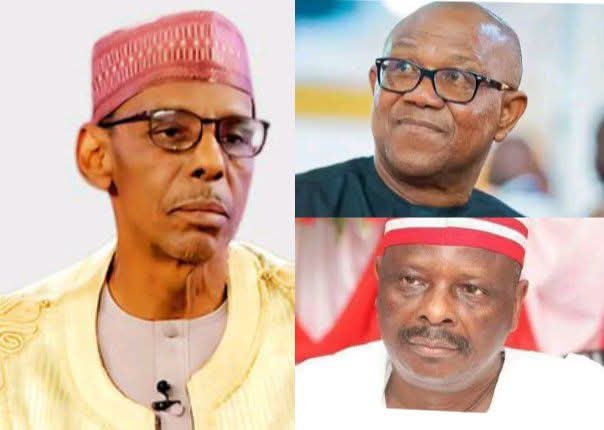
The revelation by the national chairman of Proples Redemption Party, PRP, Hakeem Baba Ahmed, that the party rejected attempt by Peter Obi and Rabiu Kwakwanso to join them before the fuo moved to National Democratic Congress, NDC, has continued to generate public reaction.
Baba Ahmed made the statement in a report that was published on Wednesday, May 13, 2026.
This is coming after the former governor of Anambra state and the former governor of Kano state defected from the African Democratic Congress, ADC to the Nigeria Democratic Congress, NDC.
In the report that surfaced online, the PRP Chairman said he blocked Peter Obi and Rabiu Musa Kwankwaso from joining the party because they demanded for the ticket of the party.
“But for you to come even before a decision is made and ask us to guarantee you the ticket without opposition. If you are truly strong contenders, then why fear competition?”.
News
Nigeria’s human rights body demands accountability over recurrent civilian casualties from military airstrikes

The National Human Rights Commission has expressed deep concern over the recurrent incidents of military airstrikes reportedly resulting in significant civilian casualties across different parts of the country, describing the development as troubling and incompatible with established human rights and humanitarian law standards.
The Executive Secretary of the Commission, Dr. Tony Ojukwu OFR, SAN, who stated this in a statement on Wednesday, said while the fight against insurgency, banditry, and other forms of insecurity remains a legitimate responsibility of the Nigerian State, such operations must at all times be conducted in strict compliance with the Constitution of the Federal Republic of Nigeria, international human rights obligations, and international humanitarian law principles.
According to the statement which was signed by Fatimah Agwai Mohammed, Director, Corporate Affairs and External Linkages, Ojukwu said repeated reports of civilian deaths and injuries, including women, children, and other vulnerable persons, arising from aerial bombardments raise serious concerns regarding the protection of the right to life, human dignity, and the obligation of State actors to exercise precaution and proportionality during security operations.
The Commission therefore calls on the Nigerian Air Force to provide a comprehensive explanation regarding the circumstances surrounding these incidents and the measures being taken to prevent further loss of innocent civilian lives.
“Nigerians deserve to know why this has become a recurring decimal, in April and May alone we have recorded the following casualties, in April Jilli market Yobe, in May Shiroro market Niger, again in May Tumfa market in Zamfara, for how long will this continue?” The Chief Human Rights Officer asked.
The NHRC Cheif emphasized that the principles of distinction, necessity, proportionality, and accountability are fundamental obligations under international humanitarian and human rights law and must guide all military engagements, particularly in conflict-affected communities.
Dr. Ojukwu noted that civilian lives must never be treated as collateral damage and urged security agencies to strengthen intelligence gathering, operational safeguards, and accountability mechanisms in order to minimize harm to non-combatants during military operations.
He further called for prompt, transparent, and independent investigations into all reported incidents of civilian casualties resulting from airstrikes, with a view to ensuring accountability, justice for victims, and adequate remedies, including compensation and psychosocial support for affected families and communities.
The NHRC reiterated that national security objectives and human rights protection are not mutually exclusive, stressing that sustainable peace and public trust can only be achieved where security operations are carried out within the bounds of legality, accountability, and respect for human dignity.
Ojukwu reaffirmed the Commission’s commitment to monitor the situation closely and engage relevant authorities and stakeholders to ensure the protection and promotion of the rights of all persons in Nigeria.

River State Governor, Sir Siminalayi Fubara on Wednesday, broke his silence over widespread speculations that he had defected from the All Progressives Congress (APC) and joined the Nigeria Democratic Congress (NDC) in the ongoing realignment of political forces ahead of the 2027 General Elections..
Governor Fubara made the clarification during an inspection tour of the newly constructed General Hospital and the fully remodelled Neuropsychiatric Hospital, both in Rumuigbo, Obiakpor Local Government Area of Rivers State.
According to Onwuka Nzechi, Chief Press Secretary to the Governor, Fubara said that contrary to the erroneous reports in a section of the media in the last couple of days, suggesting that he had joined another political party, he remained a member of the ruling party and will continue to work for the overall interest of the party.
“I know that there have been a lot of drama in the media; one story or another. I am a member of the All Progressives Congress (APC) and nothing has changed. People should stop using whatever situation that they pick up from the social media or their own interpretation of any situation to present me wrongly.
“I’ve not gone anywhere; I’m still a member of the APC and I remain a member. Whatever happens, what is important is supporting the overall interest of the party,” he said.
Governor Fubara was conducted round the facilities by the Director of Medical Services in the Rivers State Ministry of Health, Dr. Vincent Wachukwu, who led him through the hospital wards, a conference hall, ICT centre, students hostel, staff quarters, and other critical sections.
He expressed delight at the completion of the two projects which according to him, were conceived to address critical needs in the health sector in the state. He recalled that the while the rehabilitation of the Psychiatric Hospital became necessary at some point, the administration also discovered that the area had no General Hospital to take care of the basic health needs of the people.
“This very project, if you could remember, when we came in we had an issue that required our sudden visit and it had to do with mental health. So when we came here for the inspection of the Rehabilitation Centre that the board was trying to put together, we found out that we had more issues than even the mental health issue.
“We didn’t have a General Hospital to serve the people within this area. The closest medical center that they had here was the University of Port Harcourt Teaching Hospital ( UPTH) which is very far from here. We felt that with the space we have in this compound, it will be proper for us to also have a General Hospital situated in this particular facility to take care of the neighboring communities up to Rumuola, Rumuolumeni and all the surrounding areas.
“Today, to the glory of God, we can see that the project is already completed. It is not 95 percent complete, it is a hundred percent completed.
We’re happy because, it is a promise made and a promise fulfilled. Like I’ll always say, what is important is doing what will touch the life of our people. Our people should be first and that is how important this project is for us in this administration,” he said.
-

 News1 year ago
Senate to speed up conclusion of Nigeria Forest Security Service Bill
-

 News9 months ago
The Many Lies Against Bashir Haske
-

 News3 years ago
Breaking: Tinubu’s authentic ministerial nominees
-

 News3 years ago
“Anytime we want to kill terrorists, President would ask us to take permission from France but they were killing our soldiers-” Niger Republic coup leader
-

 News3 years ago
“I’m leaving the Catholic church because Bishop Onah is oppressing me,” says Okunerere
-

 News3 years ago
Radio Nigeria’s veteran broadcaster Kelvin Ugwu dies three months after retirement from service
-
 News3 years ago
Dokpesi and the Gazebo Mystique
-

 News3 years ago
Tsunami: Tinubu orders dissolution of managements, boards of MDAs, to sack all Buhari’s political appointees