
News
If All Governors Were Nyesom Wike


By Bonaventure Phillips Melah
Since the founding of the present, united nation called Nigeria through amalgamation, down to independence up to today, the country has been plagued by lack of quality leadership as those entrusted with power by the people have ended up as huge disappointments, leaving the people with only the taste of ash in their mouths.
From the military to civilian administration, many leaders have been colossal failures and disappointments with most politicians making empty promises during elections and supervising the citizens eating the bread of sorrow after their inauguration. This is the major reason why roads in the country are impassable death traps, hospitals are mortuaries, and electricity suffers epilepsy, keeping the people hungry in the midst of abundance.
In spite of this ugly reality, there are a few leaders in Nigeria at the local, state and federal levels who have made positive deviations and distinguished themselves by using state resources to positively impact the lives of the people, providing basic needs, infrastructure and human capital development.
Of these few ‘beautiful ones,’ Barrister Nyesom Wike, the current Minister for the Federal Capital Territory (FCT) stands out.
After serving as Chairman of Obiakpor Local Government Council in River state, Wike was Chief of Staff to the state governor for eight years and was in Abuja as Minister of State, Education before becoming River State Governor.
In the eight years he served as the Chief Executive Officer of the State, Wike transformed Rivers, providing state of the art infrastructure, bridges, solid roads, some of the best schools in Nigeria’s history, building hospitals and equipping them with needed laboratory and other equipments, building shopping malls, among others while raising workers pay and paying them at when due.
According to Wike, one of the strategies he deployed to achieve success as Governors was to discard bureaucratic and administrative bottlenecks that have held the nation at the jugular at the federal level and many states in the country.
In order words, Wike said his administration decided to adjust the State’s procurement law, adding that it helped his government to conceptualise, initiate and complete projects on record time.
For example Wike said that the Nabo Graham Douglas Campus of the Nigerian Law School which was constructed by his administration within eight months would have ordinarily been completed between four to five years if the country’s existing procurement life cycle was followed.
He said- “The procurement life cycle here in Nigeria is very long. If you follow the procurement life cycle religiously before you give birth to a project and commence construction, it will take like three, four, or five months.
“If you follow Procurement Act 2000, which recommends for about 15 per cent mobilisation fees, and then you budget 15 percent in your yearly budget, just like the federal government budget is being done.
“If you take it to the National Assembly they will put 15 per cent of the cost of the project in the budget. When you put 15 per cent of the cost of the project in the budget, what are we saying? We are saying that this project should be completed in six years or more.
“When you look at your contract completion period, if your contract completion period of the project is one year and you budget fully for that project in that particular year, then you are sure of completing that project in that particular year.”
The governor advised every Bureau of Public Procurement in the country to have a functional price intelligence unit.
With such ingenuity, Wike was able to launch several ambitious infrastructure projects like constructing a whooping thirteen flyover bridges, expansion and reconstruction of hundreds of roads and bridges as well as creating innovative public transportation systems.
Governor Wike gave right of first of refusal to education and worked tirelessly to improve the state’s education system. He increased funding for all the tertiary institutions in the states, introduced innovative programmes, and implemented policies that ensured every child in the go to school. He championed healthcare initiatives that aimed to provide better access to affordable and quality healthcare for Rivers people and invested in healthcare infrastructure by building new hospitals, employed hundreds of doctors, nurses and other healthcare workers who were all provided with working tools and residential quarters.
On environment, Wike implemented policies to reduce carbon emissions, promote renewable energy sources and conserve natural resources while he multinational oil companies to pay needed taxes and compensate host communities.
He implemented measures to reduce wasteful spending, streamline government operations, and improve financial accountability while his prudent fiscal management ensured that taxpayers’ monies were utilized efficiently and effectively
Before he left office, Wike constructed 1000km of roads in eight years and while responding to questions from reporters, revealed how he was able to make such unprecedented achievement.
He said that by adopting a realistic procurement law and budgetary system, his administration was able to do whatever it considered best for Rivers people.
Other major feats his administration achieved in the construction sub-sector include construction of drainages of over 493 Km, flyovers and overpasses of over 11km which was done in four years; several rivers crossing bridges of three kilometers of 300 and 400 metres long.
There is no space here to put down the numerous projects, human development policies and programmes, including empowerment of women, young people and people with disabilities.
During his days as state governor, Wike ensured that in every given year, over 70 percent of the State budget was dedicated to capital expenditure and 30 or less to recurrent expenditure. This is a positive deviation from what obtains in many other states where annual budgets are spent mainly on consumption, leaving little or nothing to infrastructure and other developmental projects.
The aim of this article is to highlight the fact that if all the governors of the 36 states that have served Nigeria in the past have achieved what Wike has done in River State for eight year, Nigeria would have by now be shoulder to shoulder with the Asian Tigers.
It is therefore a call on leaders at all levels to rise up and contribute to national development by replicating or attempt to replicate what Wike did in Rivers State, through the deployment of resources accruing or allocated to them to impact meaningfully on the lives of the people within their geographical areas or jurisdiction. That way, Nigeria would sooner than later, become the nation of or dream.
Footnote: It is a waste of time threatening Wike on the basis primordial sentiments. Truth is that this FCT Minister is not your everyday kind of leader. You can take it to the bank that Wike would not backtrack from his noble vision and mission once he is convinced he is working for the good of the people. Forgerrit.
This article is featured the Book THE BEAUTIES OF NIGERIA written by Bonaventure Melah which is billed for Public Presentation on November 28, 2023 at the National Press Centre, Abuja.
Bonaventure Phillips Melah, an Abuja based journalist and author, is the Publisher of Nationwide Reports. Bonamelah123@gmail.com 08036062975
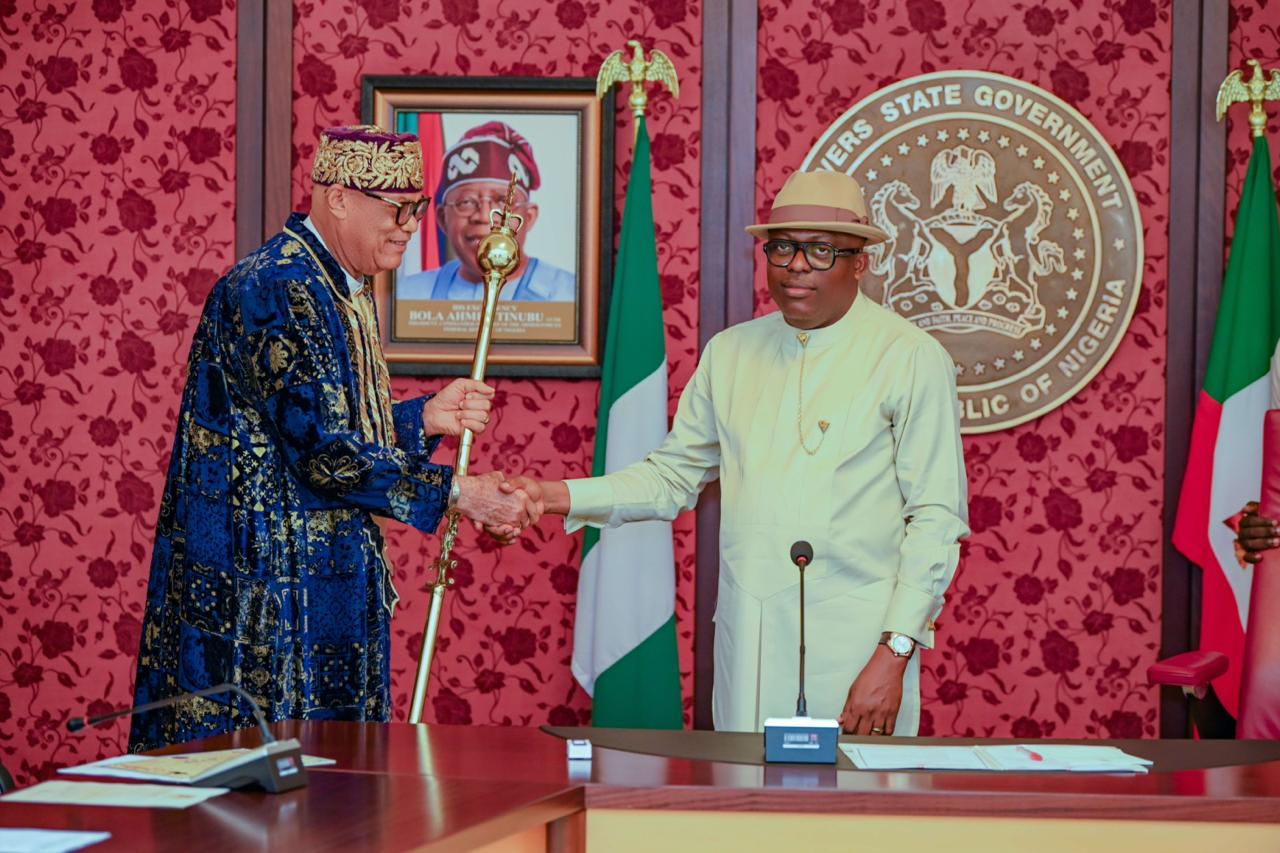
Photo caption: Governor of Rivers State, His Excellency, Sir Siminalayi Fubara (right) presenting the Staff of Office to His Majesty King Charles Douglas Mac-Pepple Jaja Jeki VI (left),the newly crowned Amanyanabo of Opobo Kingdom at Government House Port Harcourt on Friday.
Governor of Rivers State , His Excellency, Sir Siminalayi Fubara, on Friday formally presented the Certificate of Recognition and Staff of Office to the new Amanyanabo of Opobo Kingdom, His Majesty King Charles Douglas Mac-Pepple Jaja, Jeki VI, urging the new monarch to promote peace, unity and inclusiveness in the kingdom.
The governor while congratulating the new monarch, for successfully scaling the hurdles of selection and coronation, urged the royal father to see contenders who lost out of the selection process, not as victims but as comrades who must be carried along for the kingdom to move forward during his reign.
Speaking during the presentation ceremony in Government House, Port Harcourt, Governor Fubara apologized for his absence at the coronation, explaining that it was due to a call to higher national service, but that his spirit and soul were fully with the kingdom throughout the process.
He declared that history will remember his administration for peacefully laying to rest the late King, Douglas Dandeson Jaja, and mid-wifing the emergence of a new monarch without litigation.
The Governor, who said he remains one of the proudest persons on earth for the success of the transition, disclosed that the late king’s stool was enmeshed in a legal battle that lasted over 27 years, and that it took the wisdom and deliberate intervention of his administration to manage the selection process to avoid another round of court cases.
He emphasized that contrary to insinuations by mischief makers who tried to politicise his absence, his government was fully responsible for the entire process from burial of the late king to the coronation and recognition.
“Our presence was not just in that process alone. Every logistics that were required, there is nobody that can say he’s the one that did it. We did it. So, that is also a key issue in the process. So, for those people who like using everything for politics, my absence was not an intentional thing; it was a call to service. So the fact that I was unable to make it doesn’t mean that I do not value, appreciate or support the process,” Governor Fubara said.
He said the true test of kingship is in the management of success, and prayed that the new reign will usher in greater development in education, healthcare and small businesses, which he said remain the only sustainable antidotes to the growing criminality among youths.
The Governor, who described Opobo as one of the most peaceful Local Government Areas in the State, charged the new king to maintain zero tolerance for criminality, to be intentional and decisive in protecting the kingdom, and not to compromise on security on the grounds of kinship.
Governor Fubara assured the monarch of the continuous support of his administration both in and out of office, while also charging the Alapu Council to guide the king and the titled citizens to redirect their purpose from mere ceremonial uniformity to initiating tangible development projects that will be visible in the kingdom within the next one year.
In an acceptance speech, the newly installed Amanyanabo of Opobo Kingdom, His Majesty King Jaja Jeki VI, pledged to build Opobo on the pillars of service, inclusion and vision, in honour of the legacy of the great King Jaja who founded the kingdom 156 years ago with trade and diplomacy.
Describing the Staff of Office as more than a symbol of authority, the monarch said it represents a sacred trust from the government and people of Rivers State to lead with justice, peace and dignity.
In a statement, Onwuka Nzechi, Chief Press Secretary to Governor Fubara, quoted the monarch to have expressed deep gratitude to God, the ancestors, Governor Fubara, the Opobo Council of Alapu, titled citizens, elders, women and youths for the confidence reposed in him to lead Opobo into its Sixth Chapter.
The new king assured the Rivers State Government that under his reign, Opobo Kingdom will remain a dependable partner for peace, development and unity of Rivers State.
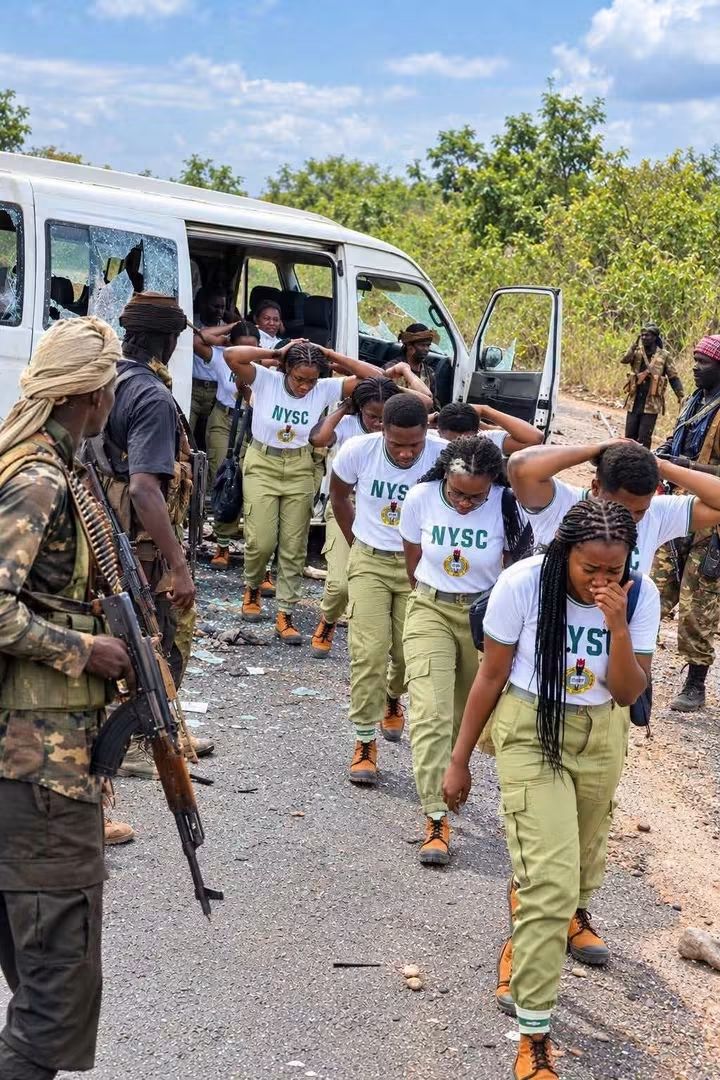
Gunmen have abducted 20 corps members serving under the National Youth Service Corps (NYSC) along the Owerri–Onitsha Road by Umunoha community in the Mbaitoli, Imo State, South East Nigeria.
Confirming the unfortunate incident, in a telephone conversation, the Police Public Relations Officer of the Imo State Police Command, Henry Okoye, said the corps members were reportedly travelling in a commercial bus from Ibadan, Oyo State, to different orientation camps in the South-East and South-South states when they were intercepted by the gunmen.
He said the Commissioner of Police, Audu Bosso, visited the scene for an on-the-spot assessment, while the police and other security agencies have intensified efforts to rescue the victims unhurt and unconditionally.
Okoye added that security operatives were currently combing surrounding bushes, while a Rapid Response Team (RRT) had also been deployed to track down the kidnappers and secure the safe release of the corps members.
The incident came weeks after the police said that 11 people, including an unidentified number of corps members serving under the National Youth Service Corps (NYSC), were rescued after gunmen attacked vehicles along the Aloma–Egane Expressway.

A former employee of Air Peace, who simply identified herself as Tade, has made a social media post on her recent encounter with the Chairman/CEO of the airline, Dr. Allen Onyena and praised him for his exceptional goodwill, benevolence and kind word of encouragement.
Tade who said she resined from Air Peace last year to set up a fashion outfit, after receiving blessings from Allen Onyena, quoted the airline’s CEO to have commended her for establishing her own business, said the encounter took place on Wednesday when the Air Peace boss paid a visit to her business premises
The obviously excited lady said- “It was such a beautiful moment having my boss visit my factory. And honestly, I still struggle to call him my former boss. Some people may be former bosses by designation, but the place they occupy in your life does not change simply because you no longer work in the same organisation.
“Two days ago, when he told me he wanted to come see the factory, I honestly wondered if he would be able to make it. I had seen how incredibly busy his schedule was, meetings, guests, engagements, one thing after another, and some of those meetings stretched well into yesterday evening.
“But around 7pm, after what I can only imagine was an incredibly long and stressful day, he still came.
“And he didn’t just come in, take a quick look around and leave. The entire house came alive.
“We received him warmly, and his presence brought such a beautiful energy into the building. He took time to speak with the staff, interacted with my friend, Mr. Jire, and his wife about their business, and then came into my office and sat with me.
“And for a while, it was just my boss being my boss.
“We talked about entrepreneurship, people management, business management, governance, leadership, and the challenges that come with growing a business, including some of the challenges I cannot even see yet. He reminded me, in his own way, that growth does not mean the challenges stop. They simply change.
“And then came that moment:
“You are now an employer of labour yourself, Tadé.”
She continued – “I don’t think he knows what those words meant to me. October will make it a year since I resigned from Air Peace and left with his blessing.
“And here I was yesterday, almost a year later, standing in my own factory, surrounded by people who now work for the fashion company I am building, while the man I once reported to was standing there looking at what has grown from that decision.
“There was something deeply emotional about it. Because when I met this man in 2023, I could not have known all that the years ahead would hold.
“Meeting you, sir, and working with you was never a coincidence. It was a necessary chapter in my life. A needed season. A significant part of the journey that brought me here. And I will always cherish it.
“Thank you, sir, for your leadership. Thank you for the opportunities, the lessons, the corrections, the wisdom, and most especially, for your consistent belief in me.
“Thank you for showing up. And thank you for coming to see what that little girl who once worked with you is building today. It meant more to me than I can properly put into words.
“And on behalf of the entire TADÉ house, thank you for the generous gift. We are deeply grateful.
“Some moments are bigger than the moment itself. Yesterday was one of them.,” she concluded.
All pictures were taken in the moment
-

 News2 years ago
Senate to speed up conclusion of Nigeria Forest Security Service Bill
-
 News1 year ago
The Many Lies Against Bashir Haske
-

 News3 years ago
Breaking: Tinubu’s authentic ministerial nominees
-
 News3 years ago
“Anytime we want to kill terrorists, President would ask us to take permission from France but they were killing our soldiers-” Niger Republic coup leader
-
 News3 years ago
“I’m leaving the Catholic church because Bishop Onah is oppressing me,” says Okunerere
-

 News3 years ago
My nude photo leak was a mistake- lawyer Ifunanya
-
 News4 months ago
See your state governor’s performance ranking
-

 News3 years ago
Radio Nigeria’s veteran broadcaster Kelvin Ugwu dies three months after retirement from service