News
ECOBANK ordered to pay N1,086 billion to 1,742 former Oceanic bank staff gratuities, savings


The National Industrial Court, Lagos Division has ordered Ecobank Nigeria Limited to pay the sum of N1, 086,611,589.11 to 1,742 ex-staff of Oceanic Bank who were denied their legitimate entitlements by the banks.
Honourable Justice R. A Gwandu gave the order while delivering judgement in Suit Number NIC/LA /231/2012 filed by 1,742 ex-employees of defunct Oceanic Bank which merged with Ecobank Bank Limited sometime in 2012.
In the representative action suit filed by Mr Nwabu Okoye, counsel to Mr Babajide Bayode, Yemisi Adesote, Adeboyejo Oladimeji, Seun Aina, Yusuf Kadiri, Segun Alasan, Adetayo Familugba and Lolade Olaribigbe who sued for themselves and as representatives of 1,733 other ex-employees of Oceanic Bank now Ecobank Nigeria Limited, the plaintiffs sought for the following orders from the National Industrial Court :
An order directing Ecobank Nigeria Limited to pay the outstanding sum of N1,146,470,393,.62 being the sum total of their savings in the Staff Savings Investment Trust Fund, SSITF, scheme contributed by 1742 ex-employees of Oceanic Bank made up of those transfered to Ecobank upon merger of the two banks through the merger of February 15, 2012 and those whose employment were determined before or upon the said merger which remain unpaid till date.
The claimants in their statement of claim said the amount outstanding as their contributions to the SSITF scheme which the defendant (Ecobank) has refused to pay till date stands at N926,901,065,.60 .
Claimants also asked the court for an order directing Ecobank to pay the sum of N159,710,523.51 being the total sum due as gratuities to 48 of the claimants and another sum of N59, 858,804,.51 being the short payments of severance or redundancy paid by the defendant to 74 of them.
The court was further asked to grant an order directing Ecobank to pay 22 percent interest per annum on the aforesaid sums of money being claimed from February 15, 2012 until judgement and thereafter at the rate of 12 percent per annum until the liquidation of judgement sum.
However, Ecobank through its lawyer, S.C Arubike filed a statement of defense to the suit as well as counter- claim.
Ecobank in it’s counter- claim demanded for the sum of N967,529,765.38 being the excess of severance and or redundance benefits paid to the ex-staff of Oceanic Bank, that is, the claimants at 24 percent interest from October 30, 2014 until any judgement is delivered in it’s favour.and interest of 10 percent untill the judgement sum is fully liquidated.
The bank also counter-claim for the sum of N225,724,076,.78 being the excess gratuities and entitlements paid to the representative members by Ecobank, another sum of N1,541,491,955.03 being the sum outstanding and payable as at October 30, 2014 on credit facility granted to the representative members of the ex-staff.
The defendant further counter- claimed the sum of N41,640,000,000 being the amount due and outstanding as at December 31,2010 on the Term Loan of N25,054,481,701.00 granted by Oceanic Bank (now Ecobank) to the former employees through the Board of Trustee of the Trust Fund which facility was accepted and fully utilized by the claimants for the purchase of shares of blue-chip companies and which sum the ex-staff (claimants) have failed, neglected or refused to repay till date despite repeated demands.
The summary of the claimants’ case according to the court was that prior to the merger of Oceanic Bank and Ecobank on December 30, 2011, there was in existence in Oceanic Bank the SSITF introduced by Oceanic Bank in 2004 to encourage it’s staff to save part of their earnings towards further financial commitments and assist staff in planning for their retirement.
It was further stated that the initial minimum contribution of each employee to the SSITF scheme was N6000 per month which was in August 2005 increased to a minimum of N14,000 per month .
Subsequently in 2008 the level of contributions to the staff Fund was further reviewed upward by the bank and the review was based on the level of the staff involved, ranging from N20,000 to N50,000.
It was also stated that sometimes in May 2010, Oceanic Bank discontinued deduction of the SSITF from its employees’ monthly salaries while every staff whose appointment was terminated or resigned from the bank was duly paid his or her SSITF.
The claimants further said that by a letter of February 13, 2012 , Ecobank advised a total number of 788 employees of Oceanic Bank whose employment has been transfered to the bank (Ecobank) consequent upon the merger, that effective from Wednesday February 15, 2012 such employees’ contract of employment with Ecobank has been terminated.
Claimant stated that 697 of those whose employments were terminated are among the 788., these 697 according to the plaintiffs have unpaid claims, including non payment of their SSITF contributions among others.
It was also contended by the claimants that the calculations and payments of final entitlement to 706 out of the 788 employees whose employment was determined as of February 15, 2012 or resigned as an option under the merger with Ecobank was flagrantly violated.
After analysing the facts of the case as submitted by counsel to both parties, Mr Nwabu .A. Okoye for claimants and S.C. Arubike for Ecobank, Justice R.A Gwandu dismissed the defense and counter- claim of Ecobank on the ground that the bank failed to put credible evidence before the court to support its counter-claim.
Justice Gwandu in his judgement held that upon the consummation of the merger , Ecobank has fully acquired all the assets and liabilities of Oceanic Bank and cannot repudiate or push some of the liabilities on its employees, more so when it was the bank that was in control of the SSITF scheme.
The trial judge further held that Ecobank cannot deny that there was contributions to the SSITF or show evidence that the claimants were paid the sum they claim.
“I therefore hold that the claimants have proved their case and are entitled to the payment of the sum of N926,901,065.60 being the sum total in the account of the Staff Savings Investment Trust Fund being contributions of 1742 ex-employees of Oceanic Bank made up of those transferred to Ecobank upon the merger and whose contract of employment were determined on February 15, 2012 and those whose employment otherwise were determined before or upon the merger.
On the issue of unpaid gratuities, Justice Gwandu said: “I therefore hold that the defendants are liable to the claimants in the sum of N159,710,523.51 being the total sum due on the basis of years of service of the employees.
The judge , however, refused the plaintiffs’ claim of N59,858,804.51 being the total sum of short payment of severance or redundancy package paid by Ecobank to 74 of the claimants.
Justice Gwandu said it would be unfair for the court to hold Ecobank responsible for any lapses that may have occurred under the agreement brokered by ASSBIFI since some of the ex-staff benefited under the agreement and are happy under the same agreement more so the intervention of ASSBIFI had the consent of the ex-staff.
Justice Gwandu, granted 10 percent interest on the judgement sum from 30 days after the judgment is delivered till it is fully liquidated.
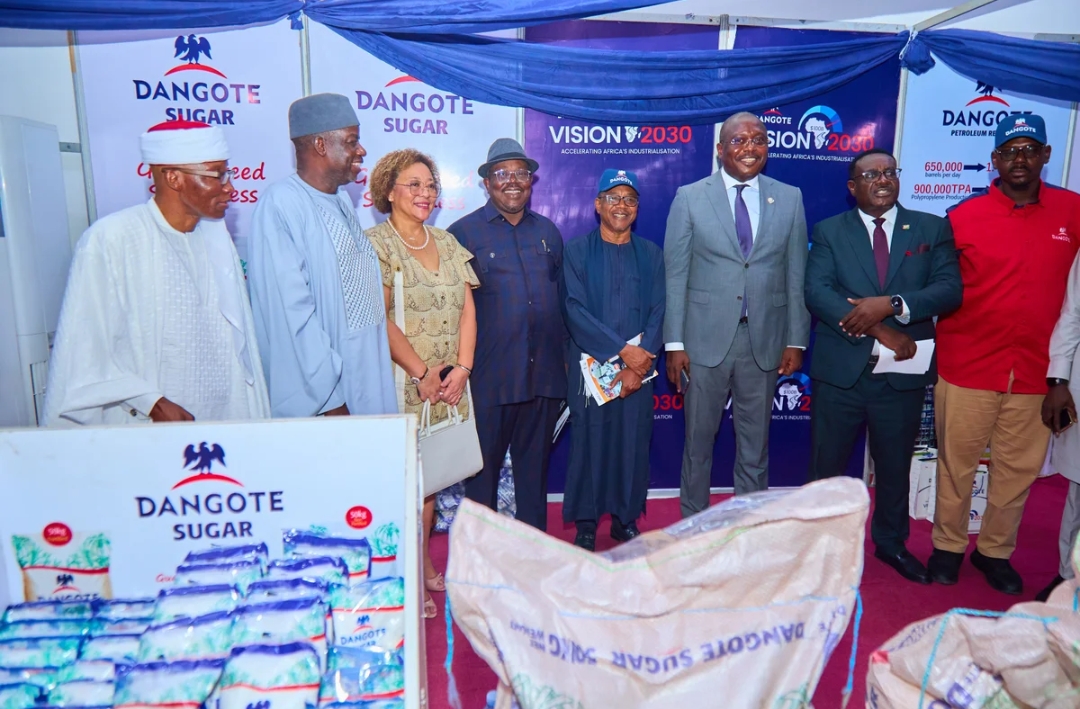
Photo caption: From Left- Co-Founder/Group Executive, ABIS Group Dr. Illiyasu B. Gashinbaki; Deputy Vice President ACCI and former Minister of Foreign Affairs Dr. Aliyu Idi Hong; Cuban Ambassador to Nigeria Miriam Morales Palmero; Perm Sec Ministry of Special Duties and Intergovernmental Affairs Dr. Onwusoro Madura Ihemelandu; Representative of Dangote Group Hashem Ahmed; President ACCI Chief Emeka Obegolu; Namibian High Commissioner to Nigeria Mr. Walde Natangwo Ndebashiya; and Mr. Abdulrazaq Sambajo of the Dangote Group, during a visit to the company pavilion at the 21st Abuja International Trade Fair on Tuesday.
Dangote Industries Limited (DIL), one of the sponsors of the 21st Abuja International Trade Fair, will spotlight the ongoing Initial Public Offering (IPO) of the Dangote Petroleum Refinery and Petrochemicals (DPRP) during the company’s Special Day.
The Dangote Special Day, scheduled for Friday October 2, will feature a high-level fireside and business interactive session bringing together representatives of Dangote Group, government, the organised private sector and business leaders to examine the transformative role of the Dangote Refinery in Nigeria’s economic development.
According to the company, the interactive session will provide prospective investors, entrepreneurs, business operators and other participants with an opportunity to engage directly with representatives of Dangote Group and gain a better understanding of the refinery’s ongoing IPO and its broader economic significance.
The session, themed “Dangote Refinery, Vision 2030, ACCI and the Economy,” will examine the refinery’s contribution to Nigeria’s energy security, industrialisation, trade, employment generation, taxation and economic growth.
Particular attention will be paid to how increased domestic refining capacity can reduce Nigeria’s dependence on imported petroleum products, conserve foreign exchange, strengthen local value chains and create new opportunities for businesses across the petroleum, petrochemical, logistics, manufacturing and services sectors.
The IPO will also feature prominently in the discussions, with participants expected to explore how the public offer can broaden participation in the ownership of one of Africa’s most significant industrial assets, deepen Nigeria’s capital market and provide eligible investors with an opportunity to participate in the country’s ongoing industrial transformation.
The fireside session will bring together senior representatives of Dangote Group, the Abuja Chamber of Commerce and Industry (ACCI), the Nigerian Association of Chambers of Commerce, Industry, Mines and Agriculture (NACCIMA), government and the wider private sector.
The company said the session would also provide an opportunity to examine Dangote Group’s Vision 2030 and its implications for industrialisation, job creation, local content development, technology transfer, investment and economic diversification.
Beyond the fireside discussion, visitors to the Trade Fair will have the opportunity to engage with the Dangote Group at its pavilion, where the company will showcase a range of products and businesses spanning cement, sugar, salt and seasoning, packaging and other sectors.
Dangote Group’s sustained participation and sponsorship of the Abuja International Trade Fair reflects its continued support for platforms that promote trade, investment, entrepreneurship and stronger linkages between the private sector and government.
The 21st Abuja International Trade Fair, organised by the Abuja Chamber of Commerce and Industry, is expected to bring together hundreds of exhibitors, businesses, investors, policymakers and members of the public, providing a platform for networking, market access, investment promotion and business-to-business engagement.
The company said it looks forward to welcoming participants to the Dangote Special Day and its pavilion to explore the Group’s products, investment opportunities and potential areas of business collaboration.
News
NiMet DG Anosike commends Minister Abubakar Kyari on climate-smart agriculture, urges stakeholders to develop practical, measurable roadmap on weather, climate services
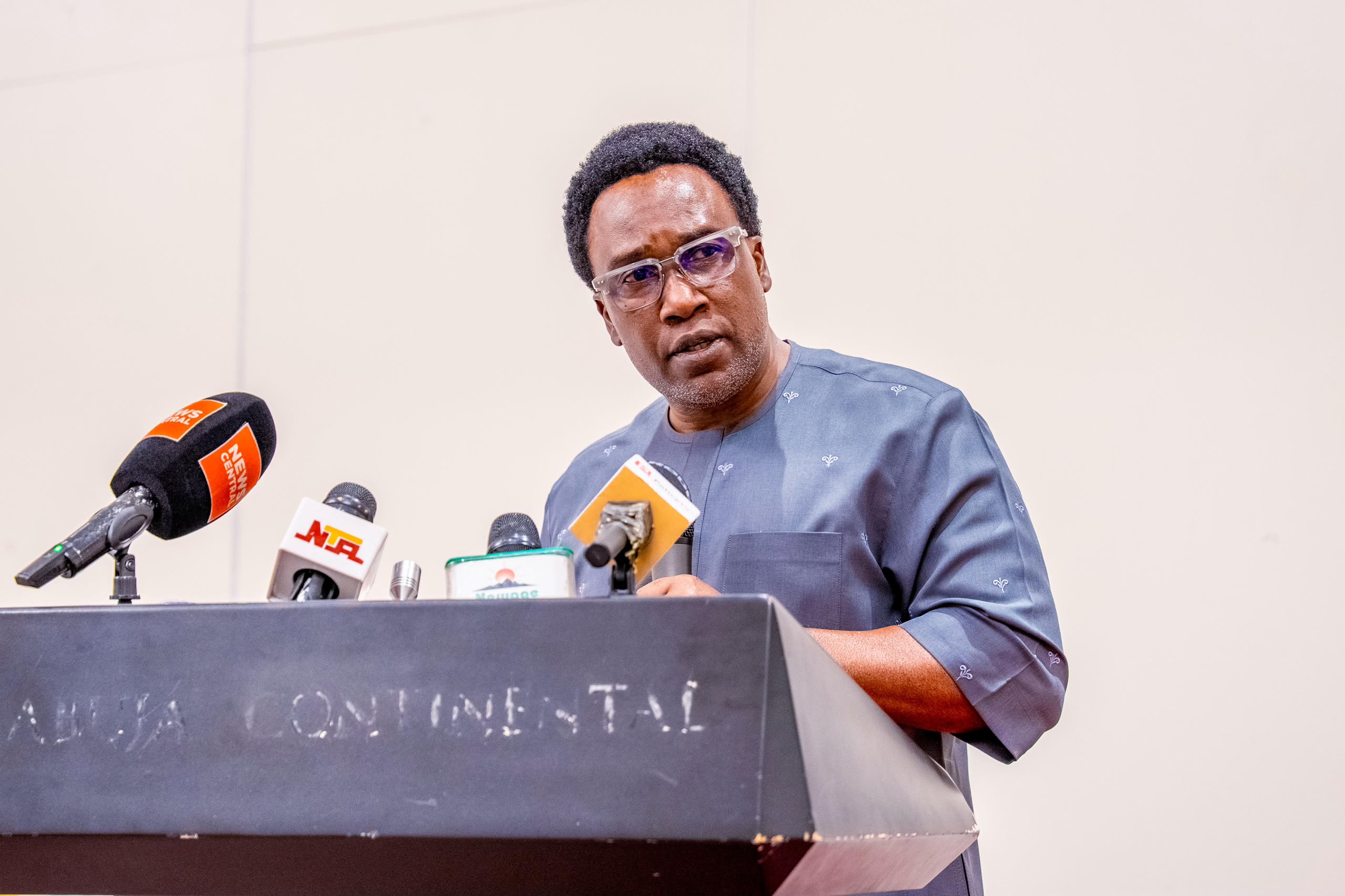
Photo caption: NiMet DG/CEO Prof. Charles Anosike speaking at the strategic dialogue.
Director General/CEO of the Nigerian Meteorological Agency (NiMet), Prof Charles Anosike, has commended the Minister of Agriculture and Food Security, Senator Abubakar Kyari, CON, for his efforts towards promoting climate-smart agriculture.
Anosike also urged stakeholders in the agriculture and good sector, to develop a practical, inclusive and measurable roadmap for integrating weather and climate services into decision-making across the sector’s value chain.
The NiMet boss stated this in his goodwill message at a National Strategic Dialogue on the Preparation of the AGROW Component 2.2 – National Implementation Strategy and Digital Agriculture Architecture, organised by the Federal Ministry of Agriculture and Food Security under the World Bank-supported Nigeria Sustainable Agricultural Value Chain (AGROW) Project.
The dialogue, held under the theme, “Building a Unified, Inclusive and Future-Ready Digital Agriculture Ecosystem for a More Productive, Resilient and Food-Secure Nigeria,” brought together key stakeholders to deliberate on strengthening Nigeria’s digital agriculture ecosystem.
Anosike confirmed NiMet’s commitment to strengthening weather and climate information services for farmers as part of efforts to build a more productive, resilient and food-secure agricultural sector in Nigeria.
He said the dialogue was important to NiMet given its mandate to provide weather and climate information that protects lives, supports livelihoods and enables informed planning across climate-sensitive sectors.
According to Anosike, climate variability, changing rainfall patterns and extreme weather events are increasingly affecting agriculture, making timely and reliable climate information critical to agricultural planning and decision-making.
He noted that NiMet provides Seasonal Climate Predictions, regular weather updates, agric meteorological services and impact-based advisories to help farmers make informed decisions on planting, water and input management, while reducing avoidable losses.
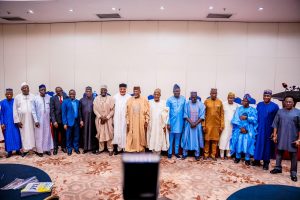
Some participants at the dialogue.
He emphasized the importance of digital agriculture as a critical pathway for translating climate information into practical, farm-level action and also highlighted NiMet’s partnerships with Tomorrow.io and MTN on the Digital Climate Advisory Services (DCAS) System, which is designed to deliver location specific weather advisories to farmers through mobile SMS.
The above, Anosike said, was in addition to NiMet’s collaboration with the Agricultural Innovation Mechanism for Scale (AIM for Scale) to strengthen the integration of AI-based weather forecasting with digital advisory systems.
He stressed the need for digital agricultural services to reach farmers through accessible and trusted channels, noting that collaboration with extension services, technology providers, telecommunications companies, community radio and farmer organisations would be essential for effective last-mile delivery.
The NiMet CEO also emphasised the importance of making such services responsive to farmers’ realities, including language, literacy, connectivity, affordability and gender inclusion, while involving farmers in the development of climate services.
He concluded his remark by expressing optimism that the dialogue would advance climate-smart, digitally enabled and farmer-centred agriculture, while reaffirming NiMet’s readiness to provide the technical leadership needed to strengthen climate services, support food security and build resilient livelihoods in Nigeria.
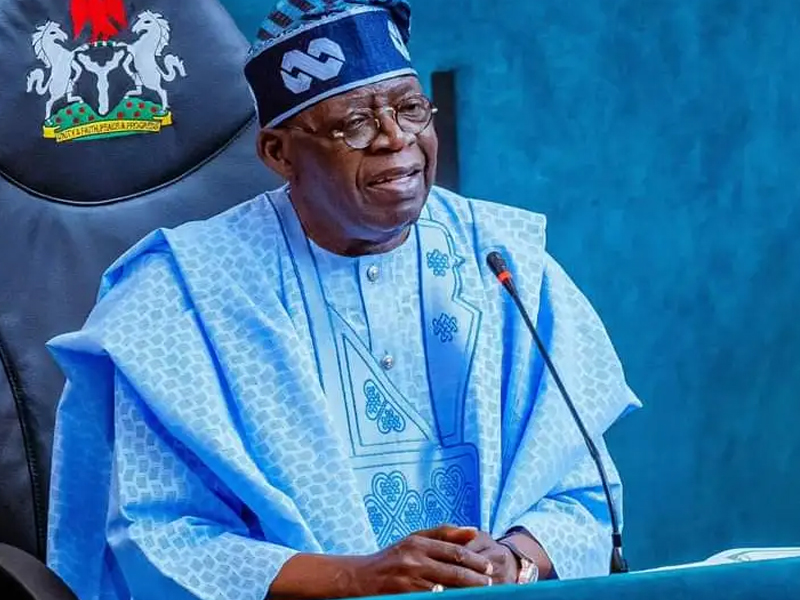
President Bola Tinubu on Monday disclosed that his government has created 650,000 jobs through its National Micro, Small and Medium Enterprises (MSME) Clinics in 19 states of the Federation and the Federal Capital Territory (FCT).
Tinubu also vowed to remove all bottlenecks militating against Nigerians turning ideas and skills into successful businesses.
The President made this known via his verified X handle, @officialABAT and explained that a tailor should not need millions of naira to buy industrial machinery before she can grow her business while a food processor should not have to build a factory before producing at scale.
This, he stated, informed why the Federal Government, “under our Renewed Hope administration, is investing in shared MSME hubs through our National MSME Clinics, giving entrepreneurs access to modern equipment, reliable power and production facilities without carrying the full cost alone.”
According to Tinubu: “Today, 21 shared facilities across 19 states and the FCT are supporting businesses and an estimated 650,000 jobs. ReadPolitical News
“Nigerians do not lack ideas, skill or ambition. Too often, they lack access to the tools and infrastructure needed to turn them into successful businesses.
“Our job is to remove those barriers.
“When small businesses can produce more, at lower cost, they become more competitive. They grow. They employ more people. They create income and opportunity for Nigerian families.
“Giving Nigerian enterprise the tools to succeed is how we build prosperity from the ground up. That is the Nigeria we are building.”
-

 News2 years ago
Senate to speed up conclusion of Nigeria Forest Security Service Bill
-

 News1 year ago
The Many Lies Against Bashir Haske
-

 News3 years ago
Breaking: Tinubu’s authentic ministerial nominees
-

 News3 years ago
“Anytime we want to kill terrorists, President would ask us to take permission from France but they were killing our soldiers-” Niger Republic coup leader
-

 News3 years ago
“I’m leaving the Catholic church because Bishop Onah is oppressing me,” says Okunerere
-

 News3 years ago
My nude photo leak was a mistake- lawyer Ifunanya
-
 News4 months ago
See your state governor’s performance ranking
-

 News3 years ago
Radio Nigeria’s veteran broadcaster Kelvin Ugwu dies three months after retirement from service