News
ECHOES OF LAGOS IN DAVOS: MARK CARNEY’S CALL MIRRORS BOLAJI AKINYEMI’S 1987 CONCERT OF MEDIUM POWERS


By- Agabaidu Jideani
In the crisp mountain air of Davos on January 20, 2026, Canadian Prime Minister Mark Carney delivered a resonant address at the World Economic Forum, framing the current global order as undergoing a profound “rupture” rather than a mere transition, where great powers wield economic integration as a weapon, through tariffs as leverage, supply chains as vulnerabilities, and financial infrastructure as coercion.
He invoked Václav Havel’s “The Power of the Powerless” to critique the “pleasant fiction” of a rules-based international system, urging middle powers, nations like Canada, neither hegemonic giants nor peripheral actors, to forge a “Compact for Middle Powers” through “variable geometry” coalitions: issue-specific alliances in trade, investment, culture, and security that build a “dense web of connections” to foster resilience and positive-sum complementaries.
Carney’s rhetoric, emphasizing that “if we’re not at the table, we’re on the menu,” positioned this compact as a pragmatic response to intensifying great-power rivalry, particularly amid U.S. President Donald Trump’s aggressive postures on Greenland and tariffs, advocating “values-based realism” rooted in human rights, sustainable development, solidarity, sovereignty, and territorial integrity, while rejecting bilateral subservience or a retreat into isolationist “fortresses.”
Yet, this call, hailed by many for its “true global leadership” and earning a standing ovation, is far from novel; it echoes, almost eerily, the intellectual architecture of Nigerian diplomat Professor Bolaji Akinyemi’s Concert of Medium Powers, proposed nearly four decades earlier in 1987 during his tenure as Nigeria’s Minister of External Affairs under General Ibrahim Babangida’s military regime. Akinyemi’s initiative, conceived amid the late Cold War’s bipolar tensions, sought to assemble an informal, flexible consultative organ of sixteen regionally representative medium powers, countries like Austria, Brazil, India, Malaysia, Mexico, and Sweden, that wielded significant regional influence but lacked superpower status, aiming to mediate global conflicts, promote international peace, and serve as a bridge between the U.S.-led West and Soviet East, thereby attenuating interstate distrust and filling governance voids left by hegemonic dominance. This was not mere idealism;
it was a strategic maneuver to elevate Nigeria beyond its anti-apartheid focus, which risked pigeonholing it as a “one-issue nation” as South Africa’s regime teetered, and to project Nigeria’s burgeoning leadership as Africa’s most populous and oil-rich state, with a GDP of approximately $71 billion and a robust military, onto the global stage.
The exploratory senior officials’ meeting in Lagos in March 1987 rechristened the group the Lagos Forum in deference to Nigeria’s initiatory role, underscoring a deliberate effort to consolidate regional hegemony through multilateralism, distinct yet complementary to the Non-Aligned Movement (NAM), where entities like India and Yugoslavia competed for Third World primacy.
The historical parallels between these two visions are striking, both emerging from eras of systemic fracture: Akinyemi’s amid the ideological stalemate of the Cold War’s twilight, where superpower proxy conflicts ravaged the Global South, and Carney’s in a post-hegemonic multipolarity marked by the erosion of Pax Americana, weaponized interdependence, and crises in finance, health, energy, and geopolitics that expose the vulnerabilities of over-integration. Both proposals embody a realist calculus of ‘middlepowermanship’, where non-hegemonic states leverage collective agency to hedge against dominance, prioritizing sovereignty, multilateral cooperation, and positive-sum outcomes over zero-sum confrontations.
For Akinyemi, this meant linking medium powers for economic diversification, accessing intermediate technologies from partners like Brazil or Malaysia suited to Nigeria’s developmental needs, while mediating disputes to ensure peace was not monopolized by the UN Security Council’s permanent members; for Carney, it translates to issue-based coalitions on AI governance, critical minerals, and climate sustainability, where shared resilience proves “cheaper than autonomy,” and consistent standards are applied to allies and adversaries alike.
Intellectually, they draw from the anarchic society framework, positing order through balanced groupings rather than hierarchy, with Akinyemi’s neutralist, anti-colonial ethos, rooted in dependency theory’s push for peripheral empowerment, mirroring Carney’s normative blend of liberal institutionalism and realist hedging, albeit updated for contemporary concerns like environmental degradation and digital disruption.
The impacts of these initiatives, however, reveal the fragility of such diplomatic innovations, particularly when tethered to individual leadership and national fortunes. Akinyemi’s Concert achieved immediate symbolic resonance, marking Nigeria as “the first black African country to project itself so vividly at the centre-stage of international politics,” enlisting non-African support for its agendas, and countering NAM rivals, yet it faltered post-Akinyemi’s 1987 departure, discontinued amid domestic skepticism about Nigeria’s medium-power credentials and external opposition, lacking institutional anchors to endure the Cold War’s abrupt end in 1991.
Its legacy lingers indirectly in forums like the D8 (Developing Eight) or BRICS reincarnations, but it remained more aspirational than operational, a conceptual pathfinder that highlighted medium powers’ potential without sustaining momentum. Carney’s Compact, still nascent, has sparked rhetorical fervor, praised for charting a “third path” beyond bilateral capitulation or isolation, it has prompted calls for action, new deals with entities like ASEAN and Qatar, and coalitions on Ukraine, yet its longevity hinges on translating oratory into concrete pacts amid great-power resistance, potentially fading like its predecessor if not bolstered by enduring structures.
This comparative lens sharpens when juxtaposed with Nigeria’s waning global influence since the 1980s, a decline that not only aborted Akinyemi’s vision but underscores the structural hurdles Carney’s compact may face.
In mirroring Akinyemi, Carney’s compact implicitly critiques such declines, suggesting that middle powers’ unity could mitigate internal frailties. As Havel might urge, true efficacy demands “living the truth” about these flaws, transforming rupture into renewal through sustained, principled action. In Carney’s Davos Akinyemi’s Lagos was resurrected.
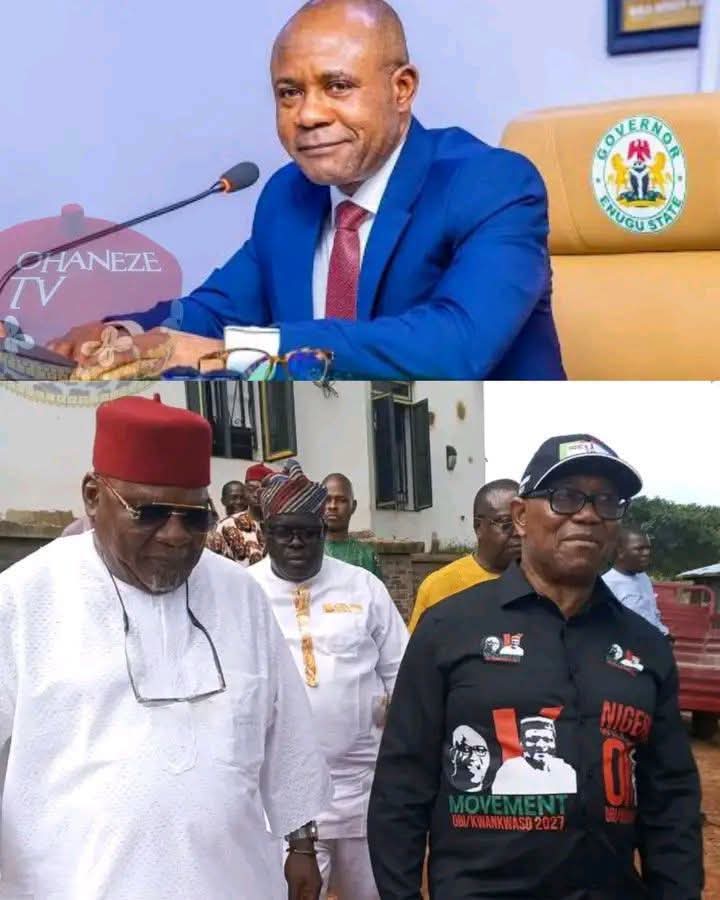
The Enugu State Government has suspended His Royal Majesty, Igwe Eze William Ezugwu, the traditional ruler of Ibagwa Ogbozalla Opi Autonomous Community, in Nsukka Local Government Area of Enugu state.
The state government accused Igwe Ezugwu of violating provisions of the state’s Traditional Rulers Law.
In a letter of suspension dated September 24, the Enugu State Government cited his alleged failure to constitute his cabinet, failure to establish a Town Union governing body, and persistent conduct deemed inconsistent with the laws governing traditional rulers in the state.
The suspension comes barely three weeks after Igwe William Ezugwu received NDC presidential candidate Peter Obi at his palace in Opi, Nsukka LGA, where he reportedly blessed Obi’s presidential ambition.
The Deputy Commander of Operation Rainbow, CSP (Chief Superintendent of Police) Dennis David Babale, has been killed after gunmen suspected to be Fulani Bandits ambushed personnel of the security outfit along the Bokkos-Barkin Ladi road in Barkin Ladi Local Government Area of Plateau State.
Operation Rainbow is a State-backed community security and intelligence-gathering outfit in Plateau State, Nigeria, originally established in 2010 under former Governor Jonah Jang and recently revamped by Governor Caleb Mutfwang to combat rural violence and beef up grassroots security.
The incident reportedly occurred at about 4:06 p.m. on Tuesday, September 22, 2026 when the personnel, travelling in a Toyota Hilux vehicle, came under attack by unidentified gunmen.
Troops of Sector 4, Operation ENDURING PEACE (OPEP), responded to a distress report and moved to the location of the attack.
Sources told reporters that Babale sustained gunshot wounds during the ambush and was evacuated to the General Hospital, Barkin Ladi, for medical attention.
Following the attack, troops, working alongside personnel of other security agencies, launched offensive operations and a manhunt for the assailants within the general area.
Security forces have intensified efforts to track the attackers and prevent further attacks along the route.

Director General/CEO of the Nigerian Meteorological Agency (NiMet) and Nigeria’s Permanent Representative at the World Meteorological Organization, Prof. Charles Anosike and other Chief Executive Officers of similar agencies across the world, have concluded a one week high level dialogue on Climate Science Information for Climate Finance and the 53rd Senior Official Field Exchange (SOFE) in Beijing, China.
The event which was hosted by World Meteorological Organization (WMO), took place from September 14 to 18, 2026 and featured discussions on: strengthening the role and leadership development of National Meteorological and Hydrological Services (NMHSs) in mobilizing climate finance; aligning scientific and technical capabilities with risk-informed, people-centred early warning systems; shifting from technical assistance to sustainable investments by expanding practical cooperation between meteorological frameworks and multilateral financing entities; and support to NMHSs leadership on strengthening strategic thinking and fostering productive partnerships.
Held back-to-back with the High-level dialogue was the 53rd Senior Official Field Exchange to Fujian Province for first-hand exposure to the implementation of Multi-hazard, Alert, Zero-gap and Universal (MAZU) platform – China’s AI-driven meteorological early warning solution in support of the Early Warnings for All (EW4All) initiative and disaster risk reduction practices through technical exchanges, field visits and peer learning.
-

 News2 years ago
Senate to speed up conclusion of Nigeria Forest Security Service Bill
-
 News1 year ago
The Many Lies Against Bashir Haske
-

 News3 years ago
Breaking: Tinubu’s authentic ministerial nominees
-
 News3 years ago
“Anytime we want to kill terrorists, President would ask us to take permission from France but they were killing our soldiers-” Niger Republic coup leader
-

 News3 years ago
“I’m leaving the Catholic church because Bishop Onah is oppressing me,” says Okunerere
-

 News3 years ago
My nude photo leak was a mistake- lawyer Ifunanya
-
 News4 months ago
See your state governor’s performance ranking
-

 News3 years ago
Radio Nigeria’s veteran broadcaster Kelvin Ugwu dies three months after retirement from service