
News
Court bans Customs from open markets, highways, restricts Service to land borders

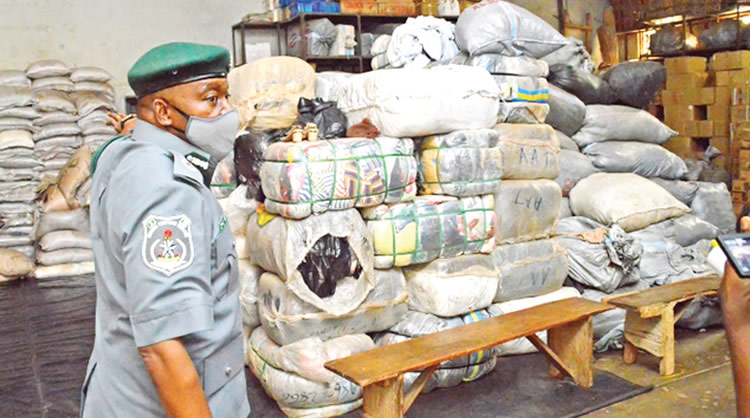
The Court of appeal in Kaduna has ruled that the Nigeria Customs Service (NCS) should not impound foreign rice in the open market or on highways.
In a judgment delivered recently by a three-member panel of justices led by Ntong Ntong held that existing laws restrict NCS’ enforcement to land borders only.
The judgment was delivered in an appeal filed by the NCS, against a decision of the federal high court that acquitted one Suleiman Mohammed, a businessman, of charges related to the importation of rice.
Customs had arrested Mohammed after seizing a truck carrying 613 bags of foreign rice and 80 bags of millet belonging to the businessman on June 14, 2019, along the Kaduna-Zaria expressway.
Mohammed was charged and arraigned on a two-count charge.
However, in a judgment delivered on November 10, 2021, Z. B. Abubakar, trial judge, acquitted the defendants of the charges.
Abubakar held that the plaintiffs (customs) failed to adduce enough evidence to prove that the defendant imported the goods.
The judge also held that there is no subsisting blanket ban on the importation of foreign rice as claimed by the plaintiffs.
“…the evidence led by the prosecution through PW1, PW2, PW3 and the Exhibits tendered has not established that the Defendant imported Exhibit ‘NCS B1-B612’. Even the investigation conducted by the complainant (Nigeria Customs Service Board) on Exhibit ‘NCS B1-B612,” the judge held.
“As a matter of fact, Exhibit ‘NCS D’ could not reveal who imported the said Exhibits or where they imported from.
“It should be borne in mind that importation of foreign rice is not absolutely or totally prohibited. It is only importation of the product through the land borders of this country that was proscribed by the Federal Government vide Circular No. NCS/TXT/1XE/045/S.416/VOL.1X of 18th March, 2016. The circular provided that foreign rice only be imported into the country through seaports.”
The trial judge held that the prosecution failed to show that the goods were imported through land borders, adding that “the said exhibits could have been imported through the seaport, and the court is entitled to presume so”.
Furthermore, the lower court held that “loading any foreign rice into a truck is not an offence under both Sections 46(b) and 47(1) (a) (ii) of Customs and Excise Management Act (CEMA) (Supra)”.
“It is the landing or unloading of goods or foreign rice at designated customs port CA/K/33/C/2022 or wharf that is prohibited by the aforementioned provisions of the Act,” the judge ruled.
However, the appellate court commended the trial court judge for “doing justice in the evaluation of the law and evidence adduced before it”.
Ntong said he agreed with the arguments put forward by the respondent’s lawyer and the judgment of the trial court.
“Truly, I also agree with the learned trial judge, that Kaduna-Zaria expressway is not a “Land border” as stipulated by the law and Exhibit “NCS D,” the justice held.
“Importation of foreign rice in any wise is not generally prohibited. It is restricted to land borders alone.
“If I were in the shoes of the appellant (NCS), I would have honourably thrown in the towel as this appeal is simply a hoax, a fluke and unmeritorious whatsoever.
“From the evidence in the Record of Appeal, the Respondent was merely a purchaser for value and not an importer. The Appellant ought to have arrested the importer and not a mere purchaser from open market with a receipt of purchase Exhibit NCS D.
“How can a fowl leave to attack who killed it to pursue who is de-feathering it? This is an Annang-African Idiom that means the Appellant ought not to shut its eyes away from the importer and be chasing petty traders and consumers who buy from the open market. After all prohibited or contraband goods always pass through the borders which are the beats of the Appellant.”
Consequently, the court dismissed the appeal in favour of the respondents.
The court further ordered customs to return all the goods seized from the businessman in 2019 or pay him the money equivalent.
“Consequently, the Appellant is hereby ordered to release or cause the release of the 613 bags of foreign rice, 80 bags of millet, Exhibit “C” and DAF truck with Registration Number: 57 BS 45 impounded and confiscated from the Respondent on 14th June, 2019 to the said Respondent Suleiman Mohammed or his representative forthwith,” the judge ruled.
“Where it has become difficult or impossible to return the items aforesaid, the Appellant shall pay to the Respondent a sum of money equivalent to the current price or cost of the items aforementioned.”

Photo caption: Governor of Rivers State, His Excellency, Sir Siminalayi Fubara (right) presenting the Staff of Office to His Majesty King Charles Douglas Mac-Pepple Jaja Jeki VI (left),the newly crowned Amanyanabo of Opobo Kingdom at Government House Port Harcourt on Friday.
Governor of Rivers State , His Excellency, Sir Siminalayi Fubara, on Friday formally presented the Certificate of Recognition and Staff of Office to the new Amanyanabo of Opobo Kingdom, His Majesty King Charles Douglas Mac-Pepple Jaja, Jeki VI, urging the new monarch to promote peace, unity and inclusiveness in the kingdom.
The governor while congratulating the new monarch, for successfully scaling the hurdles of selection and coronation, urged the royal father to see contenders who lost out of the selection process, not as victims but as comrades who must be carried along for the kingdom to move forward during his reign.
Speaking during the presentation ceremony in Government House, Port Harcourt, Governor Fubara apologized for his absence at the coronation, explaining that it was due to a call to higher national service, but that his spirit and soul were fully with the kingdom throughout the process.
He declared that history will remember his administration for peacefully laying to rest the late King, Douglas Dandeson Jaja, and mid-wifing the emergence of a new monarch without litigation.
The Governor, who said he remains one of the proudest persons on earth for the success of the transition, disclosed that the late king’s stool was enmeshed in a legal battle that lasted over 27 years, and that it took the wisdom and deliberate intervention of his administration to manage the selection process to avoid another round of court cases.
He emphasized that contrary to insinuations by mischief makers who tried to politicise his absence, his government was fully responsible for the entire process from burial of the late king to the coronation and recognition.
“Our presence was not just in that process alone. Every logistics that were required, there is nobody that can say he’s the one that did it. We did it. So, that is also a key issue in the process. So, for those people who like using everything for politics, my absence was not an intentional thing; it was a call to service. So the fact that I was unable to make it doesn’t mean that I do not value, appreciate or support the process,” Governor Fubara said.
He said the true test of kingship is in the management of success, and prayed that the new reign will usher in greater development in education, healthcare and small businesses, which he said remain the only sustainable antidotes to the growing criminality among youths.
The Governor, who described Opobo as one of the most peaceful Local Government Areas in the State, charged the new king to maintain zero tolerance for criminality, to be intentional and decisive in protecting the kingdom, and not to compromise on security on the grounds of kinship.
Governor Fubara assured the monarch of the continuous support of his administration both in and out of office, while also charging the Alapu Council to guide the king and the titled citizens to redirect their purpose from mere ceremonial uniformity to initiating tangible development projects that will be visible in the kingdom within the next one year.
In an acceptance speech, the newly installed Amanyanabo of Opobo Kingdom, His Majesty King Jaja Jeki VI, pledged to build Opobo on the pillars of service, inclusion and vision, in honour of the legacy of the great King Jaja who founded the kingdom 156 years ago with trade and diplomacy.
Describing the Staff of Office as more than a symbol of authority, the monarch said it represents a sacred trust from the government and people of Rivers State to lead with justice, peace and dignity.
In a statement, Onwuka Nzechi, Chief Press Secretary to Governor Fubara, quoted the monarch to have expressed deep gratitude to God, the ancestors, Governor Fubara, the Opobo Council of Alapu, titled citizens, elders, women and youths for the confidence reposed in him to lead Opobo into its Sixth Chapter.
The new king assured the Rivers State Government that under his reign, Opobo Kingdom will remain a dependable partner for peace, development and unity of Rivers State.

Gunmen have abducted 20 corps members serving under the National Youth Service Corps (NYSC) along the Owerri–Onitsha Road by Umunoha community in the Mbaitoli, Imo State, South East Nigeria.
Confirming the unfortunate incident, in a telephone conversation, the Police Public Relations Officer of the Imo State Police Command, Henry Okoye, said the corps members were reportedly travelling in a commercial bus from Ibadan, Oyo State, to different orientation camps in the South-East and South-South states when they were intercepted by the gunmen.
He said the Commissioner of Police, Audu Bosso, visited the scene for an on-the-spot assessment, while the police and other security agencies have intensified efforts to rescue the victims unhurt and unconditionally.
Okoye added that security operatives were currently combing surrounding bushes, while a Rapid Response Team (RRT) had also been deployed to track down the kidnappers and secure the safe release of the corps members.
The incident came weeks after the police said that 11 people, including an unidentified number of corps members serving under the National Youth Service Corps (NYSC), were rescued after gunmen attacked vehicles along the Aloma–Egane Expressway.

A former employee of Air Peace, who simply identified herself as Tade, has made a social media post on her recent encounter with the Chairman/CEO of the airline, Dr. Allen Onyena and praised him for his exceptional goodwill, benevolence and kind word of encouragement.
Tade who said she resined from Air Peace last year to set up a fashion outfit, after receiving blessings from Allen Onyena, quoted the airline’s CEO to have commended her for establishing her own business, said the encounter took place on Wednesday when the Air Peace boss paid a visit to her business premises
The obviously excited lady said- “It was such a beautiful moment having my boss visit my factory. And honestly, I still struggle to call him my former boss. Some people may be former bosses by designation, but the place they occupy in your life does not change simply because you no longer work in the same organisation.
“Two days ago, when he told me he wanted to come see the factory, I honestly wondered if he would be able to make it. I had seen how incredibly busy his schedule was, meetings, guests, engagements, one thing after another, and some of those meetings stretched well into yesterday evening.
“But around 7pm, after what I can only imagine was an incredibly long and stressful day, he still came.
“And he didn’t just come in, take a quick look around and leave. The entire house came alive.
“We received him warmly, and his presence brought such a beautiful energy into the building. He took time to speak with the staff, interacted with my friend, Mr. Jire, and his wife about their business, and then came into my office and sat with me.
“And for a while, it was just my boss being my boss.
“We talked about entrepreneurship, people management, business management, governance, leadership, and the challenges that come with growing a business, including some of the challenges I cannot even see yet. He reminded me, in his own way, that growth does not mean the challenges stop. They simply change.
“And then came that moment:
“You are now an employer of labour yourself, Tadé.”
She continued – “I don’t think he knows what those words meant to me. October will make it a year since I resigned from Air Peace and left with his blessing.
“And here I was yesterday, almost a year later, standing in my own factory, surrounded by people who now work for the fashion company I am building, while the man I once reported to was standing there looking at what has grown from that decision.
“There was something deeply emotional about it. Because when I met this man in 2023, I could not have known all that the years ahead would hold.
“Meeting you, sir, and working with you was never a coincidence. It was a necessary chapter in my life. A needed season. A significant part of the journey that brought me here. And I will always cherish it.
“Thank you, sir, for your leadership. Thank you for the opportunities, the lessons, the corrections, the wisdom, and most especially, for your consistent belief in me.
“Thank you for showing up. And thank you for coming to see what that little girl who once worked with you is building today. It meant more to me than I can properly put into words.
“And on behalf of the entire TADÉ house, thank you for the generous gift. We are deeply grateful.
“Some moments are bigger than the moment itself. Yesterday was one of them.,” she concluded.
All pictures were taken in the moment
-

 News2 years ago
Senate to speed up conclusion of Nigeria Forest Security Service Bill
-

 News1 year ago
The Many Lies Against Bashir Haske
-

 News3 years ago
Breaking: Tinubu’s authentic ministerial nominees
-

 News3 years ago
“Anytime we want to kill terrorists, President would ask us to take permission from France but they were killing our soldiers-” Niger Republic coup leader
-

 News3 years ago
“I’m leaving the Catholic church because Bishop Onah is oppressing me,” says Okunerere
-

 News3 years ago
My nude photo leak was a mistake- lawyer Ifunanya
-
 News4 months ago
See your state governor’s performance ranking
-

 News3 years ago
Radio Nigeria’s veteran broadcaster Kelvin Ugwu dies three months after retirement from service