
News
CJN commends Ojukwu, as Kaduna, Katsina govs, Marwa, others pledge collaboration with NHRC on proportional force, human dignity

Bonaventure Phillips Melah
The Chief Justice of Nigeria (CJN), Kudirat Kekere-Ekun, has commended Dr. Tony Ojukwu, SAN, the Executive Secretary/CEO of the National Human Rights Commission (NHRC), describing the work of the Commission under his leadership as ‘fantastically good.
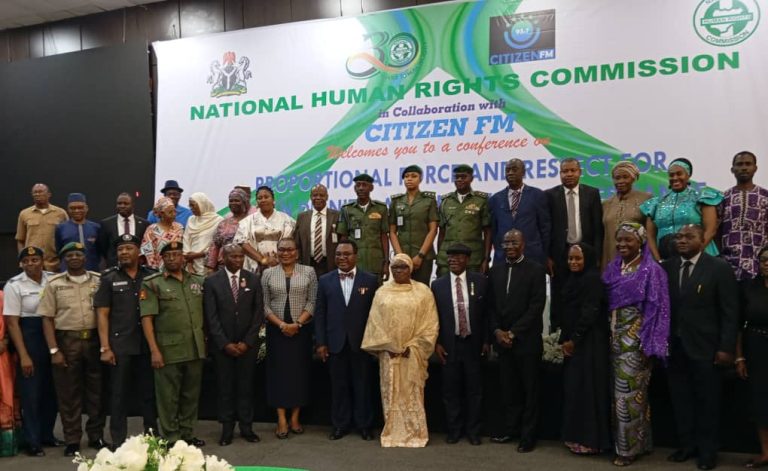
She gave the commendation on Thursday at a conference on “Proportional Force and Respect for Human Dignity: A Dialogue in Governance,’ organized by the NHRC at Nigerian Air Force Conference Centre, Mabuchi Abuja.
Represented by the Administrator of the National Judicial Institute (NJI). Justice Babatunde Adejumo, the CJN also called on NHRC to take up the task of training officers and men of the Nigeria Police, in the area of use of proportional force, in order to ensure that security agencies fight crime, justice and human dignity are not trampled upon.
She described the Police as the most abuser of Juman rights. Adding that they need to be constantly trained since unlike the military and other security agencies, the Police is closer to civil society.
The event was attended by representatives of Kaduna and Katsina State Governors, the Chairman of the National Drug Law Enforcement Agency, Buba Marwa, representatives of the Department of State Security (DSS), Inspector General of Police, Nigerian Air Force and Navy, among others, while the Chairman of Nigeria Law Reform Commission, Prof. Dakas CJ Dakas attended as Keynote Speaker.
In his opening remarks, the Executive Secretary of the National Human Rights Commission, Dr. Tony Ojukwu, SAN, said while security agencies are statutorily empowered to carry out their duties towards maintaining security of lives and property of citizens, the question of how force is applied, is not only a matter of operational necessity but also of its constitutionality and corresponding responsibility for human rights.
He said the constitution of Nigeria, 1999 (as amended) guarantees the right to life as well as the dignity of the human person.
Ojukwu said through dialogue, solutions can be co-created through transparency, accountability, and collaboration and urged participants to freely express their minds, hoping that solutions could be found on how to build a security system that is both effective and respects the rights of citizens and their human dignity.
Ojukwu said- “These provisions state that every individual possesses an inherent worth that must be respected at all times including situations of insecurity and armed conflicts. It places an obligation on security institutions to uphold and protect human dignity as a matter of law and governance.
“The principles of international humanitarian law recognize that even in situations of armed conflict, humanity must not be abandoned.
He cited other legal provisions to buttress his stand, saying that Article 51(5)(b) of Additional Protocol to the Geneva Conventions, the Armed Forces Act, Laws of the Federation of Nigeria, 2004, the Nigeria Police Act 2020 and the Revised Force Order 237, 2019 were all relevant authorities on the matter in issue.
According to Ojukwu- “While proportional force and respect for human dignity are substantive principles guiding our security operations, dialogue is the instrument through which governance becomes participatory and institutions earn trust of the citizens in the systems meant to protect them.
”For the National Human Rights Commission, dialogue in governance means creating platforms where the military, law enforcement agencies, MDAs, civil society, legal practitioners, academics, and citizens can sit together to examine the challenges of security and human rights.
“Of similar principle and relevance to proportional force are the principles for the Prohibition of Torture, Cruel, Inhuman or Degrading Treatment and Punishment. Prohibition of Torture and CID is protected under the Convention against Torture, Section 34 of the 1999 constitution as amended as well as, under the Anti-Torture Act of 2017.
“Since disproportionate force is sometimes targeted to result in the infliction of harm, pain, either physical or mental or psychological, there is need to be circumspect on force applied with response to a security situation at hand as disproportionate force can become torture, cruel, inhuman or degrading treatment which is not permitted under any circumstances.
“It is proposed that where disproportionate force is applied, it should be considered as torture, cruel, inhuman or degrading treatment or punishment unless, good faith on the part of the officer is established beyond reasonable doubts,” the NHRC boss stated.
In his keynote address, Prof. Dukas C J Dukas, Chairman, Nigeria Law Reform Commission, said Nigeria should adopt institutionalized dialogue to eliminate suspicion between citizens and the law enforcement agencies.
He said a peaceful society is built not only on laws but on relationships, stating that dialogue makes room for citizens and law enforcement agencies and operatives to understand one another, resolve conflicts early, and uphold justice in a way that is mutually reinforcing.
According to Dukas, dialogue is not a sign of weakness but a tool of strength and serves as path to reconciliation, a foundation for better law enforcement and better citizenship.
He said among other things that- “We cannot build peaceful societies through silence or suspicion. We build them through speaking, listening, understanding, and working together in an atmosphere of mutual respect,” and observed that Nigeria faces complex security realities of banditry and terrorism, communal conflict, cybercrime, among others.
Dukas said in the midst of these challenges and efforts to solve them, there are recurring concerns such as unclear engagement rules, excessive or poorly regulated force, delayed accountability mechanism and trust deficit.
in their goodwill messages, the Governors of Kaduna and Katsina states, pledged to collaborate with NHRC to support training of security agencies in their respective states on the use of proportional force, with the aim of ensuring that human dignity is preserved at all times.
While Kaduna Governor, Uba Sani was represented by his Deputy, Hadiza Balarabe, his Katsina State counterpart, Umara Dikko Radda, was represented by the State Attorney General and Commissioner for Justice, Hajiya Fadila Mohammed Dikko.
Also speaking, NDLEA Chairman, Buba Marwa, said although NHRC was established by a military head of state, Gen. Sani Abacha, the Commission has undergone several transformations to become a reference institution that is compliant with democratic governance.
He commended Dr. Tony Ojukwu for a job well done and congratulated the Commission on its 30th anniversary.

Health professionals have warned that regular consumption of shawarma containing high amounts of salt, sugar, fat, seasoning and processed meat may contribute to hypertension, obesity, diabetes and kidney disease.
Excessive salt can raise blood pressure and put additional strain on the kidneys, while high-calorie sauces may contribute to weight gain.
Nutrition experts advised Nigerians to eat shawarma in moderation, use less mayonnaise and other sauces, choose lean grilled meat and add more vegetables. Consumers were also urged to check vendors’ cleanliness and avoid food prepared where ingredients are exposed to flies, dust or poor handling.
A recent report by experts also warned that frequent consumption of Shawarma may increase the risk of other food-borne infections and long-term health problems.
The report contains documented cases of people who suffered vomiting, diarrhoea, stomach pain and weakness after eating shawarma, with some requiring hospital treatment.
According to the report, poor hygiene could allow bacteria and other contaminants into shawarma, causing illnesses including cholera, dysentery, typhoid and salmonellosis.
It also raised concerns about mayonnaise and creamy sauces kept without proper refrigeration and warned that poor storage could encourage bacterial growth and increase the risk of food poisoning.
A study cited in the report found bacterial contamination in ready-to-eat shawarma sold on the streets
Experts also raised concerns about processed meat such as sausage, noting that the International Agency for Research on Cancer classifies processed meat as carcinogenic to humans.
The mystery surrounding the death of a man whose body was found by the roadside in Abuja has taken a new turn, with police tracing the case through his missing mobile phone to a married woman who allegedly spent time with him at a hotel.
The FCT Commissioner of Police, Mohammed Sanusi, disclosed this on Saturday in Abuja, saying investigators arrested Rukayat Muhammed after tracing the deceased’s final communications.
The man was found dead on August 26 along the Kubwa Expressway, near Katampe under the bridge, after his family had earlier reported him missing.
According to the police, the case initially raised suspicion of a possible “one chance” incident. Investigators, however, established that the dead man was the missing person after identifying his remains.
Sanusi said the deceased’s mobile phone was missing and had been switched off. Police investigators subsequently traced his last known communication, leading them to Rukayat, a resident of Garki Area 2.
Investigators reportedly discovered that Rukayat, who is married, was allegedly in a romantic relationship with the deceased. The police said she had saved his contact under the name “Safiyat.”
The CP said the pair had lodged at Good Samaritan Guest House on 2nd Avenue, Gwarinpa, where the man later died.
Sanusi said Rukayat allegedly discovered that the man was no longer breathing but failed to alert the police or hotel management. Instead, she allegedly took his phone and left the hotel.
The case took another turn when hotel management later discovered the man’s body inside the room after attempts to contact the occupants failed.
Rather than reporting the discovery, two hotel staff members, Ibrahim Omeiza and Kefat Bitrus, allegedly removed the body from the room and transported it to the Kubwa Expressway, where they dumped it under the Katampe bridge.
The police said the action was apparently intended to distance the hotel and its management from the death.
Sanusi said detectives were still working to establish exactly how the man died and determine the individual roles of those connected to the incident.
He warned that anyone found to have participated in the death, concealment or abandonment of the body would face prosecution.
The commissioner said the investigation remains ongoing.
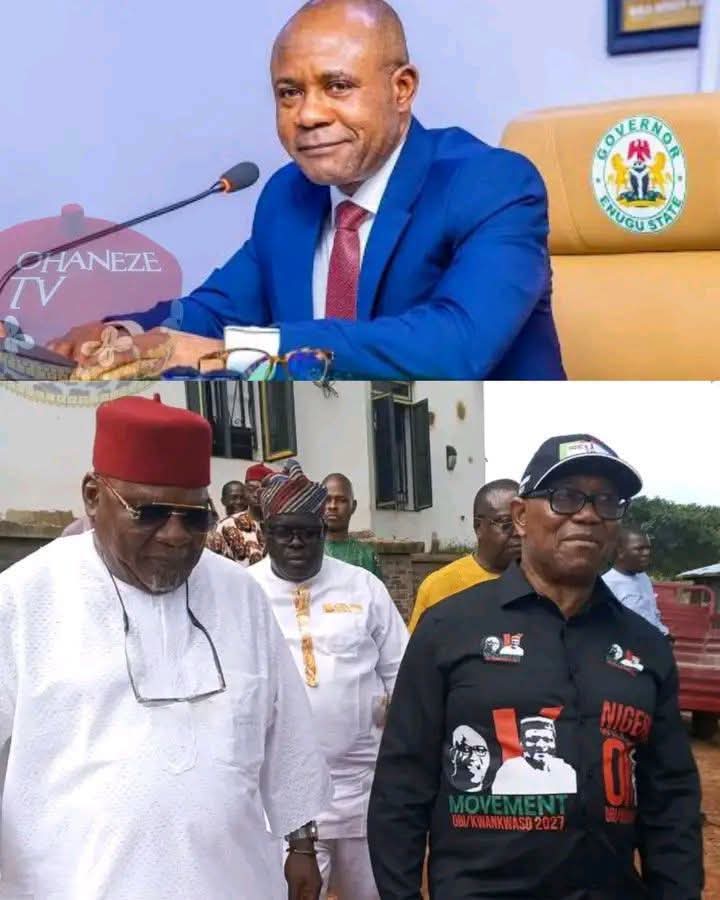
The Enugu State Government has suspended His Royal Majesty, Igwe Eze William Ezugwu, the traditional ruler of Ibagwa Ogbozalla Opi Autonomous Community, in Nsukka Local Government Area of Enugu state.
The state government accused Igwe Ezugwu of violating provisions of the state’s Traditional Rulers Law.
In a letter of suspension dated September 24, the Enugu State Government cited his alleged failure to constitute his cabinet, failure to establish a Town Union governing body, and persistent conduct deemed inconsistent with the laws governing traditional rulers in the state.
The suspension comes barely three weeks after Igwe William Ezugwu received NDC presidential candidate Peter Obi at his palace in Opi, Nsukka LGA, where he reportedly blessed Obi’s presidential ambition.
-

 News2 years ago
Senate to speed up conclusion of Nigeria Forest Security Service Bill
-
 News1 year ago
The Many Lies Against Bashir Haske
-

 News3 years ago
Breaking: Tinubu’s authentic ministerial nominees
-
 News3 years ago
“Anytime we want to kill terrorists, President would ask us to take permission from France but they were killing our soldiers-” Niger Republic coup leader
-
 News3 years ago
“I’m leaving the Catholic church because Bishop Onah is oppressing me,” says Okunerere
-

 News3 years ago
My nude photo leak was a mistake- lawyer Ifunanya
-
 News4 months ago
See your state governor’s performance ranking
-

 News3 years ago
Radio Nigeria’s veteran broadcaster Kelvin Ugwu dies three months after retirement from service