News
ACCI, others conclude practitioners’ certification programme on business and human rights in Africa

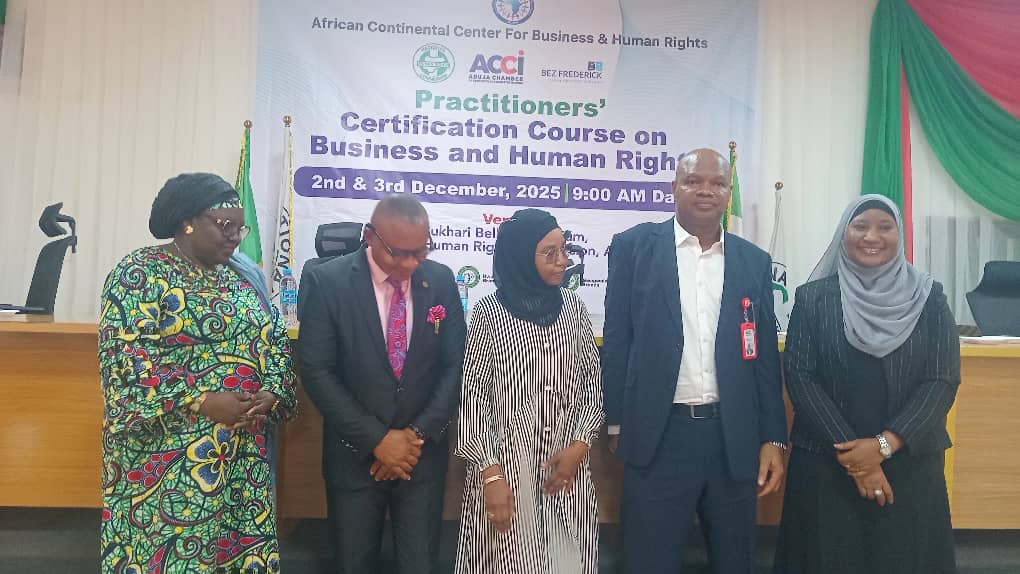
A two-day intensive practitioners’ certification course on Business and Human Rights, has been concluded in Abuja with 118 participants drawn from 11 African countries and representatives from Belgium and the Netherlands in attendance.
Organized by African Continental Centre for Business and Human Rights (ACCBHR), in partnership with Nigeria’s National Human Rights Commission (NHRC), and the Abuja chamber of Commerce (ACCI), the event marked the first professionally accredited BHR certification course to be delivered in West Africa.
According to Sir Agadaidu C. Jideani, ACCI Director General, the course was structured around the three pillars of the UN Guiding Principles on Business and Human Rights (UNGPs), Protect, Respect, and Remedy; and combined high-level theoretical grounding with practical, Africa-specific implementation tools.
Participants who were mainly from Nigeria, Ghana, Kenya, South Africa, Uganda, and Côte d’Ivoire, included legal practitioners, in-house counsel, compliance and sustainability officers from extractive and financial-sector companies, senior government regulators, members of national human rights institutions, the UNDP and civil society specialists.
The event opened on the first day with a keynote address by the Executive Secretary of the National Human Rights Commission (NHRC) Dr. Tonny Ojukwu, SAN and a welcome address by the President of the Abuja Chamber of Commerce/Leader of the Organized Private Sector in the Nigerian Capital-Abuja, Chief Emeka Obegolu, SAN.
The two speakers identified the need for strengthening the intersection between ethical business conduct and respect for human rights. They underscored the growing convergence between mandatory human rights and environmental due diligence (mHREDD) regimes and emerging African frameworks.
Barrister Chris Ugwuala delivered the foundational session, tracing the evolution of the BHR field from the 1970s draft UN Code of Conduct through to the 2011 UNGPs and subsequent National Action Plans (NAPs). Particular emphasis was placed on Nigeria’s 2022–2026 National Action Plan on Business and Human Rights, one of the most advanced in Africa, and its alignment with the OECD Guidelines for Multinational Enterprises.
Mrs. Pwamdundi Oko, subject matter expert and desk officer Business and Human Rights at the National Human rights Commission of Nigeria (NHRC) provided a detailed dissection of the Nigerian NAP’s four thematic pillars and cross-cutting obligations, candidly addressing implementation gaps, resource constraints, and the absence of binding legislative backing to date. Her session triggered robust discussion on the role of national human rights institutions as NAP coordinators in resource-constrained environments.
The afternoon concluded with a highly interactive skills-building workshop led by ACCI Director General, himself, a Human Rights Governance, Risk and Compliance Specialist. Participants worked in sectoral groups (extractives, agribusiness, finance, and manufacturing) to map salient human rights risks and design basic human rights due diligence processes using open-source tools adapted to low-capacity settings. Sir Agabaidu led the participants through the establishment and operationalization of a Business and Human Rights Compliance and Implementation Program.
Day 2 of the event opened with a sharp focus on the often-neglected third pillar with Hauwa Kaka Usman, Registrar-General of the Nigeria Chamber of Commerce Dispute Resolution Centre (NCCDRC), presenting a groundbreaking proposal for the NCCDRC to be formally recognised as a non-judicial grievance mechanism under Pillar III of the UNGPs.
Participants engaged in a mock mediation of a community–investor land-rights dispute, demonstrating the practical viability of industry-led remedial ecosystems.
Oyetola Muyiwa Atoyebi SAN delivered a masterclass on climate change litigation and corporate climate accountability, analysing landmark tort-based cases, and recent South African proceedings, alongside the accelerating wave of greenwashing and climate-washing claims. The session explored how African jurisdictions might adapt these precedents in the absence of dedicated climate statutes.
Professor Ibe Ifeakandu of the Nigerian Institute of Advanced legal Studies, examined modern slavery and forced labour risks in African supply chains, drawing on recent UK and Australian Modern Slavery Act reporting data involving Nigerian and Ghanaian exporters. The presentation concluded with practical guidance on conducting heightened due diligence in tier-2 and tier-3 supplier relationships.
The final substantive session, led by environmental rights specialist Mr. Napoleon Eyenaba of the UNDP, mapped the fast-evolving HREDD landscape: the EU Corporate Sustainability Due Diligence Directive (CSDDD), the proposed ECOWAS Directive, South Africa’s emerging companies’ amendment bill, and ongoing legislative discussions in Kenya and Nigeria. Participants received comparative compliance checklists and transition timelines.
Participants were later divided into three working groups for practical exercises on the three pillars of Business and Human Rights and scenario-based exercises. A certification Exam and practical exercises have been shared with the participants to complete at home in an open book manner before certification certificates would be issued by the organizers to the successful candidates.
In his closing remarks, ACCI boss, Sir Agabaidu Jideani, announced that the organizers will work together to integrate successful participants into a national BHR practitioners’ roster to support NAP implementation monitoring and multi-stakeholder advisory processes.
The Abuja certification course arrives at a pivotal moment: African states and companies face simultaneous pressure from incoming European due diligence laws, rising investor ESG expectations, and an expanding domestic litigation risk environment. By creating a cohort of certified African practitioners conversant with both global standards and local realities, the ACCBHR, NHRC and the ACCI, have laid critical groundwork for contextualised, effective implementation of the UNGPs across the continent.
The Centre has confirmed that the programme will be rolled out in East Africa (Nairobi) and Southern Africa (Johannesburg) in 2026, with advanced modules on supply-chain due diligence and climate-related human rights impacts already in development.
As mandatory HREDD moves from Brussels to African statute books, initiatives such as this signal that the continent is not merely reacting to global norms but is actively shaping competent, home-grown responses, led by the Nigerian National Human Rights Commission.

Health professionals have warned that regular consumption of shawarma containing high amounts of salt, sugar, fat, seasoning and processed meat may contribute to hypertension, obesity, diabetes and kidney disease.
Excessive salt can raise blood pressure and put additional strain on the kidneys, while high-calorie sauces may contribute to weight gain.
Nutrition experts advised Nigerians to eat shawarma in moderation, use less mayonnaise and other sauces, choose lean grilled meat and add more vegetables. Consumers were also urged to check vendors’ cleanliness and avoid food prepared where ingredients are exposed to flies, dust or poor handling.
A recent report by experts also warned that frequent consumption of Shawarma may increase the risk of other food-borne infections and long-term health problems.
The report contains documented cases of people who suffered vomiting, diarrhoea, stomach pain and weakness after eating shawarma, with some requiring hospital treatment.
According to the report, poor hygiene could allow bacteria and other contaminants into shawarma, causing illnesses including cholera, dysentery, typhoid and salmonellosis.
It also raised concerns about mayonnaise and creamy sauces kept without proper refrigeration and warned that poor storage could encourage bacterial growth and increase the risk of food poisoning.
A study cited in the report found bacterial contamination in ready-to-eat shawarma sold on the streets
Experts also raised concerns about processed meat such as sausage, noting that the International Agency for Research on Cancer classifies processed meat as carcinogenic to humans.

The mystery surrounding the death of a man whose body was found by the roadside in Abuja has taken a new turn, with police tracing the case through his missing mobile phone to a married woman who allegedly spent time with him at a hotel.
The FCT Commissioner of Police, Mohammed Sanusi, disclosed this on Saturday in Abuja, saying investigators arrested Rukayat Muhammed after tracing the deceased’s final communications.
The man was found dead on August 26 along the Kubwa Expressway, near Katampe under the bridge, after his family had earlier reported him missing.
According to the police, the case initially raised suspicion of a possible “one chance” incident. Investigators, however, established that the dead man was the missing person after identifying his remains.
Sanusi said the deceased’s mobile phone was missing and had been switched off. Police investigators subsequently traced his last known communication, leading them to Rukayat, a resident of Garki Area 2.
Investigators reportedly discovered that Rukayat, who is married, was allegedly in a romantic relationship with the deceased. The police said she had saved his contact under the name “Safiyat.”
The CP said the pair had lodged at Good Samaritan Guest House on 2nd Avenue, Gwarinpa, where the man later died.
Sanusi said Rukayat allegedly discovered that the man was no longer breathing but failed to alert the police or hotel management. Instead, she allegedly took his phone and left the hotel.
The case took another turn when hotel management later discovered the man’s body inside the room after attempts to contact the occupants failed.
Rather than reporting the discovery, two hotel staff members, Ibrahim Omeiza and Kefat Bitrus, allegedly removed the body from the room and transported it to the Kubwa Expressway, where they dumped it under the Katampe bridge.
The police said the action was apparently intended to distance the hotel and its management from the death.
Sanusi said detectives were still working to establish exactly how the man died and determine the individual roles of those connected to the incident.
He warned that anyone found to have participated in the death, concealment or abandonment of the body would face prosecution.
The commissioner said the investigation remains ongoing.

The Enugu State Government has suspended His Royal Majesty, Igwe Eze William Ezugwu, the traditional ruler of Ibagwa Ogbozalla Opi Autonomous Community, in Nsukka Local Government Area of Enugu state.
The state government accused Igwe Ezugwu of violating provisions of the state’s Traditional Rulers Law.
In a letter of suspension dated September 24, the Enugu State Government cited his alleged failure to constitute his cabinet, failure to establish a Town Union governing body, and persistent conduct deemed inconsistent with the laws governing traditional rulers in the state.
The suspension comes barely three weeks after Igwe William Ezugwu received NDC presidential candidate Peter Obi at his palace in Opi, Nsukka LGA, where he reportedly blessed Obi’s presidential ambition.
-

 News2 years ago
Senate to speed up conclusion of Nigeria Forest Security Service Bill
-

 News1 year ago
The Many Lies Against Bashir Haske
-

 News3 years ago
Breaking: Tinubu’s authentic ministerial nominees
-

 News3 years ago
“Anytime we want to kill terrorists, President would ask us to take permission from France but they were killing our soldiers-” Niger Republic coup leader
-

 News3 years ago
“I’m leaving the Catholic church because Bishop Onah is oppressing me,” says Okunerere
-

 News3 years ago
My nude photo leak was a mistake- lawyer Ifunanya
-
 News4 months ago
See your state governor’s performance ranking
-

 News3 years ago
Radio Nigeria’s veteran broadcaster Kelvin Ugwu dies three months after retirement from service