
News
Democracy Day: Soludo’s take at ‘The Platform’ on Nigeria’s Economic Development and Growth

By Christian ABURIME
On Democracy Day 2024 celebrating Nigeria’s 25 years of uninterrupted democracy in the 4th Republic, Anambra State Governor Charles Soludo as a guest speaker at The Platform event in Lagos reflected on the nation’s progress with democracy and a free market economy. Revisiting a lecture he gave in 2005 on sustainable democracy, Soludo noted that many of the same issues remain urgent challenges today, despite efforts over the past two decades. He argued that while Nigeria has professed to practise democracy and free market economy for decades, the country has made little meaningful progress, often taking steps forward only to stand still.
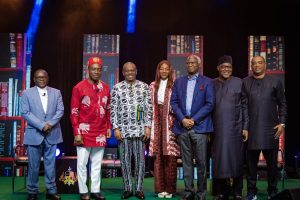
In his thought-provoking speech, Soludo argued that true democracy and free market economics are integrally linked as vehicles for maximizing liberty, security, prosperity and happiness for citizens. However, he warned that Nigeria’s democracy faces an existential threat from an unsustainable economy that all Nigerians must confront. As a member of the governing elite, Soludo stated that while public officials are trying to fix issues within their means, the challenges are too great to be left to politicians and governments alone.
In discussing the symbiotic relationship between democracy and free market economic principles, Soludo referenced Milton and Rose Friedman’s book “Free to Choose,” arguing that democracy and market economies, despite imperfections, remain the best frameworks for organising human societies, especially diverse, multi-ethnic ones like Nigeria.
However, both democracy and free markets are said to be works in progress, requiring constant effort and reform. The degree of free market policies depends on a society’s ideology around wealth distribution and the role of the state versus markets. While acknowledging an elite consensus in Nigeria favouring democracy and market economics broadly, optimising these systems for citizen welfare becomes imperative.
Governor Soludo also emphasized that the economic strength of a nation is a key determinant of enduring democracy. Citing empirical research, he suggested that with Nigeria’s current low per capita income of around $1,200, sustaining democracy will require extraordinary effort, as poorer nations tend to have less durable democracies.
According to the former CBN governor, Nigeria is a very poor country with broken public finances, despite being considered the “largest economy in Africa” a few years ago due to GDP re-basing. For over 50 years, Nigeria’s economic trajectory has been defined by booms and busts in the oil sector. The last administration engaged in populist policies like illegally printing over N22 trillion to fund subsidies and expenditures.
Today, Nigeria’s fiscal situation is dire – the 2024 federal budget revenue of N18.3 trillion is only about $20 billion or 7% of GDP for a country of 230 million people. Even this projected revenue may not be realised. Debt servicing costs are high at N8.25 trillion, while total recurrent expenditure is N18.1 trillion, likely requiring more borrowing to fund it.
Our capital expenditure is just 2% of GDP, far below the 10-15% needed to address Nigeria’s infrastructure deficit. State governments are also struggling, with real purchasing power declining severely compared to a decade ago due to inflation and currency depreciation. Thus, Nigeria faces a stringent fiscal quagmire, with low tax revenues, high debt levels, and increasing needs of citizens amidst rising costs. Difficult choices lie ahead to address the long-standing fiscal and structural crisis.
Soludo contended that Nigeria faces an existential threat to its democracy due to an unsustainable economy and broken public finances. The country is very poor, with dwindling revenues, escalating debt, rising inflation and poverty. The new Tinubu administration inherited a crisis situation akin to “a dead horse but standing.”
To fix the crumbling foundations of our nationhood, Soludo called for bold, systemic disruptions through mobilising working groups to tackle insecurity, the economy, the oil and gas sector, food security, and building a true federal system of government with devolution of powers to states. He advocated reinventing citizen engagement initiatives like MAMSER, implementing an inclusive “Big Tent” social agenda to give everyone a stake, and enforcing a strict code of conduct for public officials to cut wasteful spending.
As a leader who lives by example, Governor Soludo is known to be extremely frugal with state resources. He does not take salaries from Anambra State government. Anambra State under Soludo leadership has no office of the First Lady that would attract extraneous expenses in governance. The governor wears local fabrics and rides in Nigerian-made vehicles as official cars. And the Soludo government adheres strictly to the avoidance of borrowing by doing more with less.
Overall, Soludo urged Nigerians to join in the solution rather than complaining and leaving it all to politicians alone. He expressed confidence in President Tinubu’s ability to lead the difficult reforms needed, given the president’s past record, but emphasized the reforms will require extraordinary efforts and sacrifices from all Nigerians.
As his speech drew to a close, Governor Soludo expressed cautious optimism about Nigeria’s future despite the nation’s economic challenges that threaten its democracy and free market system. He echoed the famous words of President Clinton that “it’s the economy, stupid,” underscoring the critical importance of economic revival to sustain democracy, especially with Nigeria’s population projected to reach 440 million in the next 26 years.
Yet, the Anambra State governor remains incredibly optimistic about Nigeria’s greatness and potential, driven by his persistent belief in public service and the infinite possibilities the country offers. He envisions Nigeria’s youthful population as an unstoppable force that can conquer the world, heralding the 22nd century as Nigeria’s century.
Building this formidable future, however, demands a strong, collective effort from all Nigerians. Mere complaints are insufficient; positive action to transform challenges into opportunities is imperative. Recalling the late Sonny Okosun’s poignant 1984 song “Which Way Nigeria?”, Soludo recognised that while its lamentations ring truer than ever four decades later, its call for united action may provide the impetus required to harness Nigeria’s immense potential and forge an extraordinary destiny.
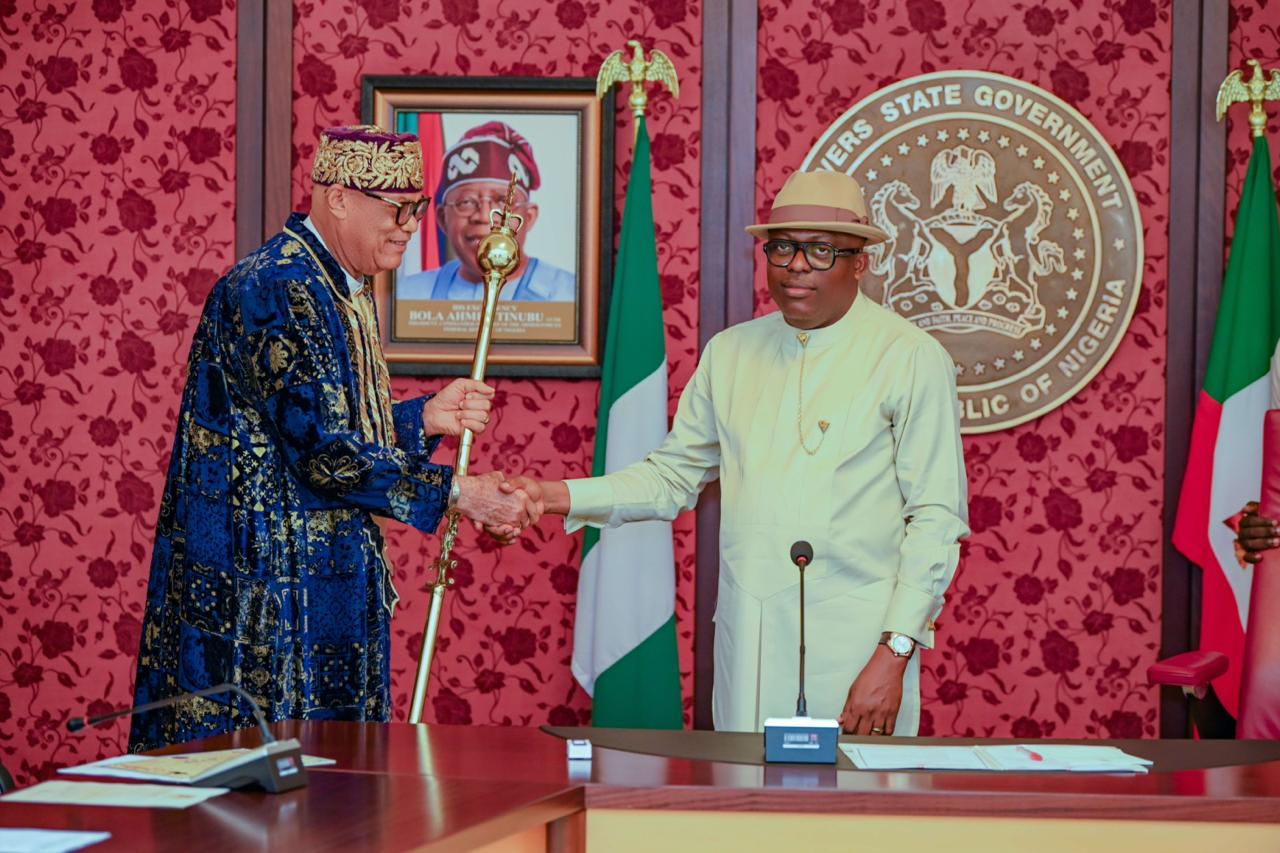
Photo caption: Governor of Rivers State, His Excellency, Sir Siminalayi Fubara (right) presenting the Staff of Office to His Majesty King Charles Douglas Mac-Pepple Jaja Jeki VI (left),the newly crowned Amanyanabo of Opobo Kingdom at Government House Port Harcourt on Friday.
Governor of Rivers State , His Excellency, Sir Siminalayi Fubara, on Friday formally presented the Certificate of Recognition and Staff of Office to the new Amanyanabo of Opobo Kingdom, His Majesty King Charles Douglas Mac-Pepple Jaja, Jeki VI, urging the new monarch to promote peace, unity and inclusiveness in the kingdom.
The governor while congratulating the new monarch, for successfully scaling the hurdles of selection and coronation, urged the royal father to see contenders who lost out of the selection process, not as victims but as comrades who must be carried along for the kingdom to move forward during his reign.
Speaking during the presentation ceremony in Government House, Port Harcourt, Governor Fubara apologized for his absence at the coronation, explaining that it was due to a call to higher national service, but that his spirit and soul were fully with the kingdom throughout the process.
He declared that history will remember his administration for peacefully laying to rest the late King, Douglas Dandeson Jaja, and mid-wifing the emergence of a new monarch without litigation.
The Governor, who said he remains one of the proudest persons on earth for the success of the transition, disclosed that the late king’s stool was enmeshed in a legal battle that lasted over 27 years, and that it took the wisdom and deliberate intervention of his administration to manage the selection process to avoid another round of court cases.
He emphasized that contrary to insinuations by mischief makers who tried to politicise his absence, his government was fully responsible for the entire process from burial of the late king to the coronation and recognition.
“Our presence was not just in that process alone. Every logistics that were required, there is nobody that can say he’s the one that did it. We did it. So, that is also a key issue in the process. So, for those people who like using everything for politics, my absence was not an intentional thing; it was a call to service. So the fact that I was unable to make it doesn’t mean that I do not value, appreciate or support the process,” Governor Fubara said.
He said the true test of kingship is in the management of success, and prayed that the new reign will usher in greater development in education, healthcare and small businesses, which he said remain the only sustainable antidotes to the growing criminality among youths.
The Governor, who described Opobo as one of the most peaceful Local Government Areas in the State, charged the new king to maintain zero tolerance for criminality, to be intentional and decisive in protecting the kingdom, and not to compromise on security on the grounds of kinship.
Governor Fubara assured the monarch of the continuous support of his administration both in and out of office, while also charging the Alapu Council to guide the king and the titled citizens to redirect their purpose from mere ceremonial uniformity to initiating tangible development projects that will be visible in the kingdom within the next one year.
In an acceptance speech, the newly installed Amanyanabo of Opobo Kingdom, His Majesty King Jaja Jeki VI, pledged to build Opobo on the pillars of service, inclusion and vision, in honour of the legacy of the great King Jaja who founded the kingdom 156 years ago with trade and diplomacy.
Describing the Staff of Office as more than a symbol of authority, the monarch said it represents a sacred trust from the government and people of Rivers State to lead with justice, peace and dignity.
In a statement, Onwuka Nzechi, Chief Press Secretary to Governor Fubara, quoted the monarch to have expressed deep gratitude to God, the ancestors, Governor Fubara, the Opobo Council of Alapu, titled citizens, elders, women and youths for the confidence reposed in him to lead Opobo into its Sixth Chapter.
The new king assured the Rivers State Government that under his reign, Opobo Kingdom will remain a dependable partner for peace, development and unity of Rivers State.

Gunmen have abducted 20 corps members serving under the National Youth Service Corps (NYSC) along the Owerri–Onitsha Road by Umunoha community in the Mbaitoli, Imo State, South East Nigeria.
Confirming the unfortunate incident, in a telephone conversation, the Police Public Relations Officer of the Imo State Police Command, Henry Okoye, said the corps members were reportedly travelling in a commercial bus from Ibadan, Oyo State, to different orientation camps in the South-East and South-South states when they were intercepted by the gunmen.
He said the Commissioner of Police, Audu Bosso, visited the scene for an on-the-spot assessment, while the police and other security agencies have intensified efforts to rescue the victims unhurt and unconditionally.
Okoye added that security operatives were currently combing surrounding bushes, while a Rapid Response Team (RRT) had also been deployed to track down the kidnappers and secure the safe release of the corps members.
The incident came weeks after the police said that 11 people, including an unidentified number of corps members serving under the National Youth Service Corps (NYSC), were rescued after gunmen attacked vehicles along the Aloma–Egane Expressway.
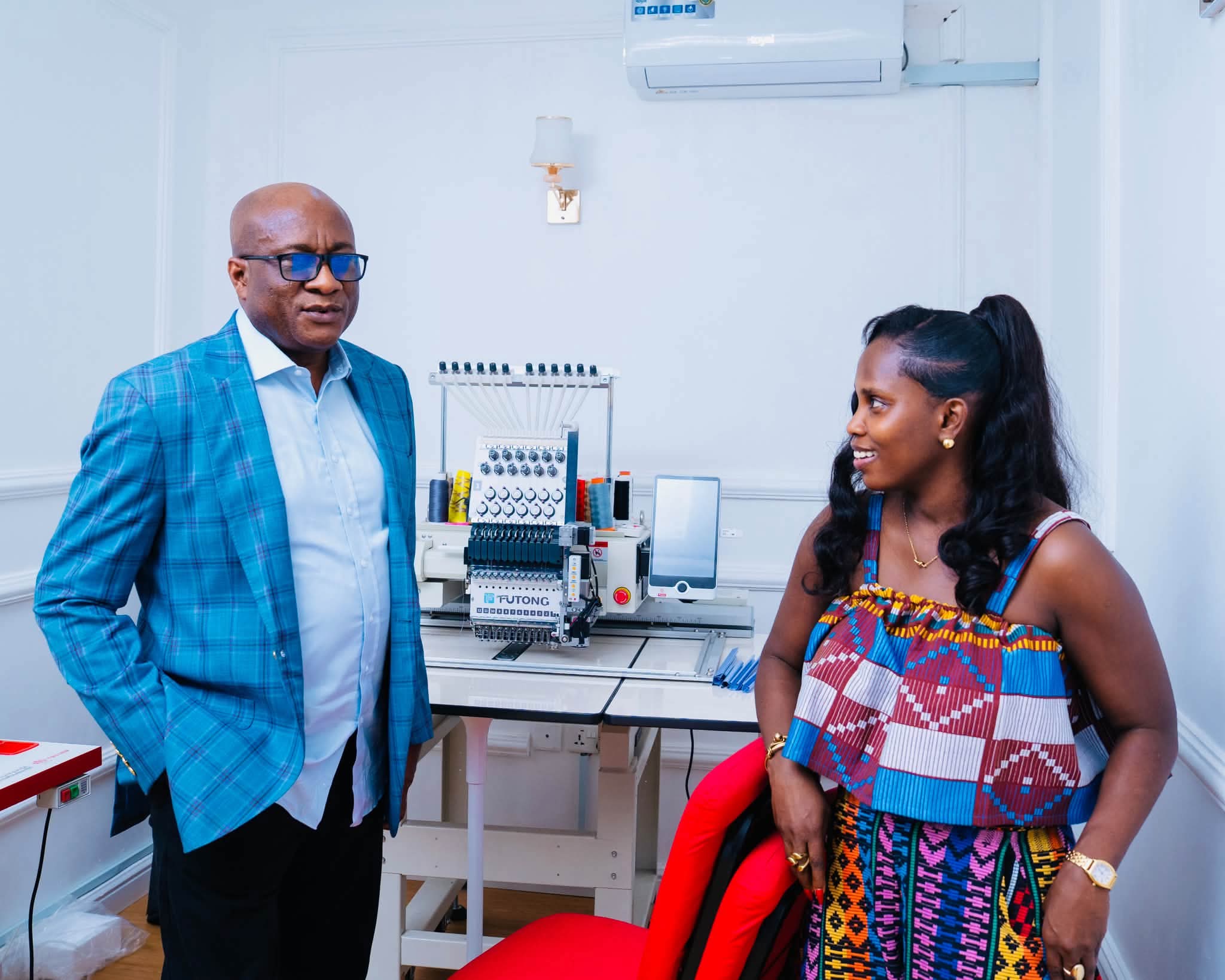
A former employee of Air Peace, who simply identified herself as Tade, has made a social media post on her recent encounter with the Chairman/CEO of the airline, Dr. Allen Onyena and praised him for his exceptional goodwill, benevolence and kind word of encouragement.
Tade who said she resined from Air Peace last year to set up a fashion outfit, after receiving blessings from Allen Onyena, quoted the airline’s CEO to have commended her for establishing her own business, said the encounter took place on Wednesday when the Air Peace boss paid a visit to her business premises
The obviously excited lady said- “It was such a beautiful moment having my boss visit my factory. And honestly, I still struggle to call him my former boss. Some people may be former bosses by designation, but the place they occupy in your life does not change simply because you no longer work in the same organisation.
“Two days ago, when he told me he wanted to come see the factory, I honestly wondered if he would be able to make it. I had seen how incredibly busy his schedule was, meetings, guests, engagements, one thing after another, and some of those meetings stretched well into yesterday evening.
“But around 7pm, after what I can only imagine was an incredibly long and stressful day, he still came.
“And he didn’t just come in, take a quick look around and leave. The entire house came alive.
“We received him warmly, and his presence brought such a beautiful energy into the building. He took time to speak with the staff, interacted with my friend, Mr. Jire, and his wife about their business, and then came into my office and sat with me.
“And for a while, it was just my boss being my boss.
“We talked about entrepreneurship, people management, business management, governance, leadership, and the challenges that come with growing a business, including some of the challenges I cannot even see yet. He reminded me, in his own way, that growth does not mean the challenges stop. They simply change.
“And then came that moment:
“You are now an employer of labour yourself, Tadé.”
She continued – “I don’t think he knows what those words meant to me. October will make it a year since I resigned from Air Peace and left with his blessing.
“And here I was yesterday, almost a year later, standing in my own factory, surrounded by people who now work for the fashion company I am building, while the man I once reported to was standing there looking at what has grown from that decision.
“There was something deeply emotional about it. Because when I met this man in 2023, I could not have known all that the years ahead would hold.
“Meeting you, sir, and working with you was never a coincidence. It was a necessary chapter in my life. A needed season. A significant part of the journey that brought me here. And I will always cherish it.
“Thank you, sir, for your leadership. Thank you for the opportunities, the lessons, the corrections, the wisdom, and most especially, for your consistent belief in me.
“Thank you for showing up. And thank you for coming to see what that little girl who once worked with you is building today. It meant more to me than I can properly put into words.
“And on behalf of the entire TADÉ house, thank you for the generous gift. We are deeply grateful.
“Some moments are bigger than the moment itself. Yesterday was one of them.,” she concluded.
All pictures were taken in the moment
-

 News2 years ago
Senate to speed up conclusion of Nigeria Forest Security Service Bill
-
 News1 year ago
The Many Lies Against Bashir Haske
-

 News3 years ago
Breaking: Tinubu’s authentic ministerial nominees
-
 News3 years ago
“Anytime we want to kill terrorists, President would ask us to take permission from France but they were killing our soldiers-” Niger Republic coup leader
-
 News3 years ago
“I’m leaving the Catholic church because Bishop Onah is oppressing me,” says Okunerere
-

 News3 years ago
My nude photo leak was a mistake- lawyer Ifunanya
-
 News4 months ago
See your state governor’s performance ranking
-

 News3 years ago
Radio Nigeria’s veteran broadcaster Kelvin Ugwu dies three months after retirement from service