
News
UNDP, GJF collaboration and promise of rethinking governance, building trust in the Sahel

By Wealth Ominabo Dickson
The quest for solutions to the daunting challenges in the Sahel is poised to receive a significant boost. In a region long plagued by political instability, insecurity, and economic hardship, the Sahel Governance Forum has emerged as a vital platform for reshaping the narrative. The inaugural edition of this landmark initiative, being hosted by The Gambia on July 30-31, 2025, in collaboration with the Goodluck Jonathan Foundation (GJF), the United Nations Office for West Africa and the Sahel (UNOWAS), the Office of the Special Coordinator for Development in the Sahel (OSCDS), and the United Nations Development Programme (UNDP), signals a pivotal moment for governance in the Sahel region. It will not just be a meeting of minds, it is billed to be a strategic intervention in the fragile democratic fabric of the subregion.
The Sahel is no doubt at a crossroads. From Mali to Burkina Faso and from Chad to Niger, democratic institutions are under severe strain. Military coups, insurgent violence, disinformation campaigns, and the marginalization of youth and women have combined to undermine peace and good governance. In this context, the Forum was convened not merely as a conference but as an incubator for resilience, a platform where leaders, civil society, and international partners could collectively chart a path forward.
Crucially, the Forum has come to serve as a convener of dialogue at a time when dialogue is under constraint. With rising authoritarian tendencies and waning trust in electoral processes, forums such as this become sanctuaries for democratic discourse. The Sahel Governance Forum, therefore, is more than an event, it is a defiant stand for inclusive governance, institutional strengthening, and sustainable peace.
This is knowing that at the heart of the governance conundrum in the Sahel lies a deeper legitimacy crisis. When citizens lose faith in the state’s ability, or willingness to deliver justice, security, and opportunity, governance becomes fragile, and the potential for unrest multiplies. This is why the Forum’s focus on social cohesion and trust is not only timely but essential.
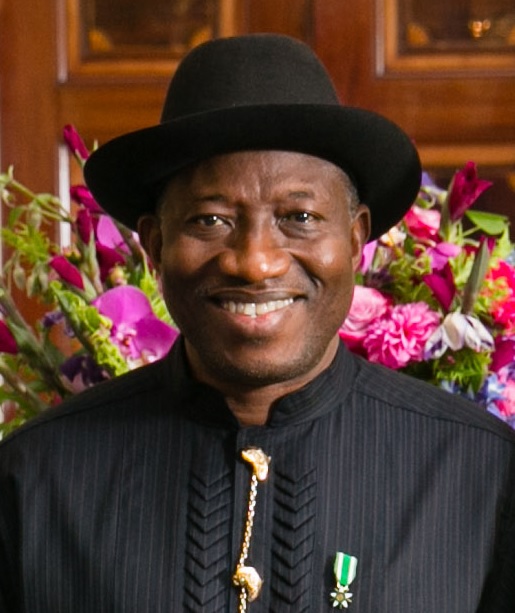
The conference is being availed further weight by the enduring legacy of Dr. Goodluck Ebele Jonathan, former President of Nigeria and a globally recognized champion of peace and democracy. Through the Goodluck Jonathan Foundation, he has consistently advanced the ideals of democracy, reconciliation, and good governance, particularly in conflict-prone societies. His presence and active leadership at the Forum underscores his deep commitment to these values.
Dr. Jonathan’s post-presidency has become a case study in transformative leadership. Rather than retreat into quiet retirement, he has thrown his weight behind peace mediation efforts, electoral integrity missions, and democratic reforms across Africa. His role in helping to peacefully resolve political crises in The Gambia (2016-2017), Mali, and elsewhere, attests to his diplomatic clout and unwavering belief in democracy as a tool for development.
The Foundation he leads has become a respected pan-African institution, convening stakeholders, producing research, and advocating for policies that deepen democratic practice, especially in leading mediation missions during elections in order to prevent election related crises in the nations of the subregion. Through its work, GJF has built a bridge between theory and practice, between policymakers and the people, and between conflict and consensus.
What makes the Sahel Governance Forum especially significant is its collaborative DNA. The GJF, in joining forces with the UNDP, UNOWAS, OSCDS, underscores the necessity of multilateral approaches to the region’s complex governance challenges. Each partner brings to the table a wealth of experience, institutional capacity, and local knowledge. UNOWAS offers political insight and regional strategy. OSCDS brings in development-oriented perspectives crucial to tackling root causes of fragility. The UNDP contributed its global development lens, with special attention to inclusive governance and capacity building.
The GJF which hosts the West African Elders Forum (WAEF) brings to bear on the process, the wealth of experience and wisdom of the subregion’s former Presidents and statesmen who populate the body as members.
Together, these institutions forged a coalition of intent; intent on restoring citizen trust, empowering local governance structures, and promoting peaceful political transitions.
Hosting the inaugural Forum in The Gambia is a symbolic masterstroke. Once under autocratic rule, The Gambia has emerged in recent years as a hopeful example of democratic renewal. Its peaceful transition of power in 2017, in which Dr. Jonathan played a mediating role, highlighted the power of dialogue over violence. By returning to Banjul to host this Forum, the region was reminded of what is possible when democracy is protected and nurtured.
President Adama Barrow’s administration, in hosting the Forum, affirms its commitment to regional leadership on governance.
The success of the Sahel Governance Forum must not be measured solely by the speeches delivered or communiqués released. Its real legacy will lie in how effectively its recommendations are implemented, how robustly its networks are maintained, and how consistently its spirit of dialogue is kept alive. Forums come and go, but institutions and movements must endure.
This is where the Goodluck Jonathan Foundation can play a unique role. With its growing influence, it can serve as a moral compass and a strategic convener, helping to translate forum outcomes into real-world impact. Its independence and credibility position it well to act as a bridge between governments, civil society, and international partners.
The Sahel Governance Forum is a model worth replicating across Africa, a model rooted in inclusive dialogue, multilateral collaboration, and African leadership. It is a timely reminder that Africa’s governance challenges, while formidable, are not insurmountable.
Dr. Goodluck Jonathan’s vision of “democracy as a tool for peace” continues to resonate across the continent. His Foundation, through initiatives like this Forum, is helping to build the scaffolding for a more stable, democratic, and prosperous Sahel.
The work is far from over, but the journey has begun. And thanks to the Sahel Governance Forum, it is a journey that now has direction, allies, and renewed hope.
· Mr. Dickson is a media officer, Goodluck Jonathan Foundation (GJF)

Benue State Police Command has condemned the killing of the Chairman of the Miyetti Allah Cattle Breeders Association of Nigeria (MACBAN), Benue State chapter, Ardo Rabo Mohammed, and another man, Yakubu Isa, describing the attack as a senseless criminal act capable of undermining ongoing peace and security efforts in the state.
The victims were reportedly attacked by gunmen while returning from a security meeting along the Okwudu-Ogoli Road in Otukpo Local Government Area.
In a statement issued on Saturday, the Police Public Relations Officer, DSP Udeme Edet, said the Commissioner of Police, CP Cletus C.N. Nwadiogbu, condemned the killings and expressed condolences to the families of the deceased.
“The Commissioner of Police strongly condemns in its entirety the brutal killing of the Chairman of Miyetti Allah Cattle Breeders Association of Nigeria (MACBAN), Benue State chapter, Ardo Rabo Mohammed, and one Yakubu Isa, who were reportedly attacked by unknown assailants while returning from a security meeting along Okwudu-Ogoli Road, Otukpo,” the statement read.
According to the police, the command has commenced a full-scale investigation into the incident, with tactical and intelligence teams deployed to track down those responsible.
The Commissioner assured residents that the command would leave no stone unturned in ensuring the perpetrators are identified, arrested and prosecuted.
He appealed to members of the public to remain calm, avoid taking the law into their own hands, and refrain from spreading unverified information capable of escalating tensions.
The police also urged anyone with credible information that could aid the investigation to report to the nearest police station or contact the command through its emergency lines.
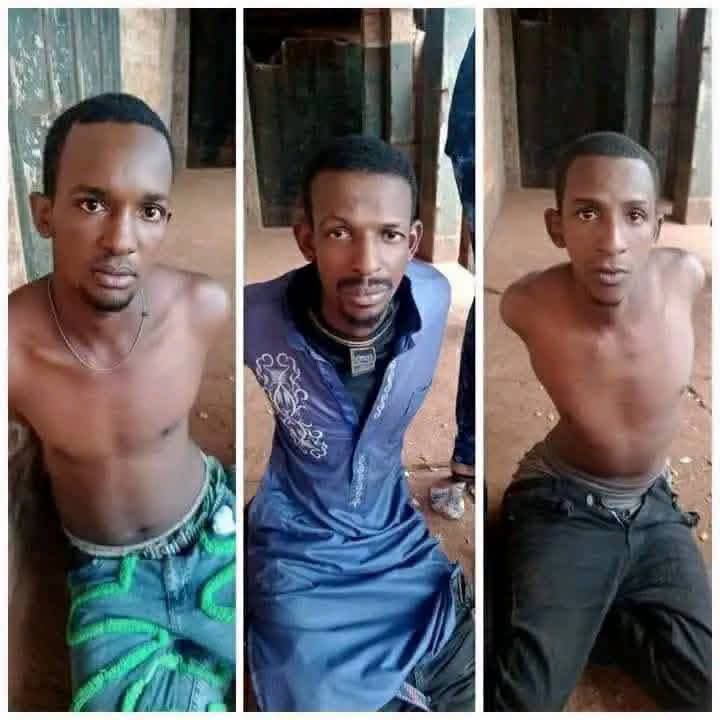
Three bandits have been arrested in Benue state after a lady who they had kidnapped and released, identified them at a motor park and raised alarm.
The k!kidnappers came to Ihotu park to board a vehicle to Makurdi and were met by the lady they had earlier kidnapped and released after collecting ransom from her relatives.
They were even using a bag they collected from the girl. The girl raised the alarm, held one inside the vehicle, and two took to their heels, but were caught.
They had a ghana-must-go bag at the back of the vehicle. N11m was found inside the bag.
Following the confirmation of their identity by another lady who was also their victim, mob gathered around with the intent to beat them up and possibly set them ablaze.
But the park manager decided to invite the police and soldiers who rescued them and took them to their station.
It was later gathered that the Benue state Governor, Rev. Father Hyacinth Alia called and said he was interested in the case which made the police to take the apprehended bandits to Makurdi, the state capital.

President Bola Tinubu Federal Government has drawn down $1.5bn from a $5bn financing facility arranged with the United Arab Emirates’ largest lender, First Abu Dhabi Bank, despite growing concerns from global financial institutions over the increasing use of complex derivative financing by African sovereigns.
Bloomberg reported on Friday that the latest drawdown represents the first tranche of a $5bn Total Return Swap facility approved by the National Assembly on March 31, 2026, and is expected to support the 2026 budget, finance infrastructure projects, and refinance existing debt obligations.
The report quoted people familiar with the transaction, who asked not to be identified because they were not authorised to speak to the media.
The report read, “Nigeria has accessed the first tranche of a $5bn derivatives deal with the United Arab Emirates’ largest lender, pressing ahead with a transaction that has been scrutinised for being opaque.
“The West African nation drew about $1.5bn in the last couple of weeks from a total return swap transaction with First Abu Dhabi Bank PJSC, according to people familiar with the transaction, who asked not to be identified because they were not authorised to speak to the media.”
The transaction comes at a time when Nigeria is facing higher borrowing costs in international capital markets, forcing the government to seek alternative financing arrangements to shore up its fiscal position and improve access to foreign exchange liquidity.
Under the arrangement, Nigeria is required to pledge Federal Government securities worth about 133 per cent of any amount drawn under the facility. This means that for the full $5bn facility, the government would have to post approximately $6.65bn worth of naira-denominated bonds as collateral.
In return, the Abu Dhabi-based lender provides dollar liquidity to the Nigerian government. The Federal Government will pay a floating interest rate benchmark plus about four percentage points, while the lender receives the returns generated by the underlying government securities.
The transaction effectively allows Nigeria to unlock immediate dollar funding without issuing new Eurobonds or taking on traditional external loans at prevailing market rates, which have become increasingly expensive for frontier economies.
The government has already indicated that the proceeds from the initial $1.5bn drawdown will be deployed to support budget implementation, fund critical infrastructure projects, and refinance costlier domestic and external debts.
However, the financing arrangement has attracted criticism from international financial institutions and market analysts over concerns about transparency and potential hidden liabilities.
In its June 2026 assessment of African sovereign debt markets, the International Monetary Fund warned that derivative financing structures such as total return swaps are often opaque and difficult for investors and creditors to monitor.
The IMF noted that such arrangements are “hard to track, hard to value in real time, and can obscure the true extent of a country’s financial obligations.”
Three days ago, Fitch Ratings warned that Nigeria’s planned $5bn financing arrangement with First Abu Dhabi Bank could increase sovereign debt risks and reduce transparency in public debt reporting.
-

 News1 year ago
Senate to speed up conclusion of Nigeria Forest Security Service Bill
-
 News11 months ago
The Many Lies Against Bashir Haske
-

 News3 years ago
Breaking: Tinubu’s authentic ministerial nominees
-
 News3 years ago
“Anytime we want to kill terrorists, President would ask us to take permission from France but they were killing our soldiers-” Niger Republic coup leader
-

 News3 years ago
“I’m leaving the Catholic church because Bishop Onah is oppressing me,” says Okunerere
-

 News3 years ago
Radio Nigeria’s veteran broadcaster Kelvin Ugwu dies three months after retirement from service
-
 News3 years ago
Dokpesi and the Gazebo Mystique
-

 News3 years ago
Tsunami: Tinubu orders dissolution of managements, boards of MDAs, to sack all Buhari’s political appointees