
News
Summary of INEC’s final submission against Obi/LP case


The Independent National Electoral Commission (INEC) in its final submission, argued that Labour Party’s presidential candidate, Peter Obi, failed to show how he scored the majority of lawful votes during the 25 February presidential election.
Mr Obi, who came third in the election, had filed his petition at the Presidential Election Petition Court in Abuja to challenge the outcome of the polls on the grounds of allegations of electoral fraud, among other alleged irregularities.
He urged the court to nullify President Bola Tinubu’s victory in the poll.
He also called on the court to either declare him the winner of the election or order a fresh poll.
Mr Obi and his party, LP, alleged that Mr Tinubu and Vice President Kashim Shettima were not qualified to vie for Nigeria’s presidency.
They alleged Mr Tinubu was convicted of drugs-related crimes and forfeited $46,000 in the US.
They also accused Mr Shettima of double nomination by their party, the All Progressives Congress (APC).
The petitioners contended at the trial of the case that Mr Tinubu was not duly elected by the majority of the lawful votes cast at the election.
Mr Obi called 13 witnesses to back his claims.
The five-member panel of the court led by Haruna Tsammani had ordered parties to the case to exchange their final addresses at the end of the trial.
In its final written address, INEC, through its lead lawyer, Abubakar Mahmoud, said Mr
Obi’s petition “lacks merits.”
Responding to allegations of Mr Shettima’s double nomination, Mr Mahmoud, a Senior Advocate of Nigeria (SAN), said the APC had, in a letter dated 6 July 2022, received on 13 July 2022 by INEC, withdrawn his candidacy for Borno Central Senatorial District to clear the way for his nomination as Mr Tinubu’s running mate.
He clarified that Mr Shettima’s voluntary withdrawal preceded his nomination as Mr Tinubu’s vice presidential pick.
Also addressing the issue of Mr Tinubu’s alleged trafficking of narcotic drugs in the US, Mr Mahmoud said, “There was no criminal charge, sentence or conviction to support the allegation of criminal conviction or forfeiture,” referencing a letter from the US government tendered during the defence.
He added that “the alleged order of forfeiture being that of a foreign court is not registered in Nigeria to be enforceable”.
The forfeiture order made by Judge John Nordberg of a United States District Court on 4 October 1993 “is in fact over 20 years since the alleged order was made,” Mr Mahmoud said, referencing Mr Tinubu’s defence in the case.
On the issue of INEC’s failure to upload polling units results of the presidential election to its Result View Portal in real-time on 25 February, Mr Mahmoud said that electoral officers “could not transmit” the image of the results to the IReV portal “due to the technical glitch that occurred on the e-transmission application hosted by Amazon Web Services…, this…technical glitch… was eventually resolved.”
INEC ‘s sole witness had, during his testimony, tendered the Amazon Cloud Trail in support of the claim that there was a technical glitch on the commission’s portal during the Presidential poll.
Mr Mahmoud said the evidence of INEC’s sole witness, Lawrence Bayode, an assistant director at the commission’s ICT department, “was uncontroverted.
Mr Bayode, during his testimony, stated that he was one of the persons who designed the INEC e-transmission system and helped resolve the technical glitch that occurred on election day.
“Petitioners neither pleaded nor demonstrated at trial any unlawful votes of the 2nd respondent (Mr Tinubu) to be discounted from the computed scores of the parties.
“… And did not present any lawful vote to be added to their own. This clearly shows…failure to lead any evidence to support same.”
25 per cent votes in FCT
On Mr Obi’s contention that Mr Tinubu ought not to be declared the winner of the election for failing to score 25 per cent of lawful votes cast in the Federal Capital Territory (FCT) in the presidential election, the commission said, “This clearly has nothing to do with lawful votes or unlawful votes”.
It noted that the issue “is clearly one of interpretation of the relevant constitutional provisions.”
Mr Mahmoud added in the INEC’s final address that Mr Obi failed to “lead credible evidence” to aid his case.
He said there was no “mandatory obligation prescribed by the Electoral Act” for INEC “to electronically transmit and collate results of the election…or to fully upload same on IReV before collation of results…”
In the court filing dated 14 July, Mr Mahmoud said, “The evidence presented by the petitioners (Mr Obi and LP) failed to make out a case that the 2nd and 3rd respondents are not qualified to contest the election.
“Section 134(2) of the constitution only requires a candidate to have scored the highest number of votes cast and at least one-quarter of the votes cast in two-thirds of all the States in the federation and the FCT as an aggregate of 37 States.
“The petition for want of evidence deserves to be dismissed and accordingly dismiss same.”

Benue State Police Command has condemned the killing of the Chairman of the Miyetti Allah Cattle Breeders Association of Nigeria (MACBAN), Benue State chapter, Ardo Rabo Mohammed, and another man, Yakubu Isa, describing the attack as a senseless criminal act capable of undermining ongoing peace and security efforts in the state.
The victims were reportedly attacked by gunmen while returning from a security meeting along the Okwudu-Ogoli Road in Otukpo Local Government Area.
In a statement issued on Saturday, the Police Public Relations Officer, DSP Udeme Edet, said the Commissioner of Police, CP Cletus C.N. Nwadiogbu, condemned the killings and expressed condolences to the families of the deceased.
“The Commissioner of Police strongly condemns in its entirety the brutal killing of the Chairman of Miyetti Allah Cattle Breeders Association of Nigeria (MACBAN), Benue State chapter, Ardo Rabo Mohammed, and one Yakubu Isa, who were reportedly attacked by unknown assailants while returning from a security meeting along Okwudu-Ogoli Road, Otukpo,” the statement read.
According to the police, the command has commenced a full-scale investigation into the incident, with tactical and intelligence teams deployed to track down those responsible.
The Commissioner assured residents that the command would leave no stone unturned in ensuring the perpetrators are identified, arrested and prosecuted.
He appealed to members of the public to remain calm, avoid taking the law into their own hands, and refrain from spreading unverified information capable of escalating tensions.
The police also urged anyone with credible information that could aid the investigation to report to the nearest police station or contact the command through its emergency lines.
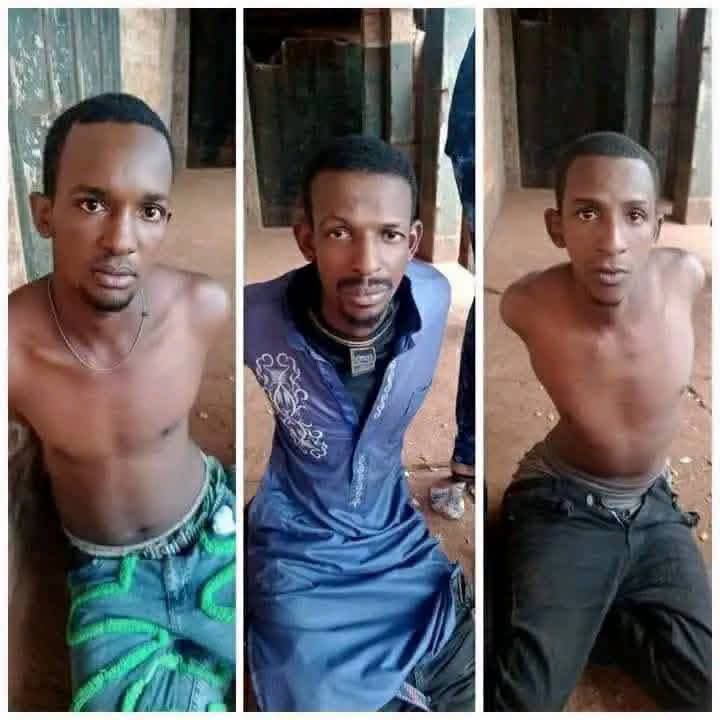
Three bandits have been arrested in Benue state after a lady who they had kidnapped and released, identified them at a motor park and raised alarm.
The k!kidnappers came to Ihotu park to board a vehicle to Makurdi and were met by the lady they had earlier kidnapped and released after collecting ransom from her relatives.
They were even using a bag they collected from the girl. The girl raised the alarm, held one inside the vehicle, and two took to their heels, but were caught.
They had a ghana-must-go bag at the back of the vehicle. N11m was found inside the bag.
Following the confirmation of their identity by another lady who was also their victim, mob gathered around with the intent to beat them up and possibly set them ablaze.
But the park manager decided to invite the police and soldiers who rescued them and took them to their station.
It was later gathered that the Benue state Governor, Rev. Father Hyacinth Alia called and said he was interested in the case which made the police to take the apprehended bandits to Makurdi, the state capital.

President Bola Tinubu Federal Government has drawn down $1.5bn from a $5bn financing facility arranged with the United Arab Emirates’ largest lender, First Abu Dhabi Bank, despite growing concerns from global financial institutions over the increasing use of complex derivative financing by African sovereigns.
Bloomberg reported on Friday that the latest drawdown represents the first tranche of a $5bn Total Return Swap facility approved by the National Assembly on March 31, 2026, and is expected to support the 2026 budget, finance infrastructure projects, and refinance existing debt obligations.
The report quoted people familiar with the transaction, who asked not to be identified because they were not authorised to speak to the media.
The report read, “Nigeria has accessed the first tranche of a $5bn derivatives deal with the United Arab Emirates’ largest lender, pressing ahead with a transaction that has been scrutinised for being opaque.
“The West African nation drew about $1.5bn in the last couple of weeks from a total return swap transaction with First Abu Dhabi Bank PJSC, according to people familiar with the transaction, who asked not to be identified because they were not authorised to speak to the media.”
The transaction comes at a time when Nigeria is facing higher borrowing costs in international capital markets, forcing the government to seek alternative financing arrangements to shore up its fiscal position and improve access to foreign exchange liquidity.
Under the arrangement, Nigeria is required to pledge Federal Government securities worth about 133 per cent of any amount drawn under the facility. This means that for the full $5bn facility, the government would have to post approximately $6.65bn worth of naira-denominated bonds as collateral.
In return, the Abu Dhabi-based lender provides dollar liquidity to the Nigerian government. The Federal Government will pay a floating interest rate benchmark plus about four percentage points, while the lender receives the returns generated by the underlying government securities.
The transaction effectively allows Nigeria to unlock immediate dollar funding without issuing new Eurobonds or taking on traditional external loans at prevailing market rates, which have become increasingly expensive for frontier economies.
The government has already indicated that the proceeds from the initial $1.5bn drawdown will be deployed to support budget implementation, fund critical infrastructure projects, and refinance costlier domestic and external debts.
However, the financing arrangement has attracted criticism from international financial institutions and market analysts over concerns about transparency and potential hidden liabilities.
In its June 2026 assessment of African sovereign debt markets, the International Monetary Fund warned that derivative financing structures such as total return swaps are often opaque and difficult for investors and creditors to monitor.
The IMF noted that such arrangements are “hard to track, hard to value in real time, and can obscure the true extent of a country’s financial obligations.”
Three days ago, Fitch Ratings warned that Nigeria’s planned $5bn financing arrangement with First Abu Dhabi Bank could increase sovereign debt risks and reduce transparency in public debt reporting.
-

 News1 year ago
Senate to speed up conclusion of Nigeria Forest Security Service Bill
-
 News11 months ago
The Many Lies Against Bashir Haske
-

 News3 years ago
Breaking: Tinubu’s authentic ministerial nominees
-
 News3 years ago
“Anytime we want to kill terrorists, President would ask us to take permission from France but they were killing our soldiers-” Niger Republic coup leader
-
 News3 years ago
“I’m leaving the Catholic church because Bishop Onah is oppressing me,” says Okunerere
-

 News3 years ago
Radio Nigeria’s veteran broadcaster Kelvin Ugwu dies three months after retirement from service
-
 News3 years ago
Dokpesi and the Gazebo Mystique
-

 News3 years ago
Tsunami: Tinubu orders dissolution of managements, boards of MDAs, to sack all Buhari’s political appointees