News
Soludo’s timely advice and the vision for South East


By Christian ABURIME
Whenever and wherever the Igbo people are mentioned, the first thing that comes to mind is their unique enterprising acumen.
By nature, it is that sheer ethnic gravitas that makes them a peculiar people who can thrive anywhere, and can draw water of success out of the rock of opportunities.
One is not in the least surprised that the Igbo are sometimes compared to the Jews for their similar traits of ubiquity, resourcefulness and resilience.
Indeed, as every race, every nationality, every people have their exceptional innate quality which holds the seeds of their greatness, so do the Igbo. In spite of their historical drawbacks from a civil war and extant challenges of today, the greatness that marks Ndigbo out cannot be dimmed or erased.
Remarkable as ever, these enterprising souls with their undaunted spark of ingenuity are like seeds carried by the wind, taking roots in foreign lands and blooming, not as mere guests, but as architects of prosperity.
That is why, in every terrain and corner of Nigeria, the Igbo can be found thriving. And in every continent across the globe, from the vibrant commercial districts of Accra to the glittering business hearts of Dubai, from the bustling streets of New York City to the tranquil markets of Bangkok, from the dynamic business environment of London to the pulsating economic hub of São Paulo, one could find the fingerprints of Igbo presence and enterprise.
Their businesses are like beacons, illuminating the path to success for many, and their impact resonate far and wide. The Igbo indomitable spirit is reflected in the revered Igbo tradition of breaking kolanut. Being a symbol of communion and tradition of goodwill prayers, any person praying over the kolanut before breaking it would normally say, among other things,: “May the river not dry up and may the fish not lack water to swim in.”
By this, the Igbo know the strength of co-existence and communalism, and they leverage it to create thriving communities wherever they landed. They form bonds, known as ‘Umunna’, which transcend blood ties, creating networks of support and shared knowledge. In distant lands, the Igbo also embrace diversity, being quite accommodating and learning from the cultures they encounter.
They adapt, not by forsaking their heritage, but by blending it harmoniously with the wisdom of their environments. As centuries, decades and years pass, Igbo businesses often become enduring bastions of success, prosperity and legacy, creating wealth, contributing to their local economies and fostering cross-cultural understanding.
They also acquire, build and own real estate everywhere they are. And through hard work and relentless dedication, they dispel stereotypes and misconceptions, showcasing the true potential of Igbo enterprise and the admirable global colours of their greatness.
But amidst their renowned global success, the Igbo homeland, Alaigbo, seems to be a far cry from development. How could a people be so enterprising and adept at sowing prosperity and development in distant lands, and Alaigbo keeps begging for development?
This has been a growing concern that is now more than a nagging whisper in the hearts of most Igbo leaders and stakeholders.
The homeland is beckoning its own sons and daughters to think homeward. It is like the voice of their ancestors, reminding them of their roots, of the land that had birthed their remarkable spirit. As they say, as the kite flies, so must the eagle fly. With this awakening, Ndigbo are being enjoined to turn their gaze homeward.
It is time to envision a South East transformed, not by foreign hands, but by our own. We know that our unique abilities can shape our homeland’s destiny.
And as we return bearing the fruits of our global endeavours, uniting under a common purpose – the advancement of our beloved land – we must realise that our strength lies in our diversity, to be harmonised and leveraged to build a regional economy and infrastructure that would rival any in the world.
The foregoing informed the recent South East Summit on Economy and Security held in Owerri, Imo State, last week. The well-attended summit which had the theme “South East Beyond 2023, Time for a Reset” was facilitated by the South-East Governors Forum and supported by Ohaneze Ndigbo Worldwide.
At the summit, Anambra State Governor, Prof. Chukwuma Charles Soludo, called for the development of a 100-year plan for the development of the South East region. For someone who revealed that Anambra State government has developed a 50-year plan called the ‘Anambra vision 2070’, it is Governor Soludo’s well-considered opinion that the much needed development of Alaigbo requires a longer-term vision and plan.
He expatiated that the South East region needs a long-term plan because without a destination in mind, any road can be explored and any road may lead to an unintended destination. Declaring with characteristic optimism that a new dawn is upon the South East, the former CBN Governor affirmed that the summit is indeed a good step towards the unity of South East governors that people have been pleading for.
He expressed the unwavering commitment of the Anambra State government to the regional development agenda, stating that his government is already demonstrating its commitment by its diverse reforms in Anambra State.
Of course, other South East governors who were at the summit expressed similar opinions and commitments as Governor Soludo. They all agreed that, in spite of the challenges confronting Ndigbo within Nigeria, the South East deserves to take its place among the most developed economies in the world. All that is needed now is bringing all hands on the plough. Ndigbo all over the world should be thinking homeward in terms of investment, the state governors should be speaking with one voice, and our leaders should be fostering synergy and partnership with the rest of Nigeria, Africa and the international community to implement the development plan.
Once the right steps are being taken, it is a matter of time before the economies of Onitsha, Aba, Enugu, Abakaliki and Owerri begin to flourish as they should, not just as centres of commerce, but as symbols of a united people’s determination and prosperity.
And so, the story of the enterprising, ubiquitous, dynamic Igbo people can be trending not just in foreign lands, but also from a well-developed homeland prosperity that can stand the test of centuries.
It will be a tribute to the power of unity and enterprise that could shape destinies of generations. It will be a legacy of not just individual success, but of shared collective prosperity. As the kite flies, so must the eagle fly.

Benue State Police Command has condemned the killing of the Chairman of the Miyetti Allah Cattle Breeders Association of Nigeria (MACBAN), Benue State chapter, Ardo Rabo Mohammed, and another man, Yakubu Isa, describing the attack as a senseless criminal act capable of undermining ongoing peace and security efforts in the state.
The victims were reportedly attacked by gunmen while returning from a security meeting along the Okwudu-Ogoli Road in Otukpo Local Government Area.
In a statement issued on Saturday, the Police Public Relations Officer, DSP Udeme Edet, said the Commissioner of Police, CP Cletus C.N. Nwadiogbu, condemned the killings and expressed condolences to the families of the deceased.
“The Commissioner of Police strongly condemns in its entirety the brutal killing of the Chairman of Miyetti Allah Cattle Breeders Association of Nigeria (MACBAN), Benue State chapter, Ardo Rabo Mohammed, and one Yakubu Isa, who were reportedly attacked by unknown assailants while returning from a security meeting along Okwudu-Ogoli Road, Otukpo,” the statement read.
According to the police, the command has commenced a full-scale investigation into the incident, with tactical and intelligence teams deployed to track down those responsible.
The Commissioner assured residents that the command would leave no stone unturned in ensuring the perpetrators are identified, arrested and prosecuted.
He appealed to members of the public to remain calm, avoid taking the law into their own hands, and refrain from spreading unverified information capable of escalating tensions.
The police also urged anyone with credible information that could aid the investigation to report to the nearest police station or contact the command through its emergency lines.
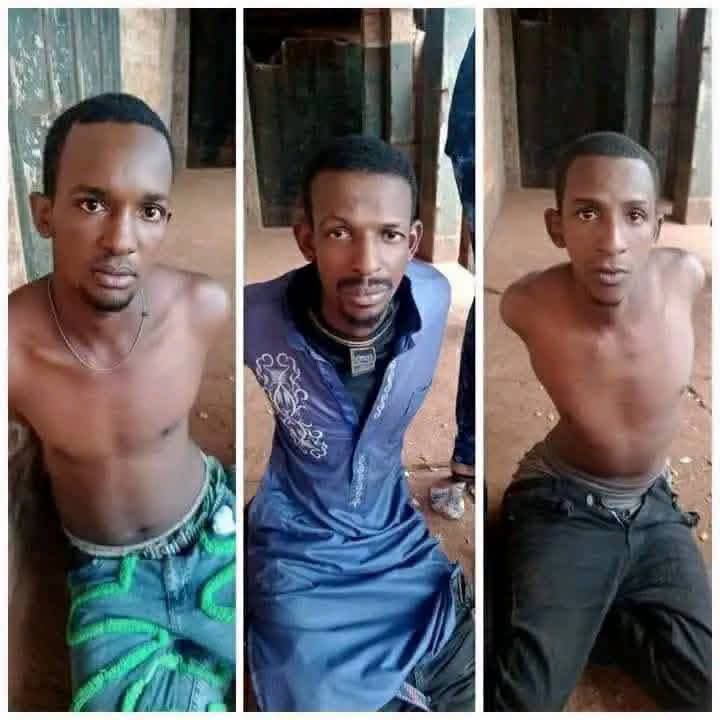
Three bandits have been arrested in Benue state after a lady who they had kidnapped and released, identified them at a motor park and raised alarm.
The k!kidnappers came to Ihotu park to board a vehicle to Makurdi and were met by the lady they had earlier kidnapped and released after collecting ransom from her relatives.
They were even using a bag they collected from the girl. The girl raised the alarm, held one inside the vehicle, and two took to their heels, but were caught.
They had a ghana-must-go bag at the back of the vehicle. N11m was found inside the bag.
Following the confirmation of their identity by another lady who was also their victim, mob gathered around with the intent to beat them up and possibly set them ablaze.
But the park manager decided to invite the police and soldiers who rescued them and took them to their station.
It was later gathered that the Benue state Governor, Rev. Father Hyacinth Alia called and said he was interested in the case which made the police to take the apprehended bandits to Makurdi, the state capital.

President Bola Tinubu Federal Government has drawn down $1.5bn from a $5bn financing facility arranged with the United Arab Emirates’ largest lender, First Abu Dhabi Bank, despite growing concerns from global financial institutions over the increasing use of complex derivative financing by African sovereigns.
Bloomberg reported on Friday that the latest drawdown represents the first tranche of a $5bn Total Return Swap facility approved by the National Assembly on March 31, 2026, and is expected to support the 2026 budget, finance infrastructure projects, and refinance existing debt obligations.
The report quoted people familiar with the transaction, who asked not to be identified because they were not authorised to speak to the media.
The report read, “Nigeria has accessed the first tranche of a $5bn derivatives deal with the United Arab Emirates’ largest lender, pressing ahead with a transaction that has been scrutinised for being opaque.
“The West African nation drew about $1.5bn in the last couple of weeks from a total return swap transaction with First Abu Dhabi Bank PJSC, according to people familiar with the transaction, who asked not to be identified because they were not authorised to speak to the media.”
The transaction comes at a time when Nigeria is facing higher borrowing costs in international capital markets, forcing the government to seek alternative financing arrangements to shore up its fiscal position and improve access to foreign exchange liquidity.
Under the arrangement, Nigeria is required to pledge Federal Government securities worth about 133 per cent of any amount drawn under the facility. This means that for the full $5bn facility, the government would have to post approximately $6.65bn worth of naira-denominated bonds as collateral.
In return, the Abu Dhabi-based lender provides dollar liquidity to the Nigerian government. The Federal Government will pay a floating interest rate benchmark plus about four percentage points, while the lender receives the returns generated by the underlying government securities.
The transaction effectively allows Nigeria to unlock immediate dollar funding without issuing new Eurobonds or taking on traditional external loans at prevailing market rates, which have become increasingly expensive for frontier economies.
The government has already indicated that the proceeds from the initial $1.5bn drawdown will be deployed to support budget implementation, fund critical infrastructure projects, and refinance costlier domestic and external debts.
However, the financing arrangement has attracted criticism from international financial institutions and market analysts over concerns about transparency and potential hidden liabilities.
In its June 2026 assessment of African sovereign debt markets, the International Monetary Fund warned that derivative financing structures such as total return swaps are often opaque and difficult for investors and creditors to monitor.
The IMF noted that such arrangements are “hard to track, hard to value in real time, and can obscure the true extent of a country’s financial obligations.”
Three days ago, Fitch Ratings warned that Nigeria’s planned $5bn financing arrangement with First Abu Dhabi Bank could increase sovereign debt risks and reduce transparency in public debt reporting.
-

 News1 year ago
Senate to speed up conclusion of Nigeria Forest Security Service Bill
-
 News11 months ago
The Many Lies Against Bashir Haske
-

 News3 years ago
Breaking: Tinubu’s authentic ministerial nominees
-
 News3 years ago
“Anytime we want to kill terrorists, President would ask us to take permission from France but they were killing our soldiers-” Niger Republic coup leader
-
 News3 years ago
“I’m leaving the Catholic church because Bishop Onah is oppressing me,” says Okunerere
-

 News3 years ago
Radio Nigeria’s veteran broadcaster Kelvin Ugwu dies three months after retirement from service
-
 News3 years ago
Dokpesi and the Gazebo Mystique
-

 News3 years ago
Tsunami: Tinubu orders dissolution of managements, boards of MDAs, to sack all Buhari’s political appointees