
News
Presidential election tribunal to rule on Tinubu’s qualification soon


Expectations are high that the Presidential Election Petition Tribunal (PEPT) may deliver its judgments on the petition filed by Peter Obi of the Labour Party and Abubakar Atiku of the Peoples Democratic Party (PDP) against Bola Tinubu of the All Progressives Congress (APC) this month.
The petitioners alleged that there were widespread irregularities and malpractices in the election, which they said affected the outcome of the vote.
After months of court sitting, the tribunal is expected to issue its judgment on Wednesday, September 6, 2023.
The Tribunal in May had merged the petitions submitted by the Allied Peoples Movement (APM), Atiku Abubakar of the Peoples Democratic Party and Peter Obi of the Labour Party.
It also reserved judgment on the petitions. While Tinubu’s lawyer prayed for a successful outcome, Atiku’s legal team admonished the tribunal to “shun executive intimidation and dispense judgment on the matter.’’
A member of the President’s legal team, Yusuf Ali, SAN, said he was hopeful of victory.
He said, “We pray for success at the end of the day. Cases are conducted in the court and not in the media, either social or mass media. The court listens to facts and applies the law.”
The Director of Publicity for the APC, Bala Ibrahim, denied that the ruling party was under any form of pressure and expressed confidence that justice would be served.
He said, “Which pressure? The ruling party has already delivered, unlike the Labour Party which is still groaning in labour. The pressure is on them. Obviously, anyone that is in labour is likely to be under pressure.’’
But a member of Atiku’s legal team, Mike Ozekhome, SAN, urged the tribunal to dispense justice on the matter.
He said Nigerians and the international community were watching them.
Ozekhome said, “Not for judgment date yet. I expect justice to be done. I expect the tribunal to shun blaring sirens of power or executive intimidation to do justice. I expect the tribunal to know that Nigerians, the international community, and indeed the whole world are watching.”
Weighing in, the PDP expressed confidence in the ability of the tribunal justices to dispense justice.
On the party’s expectations from the tribunal, the Deputy National Publicity Secretary of the PDP, Ibrahim Abdullahi, simply said “Success,” without making further comments.
But a loyalist of Atiku and Deputy National Youth Leader of the PDP, Timothy Osadolor, argued that given the weight of evidence before the tribunal, the party and the former vice president had every reason to hope that justice would prevail.
Similarly, the National Legal Adviser of the Labour Party, Kehinde Edun, submitted that the party was hopeful about the outcome of the judgment.
News
FG, NIMET, IFAD, SAPZ launch CSAPR to strengthen climate resistance, improve agric productivity
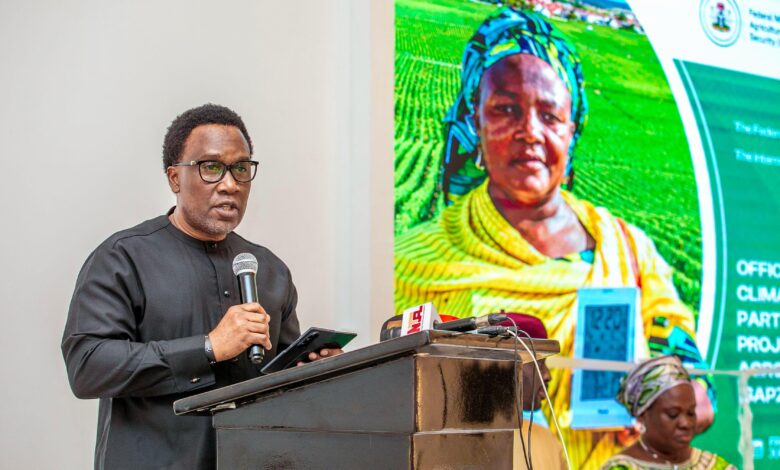
Photo caption: NiMet DG Anosike speaking at the event.
The Nigrrian government has officially launched the Climate-Smart Agribusiness Partnership for Resilience (CSAPR) Project to strengthen climate resilience, improve agricultural productivity, and promote the use of Climate Information Services (CIS) across Nigeria’s agricultural value chains.
The project was launched by the government, in collaboration with Nigerian Meteorogical Agency (NiMet), International Fund for Agricultural Development (IFAD) and the Special Agro-Industrial Processing Zones (SAPZ) Programme.

Speaking at the launch held on Friday, 24 July 2026, in Abuja, the Permanent Secretary of the Federal Ministry of Agriculture and Food Security, Dr. Marcus Olaniyi Ogunbiyi, described the project as a major milestone in Nigeria’s drive towards a more productive, inclusive, and climate-resilient agricultural sector. He said the initiative would integrate Climate Information Services into agribusiness solutions through collaboration among government institutions, development partners, financial institutions, the private sector, and farmer organizations.
Dr. Ogunbiyi acknowledged the contributions of key partners, including NiMet, IFAD, the Gates Foundation, and other stakeholders, for their commitment to climate-smart agriculture and resilient food systems. He urged all partners to sustain the spirit of collaboration to expand climate-smart agribusiness opportunities, unlock financing for farmers, and improve livelihoods.
In his remark, the Director-General/CEO of NiMet, Prof. Charles Anosike, described the project as a timely and strategic initiative that aligns with the Federal Government’s Renewed Hope Agenda. He emphasized that timely, accurate, accessible, and actionable weather, climate, and water-related information is critical to climate-smart agriculture, sustainable food systems, and building resilience across Nigeria’s agricultural value chains.
Anosike who doubles as Nigeria’s Permanent Representative at the World Meteorological Organization (WMO), described the project as a timely and strategic to farmers, agribusinesses, financial institutions, insurers, processors, logistics providers, and investors.
He added that all stakeholders require reliable climate intelligence to make informed decisions, manage risks, safeguard investments, and improve productivity. He emphasized the need to translate climate information into simple, localized, and actionable advisories while strengthening public-private partnerships to expand the delivery of climate services to farmers and agribusinesses.
He reaffirmed NiMet’s commitment to supporting the project through its Seasonal Climate Prediction, agrometeorological bulletins, impact-based forecasts, early warning advisories, and digital climate advisory platforms.
Also speaking, IFAD Country Director, Ms. Dede Ekoue, commended the Federal Ministry of Agriculture and Food Security for its leadership and acknowledged NiMet’s technical contributions to the design of the project. She noted that the CSAPR Project will strengthen financially viable public-private partnerships that integrate Climate Information Services into agricultural value chains, enabling farmers and agribusinesses to better adapt to climate variability while improving resilience, productivity, and investment.
Speaking on behalf of the National Programme Coordinator of the SAPZ Programme, Dr. Kabir Yusuf, the representative highlighted early achievements under the project, including the installation of automated weather stations in Ogun and Kano States, the commencement of climate information dissemination, and the distribution of digital devices to farmer organization leaders to facilitate timely weather advisory services.
The CSAPR Project is a Federal Government of Nigeria initiative financed by the Gates Foundation, implemented by the Federal Ministry of Agriculture and Food Security through the SAPZ Programme with support from IFAD and NiMet, and is expected to strengthen climate resilience, enhance food security, and improve the livelihoods of small holder farmers by embedding Climate Information Services into sustainable agribusiness solutions delivered through effective public-private partnerships.

Former Chief Security Officer to late Head of State, General Sani Abacha, Major Hamza Al-Mustapha, is angry with Mr. Amachree, a former DSS officer who alleged Abacha died on top of a woman
Amachree had alleged in his book released recent that the former dictator died while having sexual intercourse with a lady who was friends with the girl friend of the late head of state.
In a reaction, Al Mustapha dismissed the claims, describing the account as false.
Speaking with journalists in Kaduna, Al-Mustapha said the claims contained in the former DSS official’s book were untrue, alleging that the author was influenced by others to write them.
“The boy was asked to write the lies by others. I have all the CCTV footages of what happened in my custody, so what he said are not true,” Al-Mustapha said.
He maintained that the account presented in the publication did not reflect what transpired, insisting that he possessed evidence to contradict the assertions made about Abacha’s death.
Al-Mustapha further urged the public to disregard the claims, saying it was wrong to make what he described as false statements against someone who was no longer alive to respond.
News
Reprieve for Aisha Achimugu as court of appeal discharges EFCC of powers to freeze her accounts

The Court of Appeal in Port Harcourt, Rivers State, has delivered a major setback to the Economic and Financial Crimes Commission (EFCC) in its prolonged financial restrictions against businesswoman Aisha Achimugu.
The appellate court declared that the continued freezing of 124 bank accounts linked to Ms Achimugu was an abuse of court process and a subversion of the rule of law.
In a unanimous judgment, a three-member panel of the court discharged and vacated the ex parte order obtained by the EFCC more than 15 months earlier to freeze the accounts of Achimugu and several corporate entities associated with her.
The court also overturned the Federal High Court’s order directing the reversal of ₦1.8 billion transferred from a SunTrust Bank account to a Central Bank of Nigeria (CBN)/EFCC recovery account.
However, the appellate court’s decision did not validate the EFCC’s transfer of the money, leaving open the question of the legal basis upon which the anti-graft agency moved the funds.
The judgment was delivered by Justice Muhammad Ibrahim Sirajo, who sat with Justices Ishaq Mohammed Sani and Eleojo Enenche.
The case dates back to April 10, 2025, when the Federal High Court in Port Harcourt, presided over by Justice Turaki Adamu, granted an ex parte application by the EFCC to freeze 124 bank accounts allegedly linked to Achimugu, a businesswoman and founder of Oceangate Engineering Oil & Gas Ltd.
The order directed the affected banks to restrict outward transactions from the accounts.
But the freezing order soon became the subject of another legal battle after Achimugu challenged its continued enforcement. She alleged, among other things, that the EFCC had directed SunTrust Bank, through a letter dated April 24, 2025, to transfer funds from one of the frozen accounts into a CBN/EFCC recovery account even though the freezing order was still in force.
The controversy escalated when the Federal High Court, on August 27, 2025, ordered the reversal of ₦1.8 billion transferred from account number 0001313173 domiciled with SunTrust Bank. Justice Adamu held the transfer to be illegal and directed that the money be returned.
The EFCC challenged that decision at the Court of Appeal.
The appellate court agreed with the EFCC on one crucial point but, in doing so, exposed what it considered a fundamental evidentiary problem in the lower court’s handling of the accounts.
The court found that the accounts expressly captured by the April 10, 2025 freezing order included current accounts belonging to Drive.FGC.Net and Felak Concepts Ltd.
According to the judgment, Drive.FGC.Net’s current account carried a balance of ₦50,518,009.57, while Felak Concepts Ltd’s account had ₦16,220,608.37. But the ₦1.8 billion that became the centre of the dispute was held in a fixed deposit account, while another ₦7.79 billion was linked to internal ledger account numbers 2010155010 and 2010155011.
The appellate court questioned the lower court’s treatment of the accounts as identical.
It pointedly observed that the trial court had failed to explain how an account holding about ₦50 million could at the same time have yielded ₦1.8 billion for transfer.
The implication was decisive: the account containing the ₦1.8 billion was not among those expressly covered by the original freezing order.
The Court of Appeal therefore set aside the order directing the reversal of the ₦1.8 billion. But it carefully stopped short of giving the EFCC a clean bill of health.
The appellate court expressly stated that its decision did not amount to a declaration that the EFCC’s decision to transfer the money was lawful.
That distinction could prove significant in any subsequent legal proceedings over the disputed funds.
While the EFCC succeeded on the question of the ₦1.8 billion, it suffered a more consequential defeat over the continued freezing of the 124 accounts.
The anti-graft agency had argued that the Federal High Court acted improperly by delivering its ruling during the annual vacation and that it had been denied fair hearing. The Court of Appeal rejected both arguments.
Justice Sirajo held that delivering a reserved judgment during the court’s annual vacation did not amount to the conduct of general legal business and did not occasion a miscarriage of justice.
On fair hearing, the court noted that both sides had filed further affidavits and counter-affidavits on the disputed transfer. The court concluded that the parties had been adequately heard.
But the appellate court drew a firm constitutional and procedural line over the continued use of the ex parte order.
It held that such an order is intended to be temporary, principally to preserve disputed funds pending the hearing and determination of the substantive application.
Allowing the freezing order to remain in force for more than 15 months, the court held, amounted to an abuse of court process and a subversion of the rule of law.
The appellate court consequently discharged and vacated in its entirety the April 10, 2025 ex parte order freezing and restricting the accounts of Achimugu and the corporate entities associated with her.
The ruling effectively ends the interim restrictions that had kept the accounts frozen for more than a year.
The judgment also exposes a deeper procedural issue in the use of ex parte financial restrictions: an order intended as a short-term preservation mechanism cannot, in the court’s view, be allowed to morph into an open-ended restraint without the substantive case being properly determined.
-

 News1 year ago
Senate to speed up conclusion of Nigeria Forest Security Service Bill
-

 News12 months ago
The Many Lies Against Bashir Haske
-

 News3 years ago
Breaking: Tinubu’s authentic ministerial nominees
-

 News3 years ago
“Anytime we want to kill terrorists, President would ask us to take permission from France but they were killing our soldiers-” Niger Republic coup leader
-

 News3 years ago
“I’m leaving the Catholic church because Bishop Onah is oppressing me,” says Okunerere
-

 News3 years ago
Radio Nigeria’s veteran broadcaster Kelvin Ugwu dies three months after retirement from service
-

 News3 years ago
My nude photo leak was a mistake- lawyer Ifunanya
-
 News3 years ago
Dokpesi and the Gazebo Mystique