
News
If All Governors Were Nyesom Wike


By Bonaventure Phillips Melah
Since the founding of the present, united nation called Nigeria through amalgamation, down to independence up to today, the country has been plagued by lack of quality leadership as those entrusted with power by the people have ended up as huge disappointments, leaving the people with only the taste of ash in their mouths.
From the military to civilian administration, many leaders have been colossal failures and disappointments with most politicians making empty promises during elections and supervising the citizens eating the bread of sorrow after their inauguration. This is the major reason why roads in the country are impassable death traps, hospitals are mortuaries, and electricity suffers epilepsy, keeping the people hungry in the midst of abundance.
In spite of this ugly reality, there are a few leaders in Nigeria at the local, state and federal levels who have made positive deviations and distinguished themselves by using state resources to positively impact the lives of the people, providing basic needs, infrastructure and human capital development.
Of these few ‘beautiful ones,’ Barrister Nyesom Wike, the current Minister for the Federal Capital Territory (FCT) stands out.
After serving as Chairman of Obiakpor Local Government Council in River state, Wike was Chief of Staff to the state governor for eight years and was in Abuja as Minister of State, Education before becoming River State Governor.
In the eight years he served as the Chief Executive Officer of the State, Wike transformed Rivers, providing state of the art infrastructure, bridges, solid roads, some of the best schools in Nigeria’s history, building hospitals and equipping them with needed laboratory and other equipments, building shopping malls, among others while raising workers pay and paying them at when due.
According to Wike, one of the strategies he deployed to achieve success as Governors was to discard bureaucratic and administrative bottlenecks that have held the nation at the jugular at the federal level and many states in the country.
In order words, Wike said his administration decided to adjust the State’s procurement law, adding that it helped his government to conceptualise, initiate and complete projects on record time.
For example Wike said that the Nabo Graham Douglas Campus of the Nigerian Law School which was constructed by his administration within eight months would have ordinarily been completed between four to five years if the country’s existing procurement life cycle was followed.
He said- “The procurement life cycle here in Nigeria is very long. If you follow the procurement life cycle religiously before you give birth to a project and commence construction, it will take like three, four, or five months.
“If you follow Procurement Act 2000, which recommends for about 15 per cent mobilisation fees, and then you budget 15 percent in your yearly budget, just like the federal government budget is being done.
“If you take it to the National Assembly they will put 15 per cent of the cost of the project in the budget. When you put 15 per cent of the cost of the project in the budget, what are we saying? We are saying that this project should be completed in six years or more.
“When you look at your contract completion period, if your contract completion period of the project is one year and you budget fully for that project in that particular year, then you are sure of completing that project in that particular year.”
The governor advised every Bureau of Public Procurement in the country to have a functional price intelligence unit.
With such ingenuity, Wike was able to launch several ambitious infrastructure projects like constructing a whooping thirteen flyover bridges, expansion and reconstruction of hundreds of roads and bridges as well as creating innovative public transportation systems.
Governor Wike gave right of first of refusal to education and worked tirelessly to improve the state’s education system. He increased funding for all the tertiary institutions in the states, introduced innovative programmes, and implemented policies that ensured every child in the go to school. He championed healthcare initiatives that aimed to provide better access to affordable and quality healthcare for Rivers people and invested in healthcare infrastructure by building new hospitals, employed hundreds of doctors, nurses and other healthcare workers who were all provided with working tools and residential quarters.
On environment, Wike implemented policies to reduce carbon emissions, promote renewable energy sources and conserve natural resources while he multinational oil companies to pay needed taxes and compensate host communities.
He implemented measures to reduce wasteful spending, streamline government operations, and improve financial accountability while his prudent fiscal management ensured that taxpayers’ monies were utilized efficiently and effectively
Before he left office, Wike constructed 1000km of roads in eight years and while responding to questions from reporters, revealed how he was able to make such unprecedented achievement.
He said that by adopting a realistic procurement law and budgetary system, his administration was able to do whatever it considered best for Rivers people.
Other major feats his administration achieved in the construction sub-sector include construction of drainages of over 493 Km, flyovers and overpasses of over 11km which was done in four years; several rivers crossing bridges of three kilometers of 300 and 400 metres long.
There is no space here to put down the numerous projects, human development policies and programmes, including empowerment of women, young people and people with disabilities.
During his days as state governor, Wike ensured that in every given year, over 70 percent of the State budget was dedicated to capital expenditure and 30 or less to recurrent expenditure. This is a positive deviation from what obtains in many other states where annual budgets are spent mainly on consumption, leaving little or nothing to infrastructure and other developmental projects.
The aim of this article is to highlight the fact that if all the governors of the 36 states that have served Nigeria in the past have achieved what Wike has done in River State for eight year, Nigeria would have by now be shoulder to shoulder with the Asian Tigers.
It is therefore a call on leaders at all levels to rise up and contribute to national development by replicating or attempt to replicate what Wike did in Rivers State, through the deployment of resources accruing or allocated to them to impact meaningfully on the lives of the people within their geographical areas or jurisdiction. That way, Nigeria would sooner than later, become the nation of or dream.
Footnote: It is a waste of time threatening Wike on the basis primordial sentiments. Truth is that this FCT Minister is not your everyday kind of leader. You can take it to the bank that Wike would not backtrack from his noble vision and mission once he is convinced he is working for the good of the people. Forgerrit.
This article is featured the Book THE BEAUTIES OF NIGERIA written by Bonaventure Melah which is billed for Public Presentation on November 28, 2023 at the National Press Centre, Abuja.
Bonaventure Phillips Melah, an Abuja based journalist and author, is the Publisher of Nationwide Reports. Bonamelah123@gmail.com 08036062975

Benue State Police Command has condemned the killing of the Chairman of the Miyetti Allah Cattle Breeders Association of Nigeria (MACBAN), Benue State chapter, Ardo Rabo Mohammed, and another man, Yakubu Isa, describing the attack as a senseless criminal act capable of undermining ongoing peace and security efforts in the state.
The victims were reportedly attacked by gunmen while returning from a security meeting along the Okwudu-Ogoli Road in Otukpo Local Government Area.
In a statement issued on Saturday, the Police Public Relations Officer, DSP Udeme Edet, said the Commissioner of Police, CP Cletus C.N. Nwadiogbu, condemned the killings and expressed condolences to the families of the deceased.
“The Commissioner of Police strongly condemns in its entirety the brutal killing of the Chairman of Miyetti Allah Cattle Breeders Association of Nigeria (MACBAN), Benue State chapter, Ardo Rabo Mohammed, and one Yakubu Isa, who were reportedly attacked by unknown assailants while returning from a security meeting along Okwudu-Ogoli Road, Otukpo,” the statement read.
According to the police, the command has commenced a full-scale investigation into the incident, with tactical and intelligence teams deployed to track down those responsible.
The Commissioner assured residents that the command would leave no stone unturned in ensuring the perpetrators are identified, arrested and prosecuted.
He appealed to members of the public to remain calm, avoid taking the law into their own hands, and refrain from spreading unverified information capable of escalating tensions.
The police also urged anyone with credible information that could aid the investigation to report to the nearest police station or contact the command through its emergency lines.
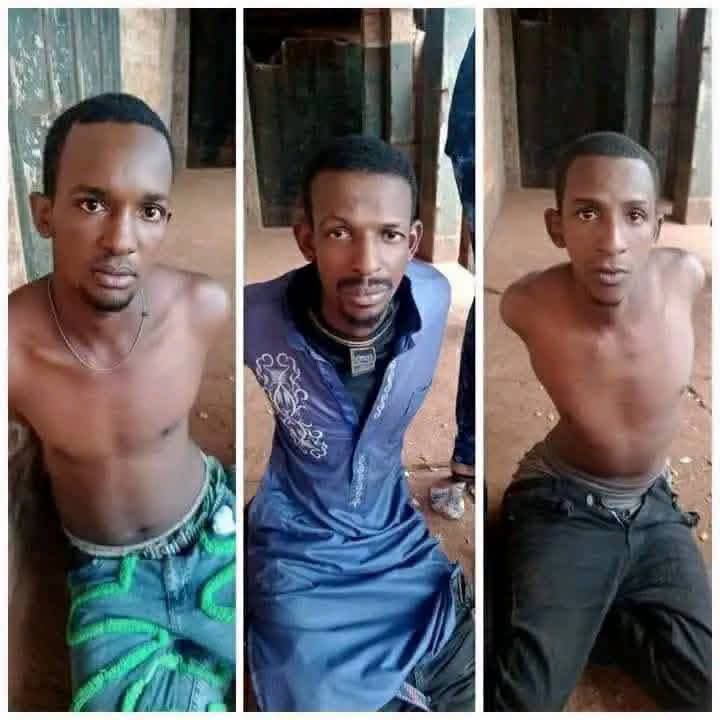
Three bandits have been arrested in Benue state after a lady who they had kidnapped and released, identified them at a motor park and raised alarm.
The k!kidnappers came to Ihotu park to board a vehicle to Makurdi and were met by the lady they had earlier kidnapped and released after collecting ransom from her relatives.
They were even using a bag they collected from the girl. The girl raised the alarm, held one inside the vehicle, and two took to their heels, but were caught.
They had a ghana-must-go bag at the back of the vehicle. N11m was found inside the bag.
Following the confirmation of their identity by another lady who was also their victim, mob gathered around with the intent to beat them up and possibly set them ablaze.
But the park manager decided to invite the police and soldiers who rescued them and took them to their station.
It was later gathered that the Benue state Governor, Rev. Father Hyacinth Alia called and said he was interested in the case which made the police to take the apprehended bandits to Makurdi, the state capital.

President Bola Tinubu Federal Government has drawn down $1.5bn from a $5bn financing facility arranged with the United Arab Emirates’ largest lender, First Abu Dhabi Bank, despite growing concerns from global financial institutions over the increasing use of complex derivative financing by African sovereigns.
Bloomberg reported on Friday that the latest drawdown represents the first tranche of a $5bn Total Return Swap facility approved by the National Assembly on March 31, 2026, and is expected to support the 2026 budget, finance infrastructure projects, and refinance existing debt obligations.
The report quoted people familiar with the transaction, who asked not to be identified because they were not authorised to speak to the media.
The report read, “Nigeria has accessed the first tranche of a $5bn derivatives deal with the United Arab Emirates’ largest lender, pressing ahead with a transaction that has been scrutinised for being opaque.
“The West African nation drew about $1.5bn in the last couple of weeks from a total return swap transaction with First Abu Dhabi Bank PJSC, according to people familiar with the transaction, who asked not to be identified because they were not authorised to speak to the media.”
The transaction comes at a time when Nigeria is facing higher borrowing costs in international capital markets, forcing the government to seek alternative financing arrangements to shore up its fiscal position and improve access to foreign exchange liquidity.
Under the arrangement, Nigeria is required to pledge Federal Government securities worth about 133 per cent of any amount drawn under the facility. This means that for the full $5bn facility, the government would have to post approximately $6.65bn worth of naira-denominated bonds as collateral.
In return, the Abu Dhabi-based lender provides dollar liquidity to the Nigerian government. The Federal Government will pay a floating interest rate benchmark plus about four percentage points, while the lender receives the returns generated by the underlying government securities.
The transaction effectively allows Nigeria to unlock immediate dollar funding without issuing new Eurobonds or taking on traditional external loans at prevailing market rates, which have become increasingly expensive for frontier economies.
The government has already indicated that the proceeds from the initial $1.5bn drawdown will be deployed to support budget implementation, fund critical infrastructure projects, and refinance costlier domestic and external debts.
However, the financing arrangement has attracted criticism from international financial institutions and market analysts over concerns about transparency and potential hidden liabilities.
In its June 2026 assessment of African sovereign debt markets, the International Monetary Fund warned that derivative financing structures such as total return swaps are often opaque and difficult for investors and creditors to monitor.
The IMF noted that such arrangements are “hard to track, hard to value in real time, and can obscure the true extent of a country’s financial obligations.”
Three days ago, Fitch Ratings warned that Nigeria’s planned $5bn financing arrangement with First Abu Dhabi Bank could increase sovereign debt risks and reduce transparency in public debt reporting.
-

 News1 year ago
Senate to speed up conclusion of Nigeria Forest Security Service Bill
-
 News11 months ago
The Many Lies Against Bashir Haske
-

 News3 years ago
Breaking: Tinubu’s authentic ministerial nominees
-
 News3 years ago
“Anytime we want to kill terrorists, President would ask us to take permission from France but they were killing our soldiers-” Niger Republic coup leader
-
 News3 years ago
“I’m leaving the Catholic church because Bishop Onah is oppressing me,” says Okunerere
-

 News3 years ago
Radio Nigeria’s veteran broadcaster Kelvin Ugwu dies three months after retirement from service
-
 News3 years ago
Dokpesi and the Gazebo Mystique
-

 News3 years ago
Tsunami: Tinubu orders dissolution of managements, boards of MDAs, to sack all Buhari’s political appointees