
News
El-Rufai’s betrayal and Akpabio’s buffoonery


By Farooq Kperogi
Former Kaduna State governor Nasir El-Rufai’s rumored withdrawal from consideration as a minister in President Bola Ahmed Tinubu’s government because high-tensile inter-elite intrigues torpedoed his senate confirmation and caused the president to sour on him is the bluntest, crudest, most double-dyed political treachery I’ve seen in a long time.
Sure, El-Rufai is a detestable, self-important, unfeeling, overweening, and divisive political villain whom I once called the most dangerous Nigerian politician alive, but he is more central to Tinubu’s emergence as president than the people on whose behalf Tinubu has thrown him under the bus.
El-Rufai left everything aside to galvanize support for Tinubu among northern governors, which was crucial to Tinubu’s win in APC’s primary election. He stood up to Muhammadu Buhari’s cabal on Tinubu’s behalf at a time when few people within the circles of power were willing to stick out their necks for a presidential wannabe.
When the Central Bank of Nigeria rolled out its damagingly bird-brained naira recolouring policy to stymie Tinubu’s chances at the polls, El-Rufai launched an all-out, scorched-earth, no-holds-barred rhetorical blitzkrieg against the CBN and honchos of the Buhari regime. Tinubu got tremendous sympathy and persuasive mileage from the knowledge that the hurt Nigerians were undergoing in the days leading up to the election was engineered to get at him, and no one enabled this awareness more than El-Rufai.
Additionally, Tinubu himself visited Kaduna and publicly implored El-Rufai to shelve his planned doctoral studies abroad and work with him. During his public appeal, Tinubu infamously said El-Rufai had the uncanny competence to turn “a rotten situation into a bad one.” At the time I wondered if it was a Freudian slip (which means he unintentionally let out what was in his mind), a targeted missile, or an innocent verbal mishap.
Now, that description of El-Rufai has assumed a whole new meaning, especially if you recall that Bayo Onanuga, celebrated journalist and former spokesman for the Tinubu presidential campaign, had said that Tinubu’s unflattering characterization of El-Rufai was “a mere Freudian slip.” Given his level of education and exposure, it’s unlikely that Onanuga doesn’t know what a Freudian slip is.
A Freudian slip, as I pointed out earlier, is a mistake that unintentionally reveals an uncomfortable truth that we wish to suppress. In other words, Onanuga said Tinubu actually secretly thought El-Rufai had a special knack for transforming rotten situations into bad ones but only unconsciously revealed this unpleasant truth in an unguarded moment.
Maybe Onanuga’s revelation that Tinubu’s statement was a “mere Freudian slip” was itself a Freudian slip. That means even Onanuga believed Tinubu’s horrid character portrait of El-Rufai, and inadvertently betrayed it in his statement defending his boss.
Anyway, because I cherish the virtues of honor and integrity, betrayal even to a scoundrel activates vicarious unease in me. Public humiliation isn’t a just reward for the efforts El-Rufai invested in contributing to Tinubu’s ascendancy to the presidency.
Nonetheless, truth be told, as a person, El-Rufai doesn’t deserve anyone’s pity. What he is going through now is mere karmic payback. Treachery is the currency of his politics.
Former Vice President Atiku Abubakar brought El-Rufai from obscurity to the national limelight by giving him a job as the DG of the Bureau of Public Enterprises. But he turned against Atiku and publicly denied any debt to him for his political rise.
But in cables WikiLeaks exposed, he confessed to American embassy officials that Atiku indeed gave him his first public service job. In a 2006 cable, Ambassador John Campbell quoted El-Rufai as telling him that “he had entered government service by working for the Vice President.”
On December 31, 2002, according to U.S. Embassy in Nigeria cables published by WikiLeaks, El-Rufai ran to US officials to give them foreknowledge of his plan to resign as DG of BPE in early 2003. He spoke approvingly of Atiku and was severely censorious of Obasanjo during the meeting.
“El-Rufai said the VP (chair of the National Council on Privatization, the policy-making body that oversees BPE) had pressed for further information on why he wanted to return to the private sector. El-Rufai responded that President Obasanjo’s commitment to privatization and greater transparency had collapsed under the pressures of politics,” Ambassador John Cambell wrote. “Trying too hard to please those who could never be placated, Obasanjo was sacrificing the precepts of a sensible economic agenda in the interest of getting re- elected.”
El-Rufai later betrayed Atiku about whom he spoke glowingly in meetings with U.S. officials. He found a new benefactor in Obasanjo whose unethical practices he’d said compelled his resignation as DG of BPE.
On September 21, 2006, for instance, El-Rufai went to meet with the U.S. ambassador to Nigeria and the UK High Commissioner “under instruction” from President Obasanjo to inform them of and seek their blessing to deny Atiku Abubakar the chance to succeed his Obasanjo. That’s a wild change of loyalties.
“After opening pleasantries in which el-Rufai noted that one of his children is an American citizen, the Minister emphasized that his call was at the explicit instruction of the President; he would also be seeing the British High Commissioner, similarly on instruction,” Campbell wrote. “The President’s purpose is to brief the representatives of Nigeria’s ‘closest allies’ on his strategy for ensuring that the Vice President may not run for the presidency in 2007. Rather than seeking the Vice President’s impeachment for corruption by the National Assembly, El-Rufai continued, the President had appointed an administrative panel of his close political allies (El-Rufai was a member, as was Minister of Education Obi Ezekwesili, Attorney General Bayo Ojo and Minister of Finance Nenadi Usman) to investigate charges of corruption against Atiku.”
Of course, El-Rufai later betrayed Obasanjo—and everybody else that has propelled his career or extended favors to him. Obasanjo himself would later write about El-Rufai’s compulsive treachery and duplicity. Given his history, there is no question that El-Rufai would have been treacherous to Tinubu, too, in due course. He would have made Tinubu’s “a rotten situation into a bad one.”
El-Rufai seems congenitally incapable of being loyal to people who feather his aspirations.
What’s happening to El-Rufai now actually pales in comparison to the depth of his serial betrayal of his benefactors. It’s a case of live by the sword, die by the sword.
Akpabio: A Buffoon as Senate President
It’s now obvious that Godswill Akpabio is a dimwitted, cognitively vacant man-child who holds a position that’s light-years above his intellectual and emotional pay-grade. He is a total airhead who has no business being in the senate, much less being the head of it. How did we get to the point that someone who is that nescient, that brainless, and that imbecilic is senate president?
The other day, he outraged the sensibilities of a hurting nation when he mocked the poor by ridiculing the phrase “Let the poor breathe,” an earnest, intense mantra that encapsulates the dire existential desperation of the vast majority of our people who are suffocating under the weight of hard-hearted, paralyzing economic policies.
Then this week, he was caught on live TV informing senators that the clerk of the senate had sent them unspecified sums of money to facilitate the enjoyment of their forthcoming parliamentary break at a time the poor are stripped of every subsidy and told to die by installment in the interest of a “better” tomorrow that many won’t live to see—and that won’t materialize even if they manage to survive the ongoing crunch.
When smarter crooks in the senate alerted him to the callousness of his unsolicited assault on the psyche of the poor, he took back what he said and lied that he meant that he had sent prayers to the mailboxes of senators! How do you send prayers to mailboxes? Does Akpabio think everyone is a rude, crude, buffoonish and vulgar rube like him?
*Kperogi is a Professor of Journalism and Emerging Media at Kennesaw State University, Georgia, United States, and a notable columnist
Alhaji Mohammed Basse, a former chairman of the Kebbi State chapter of the All Progressives Congress, APC, has died in bandits’ captivity.
Besse was abducted earlier in June.
This was disclosed on Tuesday in a post on X by Bakatsine, a journalist who reports on conflict and insecurity in Nigeria’s North-West region.
A video had emerged, showing the former APC chairman and his associate being humiliated by bandits in the Birnin Gwari forest.
Bakatsine wrote: “DEVASTATING UPDATE: Alhaji Muhammadu Mai Barga Besse, the immediate former APC Chairman of Koko/Besse LGA in Kebbi State, has now also been confirmed dead in captivity.
“This means both men seen in the videos released from the Birnin Gwari forest have lost their lives without ever reuniting with their families after their abduction.
“What began as disturbing footage of humiliation has ended in the worst possible tragedy. Two lives gone, two families shattered and more painful questions about the security crisis facing communities across northern Nigeria.
“May Almighty Allah forgive them, grant them Aljannatul Firdaus and comfort their loved ones.”

Nigeria has been listed among countries through which terrorism funding is channeled across international borders.
This comes as part of the names of individuals and entities connected to financing global terrorism, including ISIS financial networks. The release is furtherance of the Donald Trump Administration’s fight against global terrorism financing.
The designations announced on Monday affect three men and six businesses “who have enabled ISIS to move money across borders.” They operate in Europe, the Middle East, and West Africa.
Washington says by crippling the web, which spans from France and Syria to Türkiye and Nigeria, the U.S. is cutting off funds that enable ISIS to execute attacks, support its regional affiliates, and threaten civilians, including religious minorities.
The targets include a Nigerian whose money exchange firms served as conduits for ISIS financing, a French man who provided information on explosives to ISIS supporters, and a Syrian who used crypto to transfer funds on behalf of ISIS allies.
The American Government reaffirmed its strong partnership with Nigeria, which joined the U.S. in the May 16, 2026, operation that resulted in the killing of Abu-Bilal al-Minuki, the number two official in ISIS.
The United States’ unrelenting pressure on ISIS, according to the State Department, continues to decentralize its operations and rely on financial intermediaries to connect its global network.
The statement reads, “We will continue to use every diplomatic and legal tool available to hold ISIS and its supporters accountable – wherever they operate and however they move money.”
The Department of Treasury’s Office of Foreign Assets Control has published the details of companies and three nationals now regarded as Specially Designated Global Terrorists (SDGT).
The Nigerian among the list, is Muhammad Mukhtar Adamu, linked to ISIS-West Africa. Born 02 (alt 03) August 1990, Muhammad’s home address shows he resides in the Agege area of Lagos State.
The Syrian is Abdelhakim Boukich a.k.a. Babili Muhammad.
The French is Abderrahmane Miloud a.k.a. Ghazi Ibrahim, DOB August 1992. Both are linked to the Islamic State of Iraq and the Levant.
The three companies linked to Muhammad, based in Nigeria, include General Currency Bureau De Change Limited, located in Lagos. It was established on January 9, 2019, with Registration Number RC 1555604.
Others: Manhattan Bureau De Change, Murtala Mohammad Way, Kano, est. 26 January 2021, Reg. No. RC 1763824; Nine To Nine Exchange Bureau De Change, FAAN Complex, Airport Road, Lagos, est. 22 August 2017, Reg. No. RC 1462752.
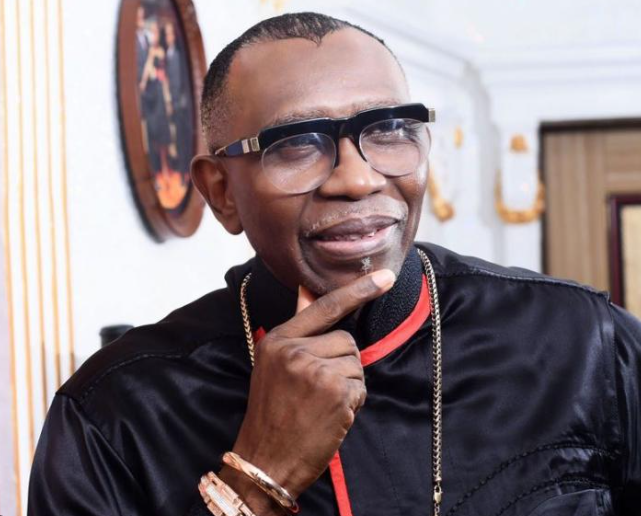
……The former CAN president urged President Tinubu not to seek reelection
By Bonaventure Phillips Melah
The founder and General Overseer of Word of Life Bible Church, Pastor Ayo Oritsejafor, has mocked those who described former president Goodluck Jonathan as clueless, saying they have failed to solve Nigeria’s problems since they took over government.
Oritsejafor, a former president of the Christian Association of Nigeria, CAN, made the remarks during an appearance on Channels Television’s Politics Today on Monday while responding to criticisms that trailed Jonathan’s administration, particularly allegations that insecurity and corruption thrived under his leadership.
“Where are those people now? Are they not the same people today who are in power?” Oritsejafor asked.
“People who called him clueless, but they wouldn’t allow him to do the things he needed to do. They protested against him all over the place in Lagos especially, and across the country.”
According to the cleric, many of those who sponsored and supported the protests against Jonathan are now occupying key positions in government.
“Now, the people who sponsored all those protests, who did a lot of all those things, many of them are the people in power today. So, now they have the clue, but look at where Nigeria is now,” he said.
Asked whether he regretted supporting Jonathan during the 2015 presidential election, Oritsejafor replied, “No, I don’t.”
The cleric also weighed in on the performance of President Bola Tinubu’s administration, expressing concern over the state of the country and advising the president against seeking a second term in office.
He said the current administration had worsened Nigeria’s challenges and questioned the government’s ability to reverse the country’s declining fortunes.
“The government of Tinubu has done more harm to this nation than this nation has ever experienced,” he said.
While declining to directly support calls for Tinubu’s resignation, Oritsejafor urged the president to honestly assess his capacity to address the country’s problems.
“I would not sit here categorically and tell him resign. But I think what I would say to him is, look, don’t pretend to know what to do when you don’t know what to do. Don’t pretend that you can take Nigeria out of where it is now, when you know you can’t,” he stated.
The cleric further criticised the administration’s “Renewed Hope” slogan, arguing that many Nigerians have lost confidence due to economic hardship and insecurity.
“The average Nigerian today has no hope, except if you say you look up to God to give you hope,” he said.
Oritsejafor concluded by urging Tinubu not to pursue another term, saying, “Don’t begin to dream of coming back to continue this same mess.”
-

 News1 year ago
Senate to speed up conclusion of Nigeria Forest Security Service Bill
-
 News11 months ago
The Many Lies Against Bashir Haske
-

 News3 years ago
Breaking: Tinubu’s authentic ministerial nominees
-
 News3 years ago
“Anytime we want to kill terrorists, President would ask us to take permission from France but they were killing our soldiers-” Niger Republic coup leader
-
 News3 years ago
“I’m leaving the Catholic church because Bishop Onah is oppressing me,” says Okunerere
-

 News3 years ago
Radio Nigeria’s veteran broadcaster Kelvin Ugwu dies three months after retirement from service
-
 News3 years ago
Dokpesi and the Gazebo Mystique
-

 News3 years ago
Tsunami: Tinubu orders dissolution of managements, boards of MDAs, to sack all Buhari’s political appointees