News
Ekweremadu: The man who ‘loved’ Nigeria

By Abimbola Adelakun
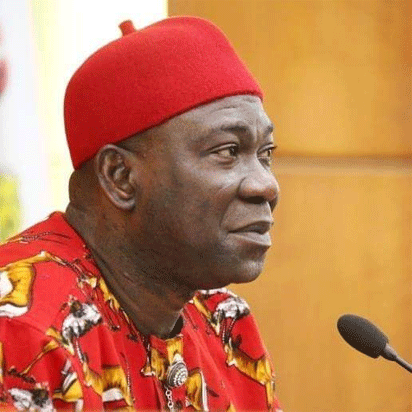
In the opening pages of his book, Who Will Love My Country: Ideas for Building the Nigeria of Our Dreams, Senator Ike Ekweremadu unapologetically declared his love for Nigeria saying, “I love Nigeria and will forever love it.”
The book contents, the regular sweet nothings Nigerian leaders preachify but which they cannot stretch themselves to live by, now take a new meaning in the light of his fall from the grace of deputy Senate presidency to a convicted prisoner.
When you consider the past 11 months when he and his wife, Beatrice, were tried in a London court for organ trafficking, you will understand why the man loved Nigeria as fiercely as a scoundrel raised by indulgent parents.
Hardly had the arrest of Ekweremadus been announced when sympathies poured in for them. From Senators Dino Melaye and Smart Adeyemi to the Labour Party presidential candidate Peter Obi, they were never short of commiseration. Ebonyi State Government announced it stood with his family and asked the UK Government to be considerate of their children’s plight. Speaker of the House of Representatives Femi Gbajabiamila too requested the Nigerian High Commission in the UK to give him needed support (and those ones hired a lawyer for him shortly after). Colleagues in the Senate visited the Ekweremadus, and some even attended the court sessions to show support. Former president Olusegun Obasanjo the letterman wrote to the Chief Clerk of the Central Criminal Court of England to beg for mercy in their sentencing. Speaker of ECOWAS Parliament, Rt. Hon. Dr. Sidie Mohamed Tunis, and Head of Diplomatic Mission to the Federal Republic of Nigeria, Dr Duru Hezekiah, also appealed to the UK Government for leniency. Both chambers of the National Assembly also begged for mercy. Even the Chair of Nigerians in Diaspora Commission, Abike Dabiri-Erewa, who once advised Nigerians to shun crimes while abroad set aside her conviction and joined in the plea for leniency. Her disdain for Nigerians caught in the vortex of crime abroad does not seem to extend to the political elite.
In all the demonstration of anxieties by several highly placed Nigerians not used to seeing their fellow “big man” in jail was a glaring omission: some fellow feeling or even as much as a thought spared for the other Nigerian—the poor young man whose kidney would have been harvested— involved in the matter. There were times during the months of trial I wondered how that young man felt when he saw the overwhelming support from official quarters for the person who was going to rob him of his life. He must have felt lonely, invisible, unsupported, and inconsequential.
With all the high-powered support he received, it is understandable why Ekweremadu would love Nigeria with all his heart. Who would not love a country where the powers that be commit themselves to work in your favour? Why would he not love a country that sides with him against his victimised countryman? The demonstration of support that the Nigerian political class offered Ekweremadu against that young man proved how much our society lacks an appreciation of justice. If that young man had walked into a Nigerian police station to report that a big man wanted to harvest his organs, nothing would have happened. Apart from our lax laws on organ harvesting, our justice system abhors the idea of punishing a big man for an infraction committed against a lowly nobody. In a country where people buy human body parts for N50,000 or even less, Ekweremadu would even have been commended for offering N3.7m. He would even have been garlanded to assuage the shame of the allegation. He would be given the title of “Fiwajoye” or something similarly ridiculous.
Given what we know about the crime of the Ekweremadus, I am baffled some Nigerians think it was their parental instinct that went on overdrive. Even if you do not find their attempt to jump the long queue for organ donation immoral, how about the paltry sum they offered their victim? The boy is around the same age as their daughter. If the transaction had sailed through, it would have been tantamount to shaving off a part of the young man’s life to extend their daughter’s own. What would have at least been moral in such a shady transaction would be to make a willing donor an offer that can at least guarantee them a quality life. Imagine the victim had been returned to Nigeria and fallen sick sometime later, how would he have coped? Even with all the mad love Ekweremadu proclaimed for Nigeria, he did not entrust his child’s life to the dilapidated hospital system in the country.
One clown who labelled himself a “deep thinker” even blamed the Ekweremadus’ travails on the average Nigerian southerners’ tendency to pull down their own. He said if the person involved were a northern Muslim, he would have sought refuge from a mosque rather than inform the law enforcement agents. Such a mindset, reeking of the southern Nigerian condescension that serially stereotypes the average northerner as meek and lacking agency, is irritating and problematic on all levels. Why should the person whose life was undervalued hesitate to affirm their self-worth so that one big man somewhere would not be accountable to the law? The road that leads home might be far, but even the lowly-born slave has a father.
In a country like Nigeria where people with kidney disease and who can afford the expense have to go to India for medical care, what would have become of that poor guy if they had taken his kidney for a measly sum? The fact that the Ekweremadus priced the young man’s life less than the cost of a business class flight ticket from Nigeria to London shows they are depraved and wicked. Actually, what they proposed to do is what Nigerian leaders have done since forever. They take and take and take from the people, and that is all they know how to do. They have been robbing our society of the vital organs that it needs to function, and it is nothing to them to try to take a bodily organ just to shore up their own lives.

Several candidates recently shortlisted for recruitment into the Nigerian Army from Imo State have sustained varying degrees of injuries after the vehicle conveying them to the Nigerian Army Depot in Zaria, Kaduna State, was involved in a road accident on Saturday.
The candidates were said to be travelling to the training institution to commence their basic military training when the accident occurred.
Military sources familiar with the incident disclosed that the journey was being coordinated under the supervision of Lieutenant Colonel P.D. Ngal.
A military source said the victims had successfully passed the recruitment process and were heading to the Depot Nigerian Army in Zaria to begin their recruit training before the accident disrupted the journey.
“The candidates from Imo State were on their way to the Depot Nigerian Army in Zaria to begin their recruit training when the accident happened this morning,” the source said.
Videos seen by our correspondent showed several injured candidates lying by the roadside and inside damaged vehicles as emergency responders and other travellers made frantic efforts to evacuate them.
Many of the injured candidates were subsequently rushed to nearby hospitals for medical attention.
As of the time of filing this report, the exact cause of the accident and the number of casualties had yet to be officially confirmed.

Benue State Police Command has condemned the killing of the Chairman of the Miyetti Allah Cattle Breeders Association of Nigeria (MACBAN), Benue State chapter, Ardo Rabo Mohammed, and another man, Yakubu Isa, describing the attack as a senseless criminal act capable of undermining ongoing peace and security efforts in the state.
The victims were reportedly attacked by gunmen while returning from a security meeting along the Okwudu-Ogoli Road in Otukpo Local Government Area.
In a statement issued on Saturday, the Police Public Relations Officer, DSP Udeme Edet, said the Commissioner of Police, CP Cletus C.N. Nwadiogbu, condemned the killings and expressed condolences to the families of the deceased.
“The Commissioner of Police strongly condemns in its entirety the brutal killing of the Chairman of Miyetti Allah Cattle Breeders Association of Nigeria (MACBAN), Benue State chapter, Ardo Rabo Mohammed, and one Yakubu Isa, who were reportedly attacked by unknown assailants while returning from a security meeting along Okwudu-Ogoli Road, Otukpo,” the statement read.
According to the police, the command has commenced a full-scale investigation into the incident, with tactical and intelligence teams deployed to track down those responsible.
The Commissioner assured residents that the command would leave no stone unturned in ensuring the perpetrators are identified, arrested and prosecuted.
He appealed to members of the public to remain calm, avoid taking the law into their own hands, and refrain from spreading unverified information capable of escalating tensions.
The police also urged anyone with credible information that could aid the investigation to report to the nearest police station or contact the command through its emergency lines.
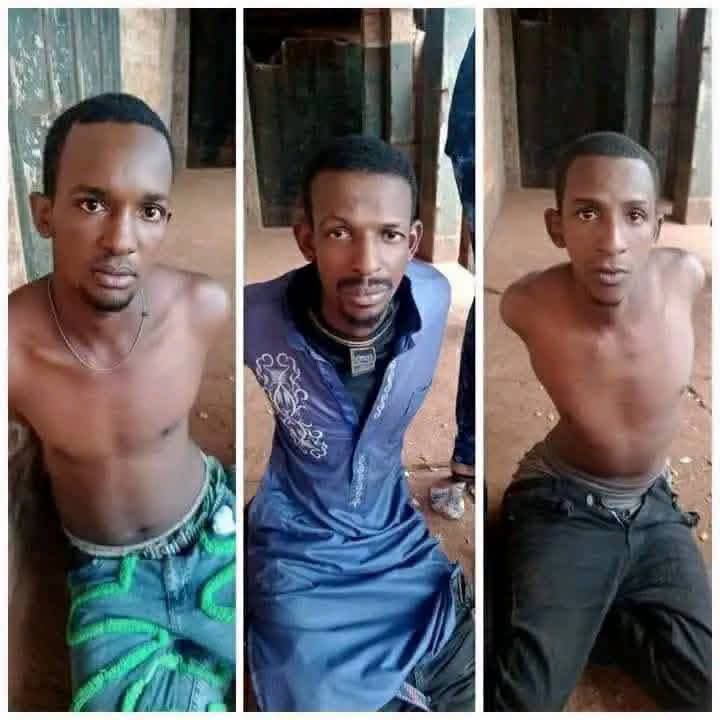
Three bandits have been arrested in Benue state after a lady who they had kidnapped and released, identified them at a motor park and raised alarm.
The k!kidnappers came to Ihotu park to board a vehicle to Makurdi and were met by the lady they had earlier kidnapped and released after collecting ransom from her relatives.
They were even using a bag they collected from the girl. The girl raised the alarm, held one inside the vehicle, and two took to their heels, but were caught.
They had a ghana-must-go bag at the back of the vehicle. N11m was found inside the bag.
Following the confirmation of their identity by another lady who was also their victim, mob gathered around with the intent to beat them up and possibly set them ablaze.
But the park manager decided to invite the police and soldiers who rescued them and took them to their station.
It was later gathered that the Benue state Governor, Rev. Father Hyacinth Alia called and said he was interested in the case which made the police to take the apprehended bandits to Makurdi, the state capital.
-

 News1 year ago
Senate to speed up conclusion of Nigeria Forest Security Service Bill
-
 News11 months ago
The Many Lies Against Bashir Haske
-

 News3 years ago
Breaking: Tinubu’s authentic ministerial nominees
-
 News3 years ago
“Anytime we want to kill terrorists, President would ask us to take permission from France but they were killing our soldiers-” Niger Republic coup leader
-
 News3 years ago
“I’m leaving the Catholic church because Bishop Onah is oppressing me,” says Okunerere
-

 News3 years ago
Radio Nigeria’s veteran broadcaster Kelvin Ugwu dies three months after retirement from service
-
 News3 years ago
Dokpesi and the Gazebo Mystique
-

 News3 years ago
Tsunami: Tinubu orders dissolution of managements, boards of MDAs, to sack all Buhari’s political appointees