
News
Dismiss application for live broadcast of proceedings, Tinubu, Shettima tell court


The Presidential Election Petition Court has been urged to dismiss the application by Atiku Abubakar and the Peoples Democratic Party for a live broadcast of proceedings.
President-elect, Bola Tinubu and his vice, Kashim Shettima told the court that the relief sought by the applicants are not such that the court could grant it.
“With much respect to the petitioners, the motion is an abuse of the processes of this honourable court,” the respondents stated.
Besides describing the application as frivolous, they said the court is not a soapbox, stadium or theatre where the public should be entertained.
They made the submission through their team of lawyers, led by Chief Wole Olanipekun and wondered why a petitioner would file an application to distract the court and waste its precious time.
They stated, in the counter affidavit, that the application relates to policy formulation of the court, which is outside the PEPC’s jurisdiction as constituted.
“The application also touches on the powers and jurisdiction invested in the President of the Court of Appeal by the Constitution, over which this honourable court as presently constituted cannot entertain.
“The application touches on the administrative functions, which are exclusively reserved for the President of the Court of Appeal.
“The application is aimed at dissipating the precious judicial time of this honourable court.
“The said application does not have any bearing with the petition filed by the petitioners before this honourable court.
“It is in the interest of justice for this honourable court to dismiss the said application filed by the petitioners,” they said.
In an attached written address, the respondents faulted the applicants’ reference to the fact that virtual proceedings were allowed during the COVID-19 pandemic.
They argued that Atiku and his party failed to draw the court’s attention to the fact that practice directions were made by the respective courts for the exercise.
“Another angle to this very curious application is the invitation it extends to the court to make an order that it cannot supervise.
“The position of the law remains, and we do submit that the court, like nature, does not make an order in vain, or an order which is incapable of enforcement,” the respondents stated.
More so, they stated that “At the very best, this application is academic, very otiose, very unnecessary, very time-wasting, most unusual and most unexpected, particularly, from a set of petitioners, who should be praying for the expeditious trial of their petition.
“Petitioners have brought their application under Section 36(3) of the Constitution which provides that the proceedings of a court/tribunal shall be held in public.
“The word ‘public’ as applied under Section 36(3) of the Constitution has been defined in a plethora of judicial authorities to mean a place where members of the public have unhindered access, and the court itself, sitting behind open doors, not in the camera.
“Even in situations where a class action is presented, the particular people constituting the class being represented by the plaintiffs or petitioners are always defined in the originating process.
“Here, in this application, the public at whose behest this application has been presented is not defined, not known, not discernable.
“Beyond all these, it is our submission that the court of law must and should always remain what it is, what it should be and what it is expected to be: a serene, disciplined, hallowed, tranquil, honourable and decorous institution and place.
“It is not a rostrum or a soapbox. It is not also a stadium or theatre. It is not an arena for ‘public’ entertainment.
“With much respect to the petitioners, the motion is an abuse of the processes of this honourable court.”

Chairman of the Nigeria Democratic in Congress (NDC), Fiidi Council Ward in Makurdi Local Government Area of Benue State, Igbu Terhemen, has reportedly been killed by unknown assailants.
Terhemen was said to have been attacked and left unconscious in a bush near his residence around the NNPC Depot, along the Makurdi-Otukpo Road, on the outskirts of Makurdi, the state capital.
A friend of the deceased, who spoke on condition of anonymity, said Terhemen left his residence on Tuesday evening to watch a local football match in the Kanshio axis of the town but did not return home.
According to him, family members and friends became worried after the deceased failed to return and subsequently began searching for him.
He said, “He left home to watch the match Tuesday evening and he was expected back home, but nobody saw him. It was while people were looking around for him that he was discovered around 2am Wednesday in a bush near his residence unconscious.
“Unfortunately, he died before he could get medical attention. Strangely, his attackers did not take his phone, which was discovered on him when he was taken to the morgue.
“There was also a needle-like injury on his body, indicating that he could have been injected with a substance by his attackers, dumped in the bush and left to die.
“All that is left for the police to uncover in the course of their investigation because this is a sad development in the state.”
The incident has sparked concern among members of the NDC, with the state chapter condemning the alleged killing and calling on security agencies to investigate the circumstances surrounding Terhemen’s death.
In a statement issued by the party’s State Publicity Secretary, Agile Bem, the NDC described the deceased as a committed member who contributed significantly to the growth of the party in the state.
The statement said, “The Nigeria Democratic Congress (NDC), Benue State Chapter, has condemned the gruesome murder of Hon. Igbu Terhemen, who, until his death, was the NDC Chairman of Fiidi Council Ward in Makurdi Local Government Area.
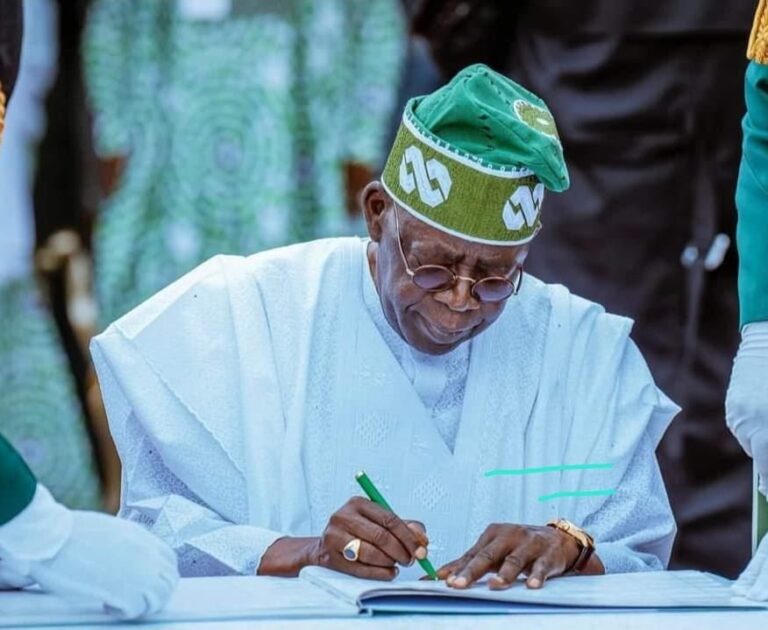
President Bola Ahmed Tinubu has signed into law the Appropriation (Amendment) (No.4) Bill, 2025, extending the implementation period of the 2025 budget from September 30, 2026 to December 31, 2026.
Presidential spokesman, Bayo Onanuga stated this in a press release on Wednesday, saying the president’s assent followed the amendment’s swift passage by both the Senate and the House of Representatives on Tuesday, September 29, 2026.
According to Onanuga, the extension gives Ministries, Departments and Agencies more time to complete ongoing capital projects. It ensures that funds already appropriated are fully put to work for Nigerians, without disrupting critical programmes.
“The President commended the leadership and members of the National Assembly for their prompt consideration of the bill, a further sign of the cooperation between the Executive and the Legislature in the service of the nation,” Onanuga said.

Governor of Rivers State, His Excellency Sir Siminalayi Fubara, has congratulated the federal government to and people of Nigeria on the occasion of the country’s 66 independence anniversary.
Fubara also called on the people of the State to embrace peace and unity, describing them as indispensable pillars for the socioeconomic development of any society.
In a goodwill message issued on Fubara’s behalf by Onwuka Nzechi, Chief Press Secretary to the Governor, he said the anniversary celebration offers an opportunity for the people to reflect on Nigeria’s journey since 1960 and to renew their commitment to peaceful coexistence.
The Governor noted that Rivers State, as the “treasure base of the nation” and a melting pot of diverse ethnic nationalities, has always thrived when its people lived in harmony. He said no meaningful development can take place in an atmosphere of rancour, division and political hostility.
According to him, while political differences are normal in a democracy, they must never be allowed to undermine the collective interest of the State. “We may disagree as politicians, but we must never disagree on the peace and progress of Rivers State,” he stated.
Governor Fubara stressed that since assumption of office, his administration has anchored its governance philosophy on peace, describing it as the most invaluable infrastructure. He said the relative peace enjoyed in the State today has made it possible for his government to attract investments and execute projects across the three senatorial districts.
He therefore appealed to youths, traditional rulers, political leaders and all stakeholders to be ambassadors of peace in their communities, wards and local government areas, stressing that no one benefits when the State is in crisis.
The Governor further urged Rivers people to continue to support the Federal Government under President Bola Ahmed Tinubu, noting that national unity and sub-national cooperation are critical to achieving the goals of the Renewed Hope Agenda.
-

 News2 years ago
Senate to speed up conclusion of Nigeria Forest Security Service Bill
-

 News1 year ago
The Many Lies Against Bashir Haske
-

 News3 years ago
Breaking: Tinubu’s authentic ministerial nominees
-
 News3 years ago
“Anytime we want to kill terrorists, President would ask us to take permission from France but they were killing our soldiers-” Niger Republic coup leader
-
 News3 years ago
“I’m leaving the Catholic church because Bishop Onah is oppressing me,” says Okunerere
-

 News3 years ago
My nude photo leak was a mistake- lawyer Ifunanya
-
 News4 months ago
See your state governor’s performance ranking
-

 News3 years ago
Radio Nigeria’s veteran broadcaster Kelvin Ugwu dies three months after retirement from service