
News
Dangote unveils expansion plan, says Nigeria’s industrialism top priority


Dangote Group has unveiled its expansion plans and promised to work towards full industrialization and development of Nigeria.
Mrs Fatima Aliko-Dangote, the Group Executive Director, Commercial Operations, made this known at the ongoing 2025 Lagos International Trade Fair organised by the Lagos Chamber of Commerce and Industry (LCCI) on Wednesday
She was represented by Mrs Funmi Sanni, Group Head, Sales and Marketing, Dangote Cement Plc.
Aliko-Dangote described industrialisation as the most viable path to value addition, economic diversification, and large-scale job creation for the nation’s youth.
She also revealed the company’s plan to expand Dangote Petroleum Refinery’s capacity from 650,000 barrel per day to 1.4mn per day by 2028.
She noted that the theme of the ongoing trade fair: ” Connecting Businesses, Creating Value”, was both timely and highly appropriate.
According to her, it encapsulates the chamber’s strategic vision of bringing together many stakeholders, manufacturers, suppliers, distributors and consumers in the same location.
Aliko-Dangote said the group as Africa’s leading indigenous conglomerate, was connected to several businesses across the world and consistently creating values.
She said its investment philosophy is that only Africans can develop Africa.
“This is why we have invested in many African countries.
“Recently, we had the historic groundbreaking ceremony of the $2.5 billion, three million metric tonne Urea Fertiliser Production Complex, in Gode, Ethiopia.
“This new plant is a partnership between the Dangote Group and Ethiopian Investment Holdings (EIH), the strategic investment arm of the Government of Ethiopia.
“The project at completion will generate thousands of direct and indirect jobs in the country while at the same time boosting agricultural output,” she said.
Aliko-Dangote added that the group had commenced the expansion of Dangote Cement Plant in Ethiopia with a $400 million investment plan for a second production line at the cement plant.
She said its 3Mta Côte d’Ivoire grinding plant started operations in the third quarter, marking another major step in Dangote Cement’s growth journey, increasing our total installed capacity to 55Mta across Africa.
“This milestone reinforces our commitment to regional self-reliance and strengthens our position as the continent’s leading cement producer.
“We have started construction of a new 6Mta integrated cement plant in Itori Ogun state, a facility that would be dedicated for export to neighbouring countries,” she said.
Aliko-Dangote said in Nigeria, the group was expanding Dangote Petroleum Refinery’s capacity from 650,000 barrel per day to 1.4mn per day by 2028.
She stated that Dangote Fertiliser Ltd., and Dangote Polypropylene, Dangote Sugar Refinery and NASCON Allied Industries Plc (Dangote Salt) were leading players in their sectors.
She affirmed the commitment of Dangote Sugar to ensuring that Nigeria ends the importation of raw sugar by actively intensifying its execution of the Sugar Backward Integration.
“In this regard, it has committed over $700 million in land acquisition, machinery, infrastructure, manpower, community relations, corporate social responsibility and other impactful activities,” she said.
Addressing the trade fair, Aliko-Dangote expressed her expectations, hoping that through the fair, the company would be able to expand awareness of its innovative products and generate sales.
She said the fair would provide the opportunity to improve the image of brands and open new markets that would further translate to job creation and overall economic development.
The Chief Executive Officer, Dangote Sugar Refinery Plc, Mr Ravindra Singhvi, unveiled two new categories of Dangote Sugar pack.
Singhvi acknowledged the immense growth of the Dangote Group companies, highlighting its position as the largest in Africa and a significant player globally.
Looking to the future, he announced ambitious plans for two major projects, which would focus on producing sugar from Nigeria, by Nigerians, and for Nigerians.
According to him, these initiatives are set to significantly enhance the company’s capabilities and better meet market demands.
“Currently, the company offers 50kg bags—both fortified and unfortified—for various consumer segments.
“In response to changing consumer preferences and market dynamics, two new packages are being launched: 25 kg bags and 100-gram bags,” he said.
Singhvi said the introduction of the 25kg bag was a strategic move to aid distributors and consumers who often had to divide larger bags for retail purposes.
He stated that by offering this more manageable size, the company aimed to streamline the purchasing process for corporate customers and others, ensuring they can buy a fresh product without additional costs.
Mr Gabriel Idahosa, President, LCCI, said to navigate the complexities of a rapidly evolving global economy, the role of visionary industrial leadership was crucial.
Idahosa said the leadership of Dangote Group had demonstrated industrial prowess by investing where others were hesitant.
He described the birth of Dangote Refinery as a clear demonstration of an industrialist utterly passionate about the country and willing to support various areas of impact.
“With the Dangote Refinery having a confirmed capacity to meet the local demand in Nigeria, the Nigerian economic outlook looks bright.
“The LCCI remained committed to fostering partnerships, promoting policy advocacy, and creating platforms that enabled businesses and industries to thrive,” he said.

Benue State Police Command has condemned the killing of the Chairman of the Miyetti Allah Cattle Breeders Association of Nigeria (MACBAN), Benue State chapter, Ardo Rabo Mohammed, and another man, Yakubu Isa, describing the attack as a senseless criminal act capable of undermining ongoing peace and security efforts in the state.
The victims were reportedly attacked by gunmen while returning from a security meeting along the Okwudu-Ogoli Road in Otukpo Local Government Area.
In a statement issued on Saturday, the Police Public Relations Officer, DSP Udeme Edet, said the Commissioner of Police, CP Cletus C.N. Nwadiogbu, condemned the killings and expressed condolences to the families of the deceased.
“The Commissioner of Police strongly condemns in its entirety the brutal killing of the Chairman of Miyetti Allah Cattle Breeders Association of Nigeria (MACBAN), Benue State chapter, Ardo Rabo Mohammed, and one Yakubu Isa, who were reportedly attacked by unknown assailants while returning from a security meeting along Okwudu-Ogoli Road, Otukpo,” the statement read.
According to the police, the command has commenced a full-scale investigation into the incident, with tactical and intelligence teams deployed to track down those responsible.
The Commissioner assured residents that the command would leave no stone unturned in ensuring the perpetrators are identified, arrested and prosecuted.
He appealed to members of the public to remain calm, avoid taking the law into their own hands, and refrain from spreading unverified information capable of escalating tensions.
The police also urged anyone with credible information that could aid the investigation to report to the nearest police station or contact the command through its emergency lines.
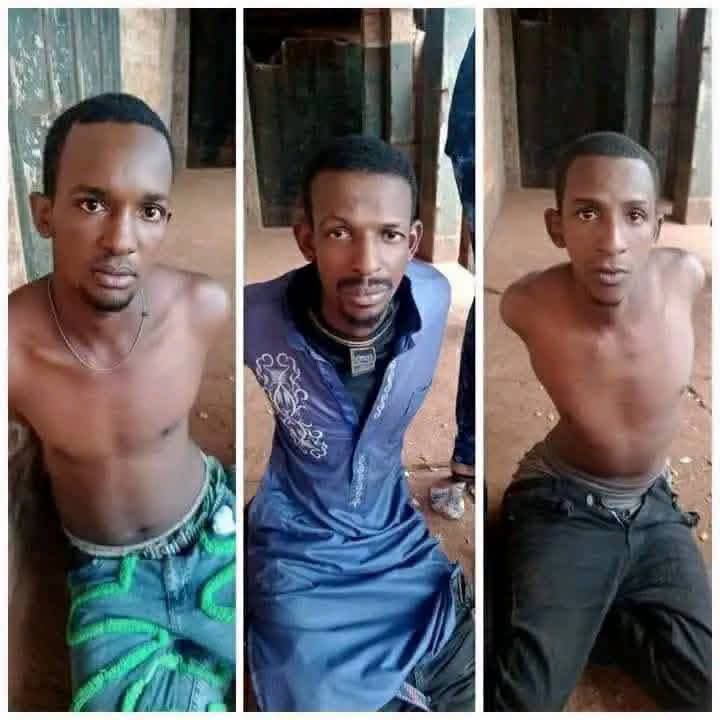
Three bandits have been arrested in Benue state after a lady who they had kidnapped and released, identified them at a motor park and raised alarm.
The k!kidnappers came to Ihotu park to board a vehicle to Makurdi and were met by the lady they had earlier kidnapped and released after collecting ransom from her relatives.
They were even using a bag they collected from the girl. The girl raised the alarm, held one inside the vehicle, and two took to their heels, but were caught.
They had a ghana-must-go bag at the back of the vehicle. N11m was found inside the bag.
Following the confirmation of their identity by another lady who was also their victim, mob gathered around with the intent to beat them up and possibly set them ablaze.
But the park manager decided to invite the police and soldiers who rescued them and took them to their station.
It was later gathered that the Benue state Governor, Rev. Father Hyacinth Alia called and said he was interested in the case which made the police to take the apprehended bandits to Makurdi, the state capital.

President Bola Tinubu Federal Government has drawn down $1.5bn from a $5bn financing facility arranged with the United Arab Emirates’ largest lender, First Abu Dhabi Bank, despite growing concerns from global financial institutions over the increasing use of complex derivative financing by African sovereigns.
Bloomberg reported on Friday that the latest drawdown represents the first tranche of a $5bn Total Return Swap facility approved by the National Assembly on March 31, 2026, and is expected to support the 2026 budget, finance infrastructure projects, and refinance existing debt obligations.
The report quoted people familiar with the transaction, who asked not to be identified because they were not authorised to speak to the media.
The report read, “Nigeria has accessed the first tranche of a $5bn derivatives deal with the United Arab Emirates’ largest lender, pressing ahead with a transaction that has been scrutinised for being opaque.
“The West African nation drew about $1.5bn in the last couple of weeks from a total return swap transaction with First Abu Dhabi Bank PJSC, according to people familiar with the transaction, who asked not to be identified because they were not authorised to speak to the media.”
The transaction comes at a time when Nigeria is facing higher borrowing costs in international capital markets, forcing the government to seek alternative financing arrangements to shore up its fiscal position and improve access to foreign exchange liquidity.
Under the arrangement, Nigeria is required to pledge Federal Government securities worth about 133 per cent of any amount drawn under the facility. This means that for the full $5bn facility, the government would have to post approximately $6.65bn worth of naira-denominated bonds as collateral.
In return, the Abu Dhabi-based lender provides dollar liquidity to the Nigerian government. The Federal Government will pay a floating interest rate benchmark plus about four percentage points, while the lender receives the returns generated by the underlying government securities.
The transaction effectively allows Nigeria to unlock immediate dollar funding without issuing new Eurobonds or taking on traditional external loans at prevailing market rates, which have become increasingly expensive for frontier economies.
The government has already indicated that the proceeds from the initial $1.5bn drawdown will be deployed to support budget implementation, fund critical infrastructure projects, and refinance costlier domestic and external debts.
However, the financing arrangement has attracted criticism from international financial institutions and market analysts over concerns about transparency and potential hidden liabilities.
In its June 2026 assessment of African sovereign debt markets, the International Monetary Fund warned that derivative financing structures such as total return swaps are often opaque and difficult for investors and creditors to monitor.
The IMF noted that such arrangements are “hard to track, hard to value in real time, and can obscure the true extent of a country’s financial obligations.”
Three days ago, Fitch Ratings warned that Nigeria’s planned $5bn financing arrangement with First Abu Dhabi Bank could increase sovereign debt risks and reduce transparency in public debt reporting.
-

 News1 year ago
Senate to speed up conclusion of Nigeria Forest Security Service Bill
-
 News11 months ago
The Many Lies Against Bashir Haske
-

 News3 years ago
Breaking: Tinubu’s authentic ministerial nominees
-
 News3 years ago
“Anytime we want to kill terrorists, President would ask us to take permission from France but they were killing our soldiers-” Niger Republic coup leader
-
 News3 years ago
“I’m leaving the Catholic church because Bishop Onah is oppressing me,” says Okunerere
-

 News3 years ago
Radio Nigeria’s veteran broadcaster Kelvin Ugwu dies three months after retirement from service
-
 News3 years ago
Dokpesi and the Gazebo Mystique
-

 News3 years ago
Tsunami: Tinubu orders dissolution of managements, boards of MDAs, to sack all Buhari’s political appointees