
News
Centre says JAMB’s ban on Mmesoma violates her Rights as a child


Our attention has been drawn to the recent case of Miss Ejikeme Joy Mmesoma’s alleged fake JAMB score which is trending in the national dailies and many social media platforms. It is reported that the Joint Admissions and Matriculation Board (JAMB) accused Miss Ejikeme of manipulating her UTME result to fraudulently attract scholarship and recognition. This careless, apparently official statement, has sparked viscous and unrelenting condemnation of the girl whose only offense is that she made the highest score in JAMB. The examination body went to town with news of her ‘manually’ manipulating her own results before launching a discreet investigation into how and why a young, innocent girl of her class could go into such high-tech gymnastics. According to JAMB, ‘Ejikeme Joy Mmesoma manually inflated her UTME result from 249 to 362, using the inflated score to secure a N3 million scholarship from Innoson Motors.’ It should be noted that the Anambra State Government was also set to award her another scholarship before the forgery allegations broke out.
JAMB stopped short of telling the world how she inflated her score, when she did it, whether or not she did it alone or in consortium with some high-tech wizards, or the app or software used to hack JAMB’s data base or server. Someone who uses an app or a computer application to inflate a JAMB score cannot be said to have ‘manually’ inflated her UTME result.’ There is a clear difference between manual and electronic applications or manipulation.
While the public uproar and angst against the innocent girl raged, JAMB has since gone into the dark recesses of its infamy, refusing to give further details or substantiate it’s premature and blatant allegations. It appears JAMB’s grouse is that INNOSON has awarded the young girl N3m scholarship, and Anambra State Government is also getting set to award more scholarship. This, to the handlers of JAMB is too much for a young girl from Anambra State! Maybe if Mmesoma were from North East or North West of the country, JAMB may not have seen anything wrong with her score. But coming from Anambra State, South East Nigeria, she must be pulled down by all means!
We dare say that by this singular act of indiscretion, JAMB, like INEC, has destroyed public confidence in it’s handling of matriculation examinations in Nigeria and the process through which candidates’ scores are aggregated. Like INEC, JAMB has demonstrated untold incompetence in its ability to maintain the credibility and standard of its exams. There is public speculation that JAMB tampered with Mmesoma’s result, possibly out of jealousy over the scholarship awarded to her by INNOSON. Social media users have also taken swipes on JAMB over it’s procedural lapses and organisational ineptitude.
By coming public with such grave allegations against Mmesoma, without regard to her status as a child under the Child Rights Act of 2003, the managers and officials of JAMB have demonstrated crass ignorance of, or contempt for Nigerian laws, especially as it relates to the rights of a child. Section 11(c) of the Child Rights Act provides that ‘Every child is entitled to respect for the dignity of his (or her) person, and accordingly no child shall be subjected to attacks upon his (or her) honour or reputation.’
This Act is an adaptation of the United Nations Convention on the Rights of the Child (UN General Assembly Document A/RES/44/25) adopted on 12 December 1989. Nigeria is a signatory to this Convention which sets out the fundamental rights of children and establishes the obligations of State Parties to ensure that they take all administrative and legislative measures to ensure their protection and well-being of children in their respective States. The Child Rights Act of 2003 (an Act of the National Assembly) is Nigeria’s own legislative measure to ensure the protection of children in Nigeria. As an administrative measure to ensure the rights and well-being of Nigerian children, Nigeria has also established the National Child Rights Implementation Committee to enforce the Child Rights Act. As at 2016 (the current figure is yet to be ascertained) the Child Rights Act has been codified into law by 24 out of 36 states in Nigeria, with Enugu as the latest State to enact the Child Rights Law in December 2016.
Mmesoma has been honoured as the highest scorer in 2023 Joint Admission and Matriculation examinations. This is a reputation she has acquired by mere dint of hard labour. This reputation is not unusual as those who knew her, even her teachers, testify to her brilliance and excellent academic performance. So, what exactly is the motive of JAMB in its latest acerbic vitriol against Mmesoma, especially its repeated mention of Anambra State and INNOSON in its ill-advised public statement?
We challenge and condemn whatever motive behind the latest senseless attack against a Nigerian child by JAMB, a federal government agency. JAMB has shown impunity and grave disrespect to Mmesoma’s right to dignity, and has unfortunately and unjustifiably launched the most viscous attack on her honour and her reputation, against the spirit and letters of the Child Rights Act of 2003.
We therefore call on the Federal Government, the National Child Rights Implementation Committee, and the Anambra State Government to launch a discreet investigation into the activities of JAMB, especially it’s data base to determine whether any manipulation has occurred; either by Mmesoma, as alleged, or by perverse JAMB officials against the innocent girl, to bring her and Anambra State to public odium and contempt.
The last administration of President Mohammadu Buhari did untold damage to State institutions by railroading all manner of inexperienced and incompetent people to head sensitive positions of authority. The time has therefore come, and it is now, when the present Federal Government must elevate merit above mediocrity by weeding out all incompetent and inexperienced people from high public offices.
The importance of supporting children with outstanding academic performances cannot be overemphasised, and we urge Nigerians to be circumspect in swallowing the bait and infamy of JAMB until the outcome of a discreet investigation by an independent body is made public.
We agree with critics that JAMB’s press release repeatedly mentioning Anambra State instead of addressing the credibility of their own exam raises suspicion. And that, even if the allegations were true, which is denied at this point, JAMB and the media should have shown some restraint in the matter to protect a young girl from unfair public opprobrium that may last a life time. We also find merit in the opinion that JAMB may have tampered with the result of this young girl, by reducing her scores from their database out of envy over the 3 million naira scholarship from INNOSON.
Be that as it may, we dare say that even where a crime has been committed, the Child’s Right Act prohibits the publication of such information or identifying a child linked to such criminal allegations. This applies even during judicial proceedings. Miss Mmesoma is an underaged girl, a minor, who has the right to protection from cyber bullying and media trial orchestrated by an incompetent institution like JAMB. Nigerians also deserve apology from JAMB for its failure in properly utilising humongous public funds at it’s disposal to evolve an effective and seamless process in matriculation examinations.
We therefore call on Anambra State Government, women advocacy groups, and all relevant authorities, to protect Mmesoma’s image and take necessary actions against JAMB for its alleged misconduct. Mmesoma is a minor and cannot speak for herself and does not have the mental energy to defend herself in the cyber space. We therefore call on all women groups and the civil society to stand up to, not only defend Mmesoma, but to defend the Child Rights Act, and to defend the Nigerian child! JAMB must be made to pay reparations to Mmesoma for this unwarranted assault on her dignity, her honour, and her reputation.
© Chef Amos Ogbonnaya
Executive Director
Centre for Nonviolence and Social Justice ✍️
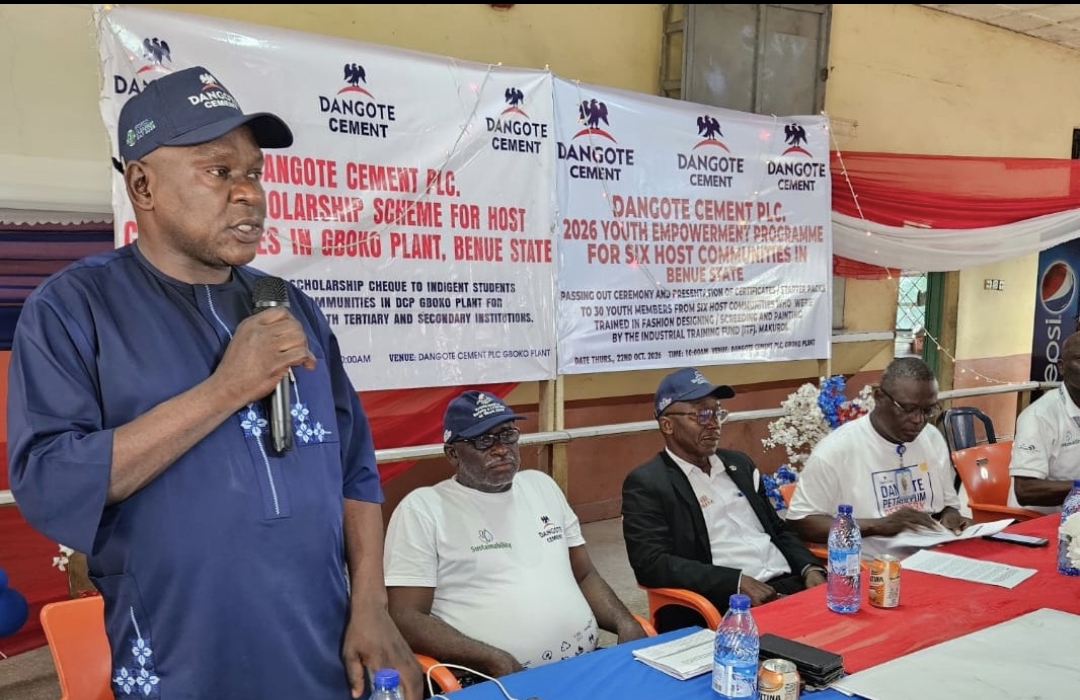
Dangote Cement Plc, Gboko Plant has awarded multi-million-naira scholarships to tertiary and secondary school students from its six host communities in Benue State.

The company also presented starter packs, working tools and certificates to graduates of its Youth Empowerment Programme to enable them to establish their own businesses, apply the skills acquired during the training and become financially reliant.
The Minister of Solid Minerals Development, Dr. Henry Dele Alake, lauded Dangote Cement Plc for its community development interventions, calling on other private sector players to adopt similar initiatives to promote socio-economic development in their host communities.
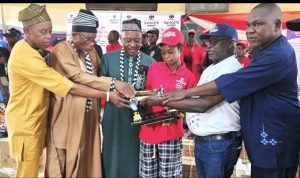
Dr. Alake, who was represented by the Federal Mines Officer of the Federal Ministry of Solid Minerals Development in Benue State, Engr. Achi Gregory, urged the company to sustain its commitment to implementing community development programmes agreed upon with its host communities.
Speaking at the official presentation ceremony, Group Head, Social Performance, Dangote Cement Plc, Mr. Wakeel Olayiwola, said the implementation of the Community Development Agreement underscores Dangote Cement’s commitment to equipping young people with practical skills and resources to promote entrepreneurship, create employment opportunities and improve livelihoods in its host communities.
Mr. Olayiwola, who was represented by the Head of Social Performance of the Dangote Cement, Gboko Plant, Dr. Johnson Kor, said the scholarship and youth empowerment programmes came against the backdrop of several other programmes recently executed by the company, which include farmers and women empowerment programmes.
The Acting Plant Director, Dangote Cement, Gboko, Engr. Arbind Singh, said: “This annual scholarship scheme for indigent students of the host communities is an indication of our company’s commitment to its Corporate Social Responsibilities (CSR).”
Engr Singh, who was represented by the company’s General Manager, Production, Engr Tabershima Soom, said: “The Gboko Plant has already launched 150 Women Empowerment Programme and 50 Farmerss Empowerment Programme where women were provided with cash to support their businesses, and farmers were supported with farm inputs.”
The beneficiary communities for these programs are: Tse-Kucha, Quarry, Amua, Mbazembe, Mbatur, and Pass Brothers.
Speaking on behalf of the Benue State Attorney-General, the Chairman of the Mineral Resources and Environmental Management Committee (MIREMCO), Barr. Dooshima Orosaga, commended Dangote Cement Plc for its compliance with the Community Development Agreement (CDA), urging the beneficiaries and host communities to maximise the benefits of the company’s interventions.
Chairman of the Gboko Local Government, Hon Yina Elias said the government will continue to provide the support needed for the company to succeed, adding that the Dangote Cement Plc is an exemplary company in Corporate Social Responsibilities programmes.
In his remarks, the District Head of Ukpekpe, Chief Tsegba Igbarumun, commended Dangote Cement Plc’s Gboko Plant for its contributions to the community, assuring the company of the community’s continued support.
He said the community valued its mutually beneficial relationship with the company and would continue to serve as its ambassadors.
A beneficiary of the Youth Empowerment Programme, Mr Ignatius Aondohemba, expressed appreciation to Dangote Cement Plc for the support, pledging to put the skills and resources provided to good use and build a business that would enable him to become an employer of labour.


By Prof. Mike Ozekhome, CON
Happy 97th Birthday to a living legend, Aare Afe Babalola, SAN, CON, OFR, FCIArb, LL.D,D.Litt, Founder and Chancellor of Afe Babalola University, Ado-Ekiti. A great man was born today, and Nigeria is still blessed by that birth.
When a man turns 97 and is still relevant, still building, still teaching and still healing, his birthday is no longer a mere episode. It becomes a national lesson and a celebration of life.
The man Afe Babalola is resilience clothed in humility,doggedness masked in simplicity. Born today in 1929, in a humble homestead in Ado-Ekiti, without any silver or golden spoon or privilege, he walked through life laboriously as farm labourer, Grade Two teacher, court registrar and became one of Africa’s most celebrated lawyers and educatioists.His life teaches that where you started can never define where you end.
From that humble beginning, he taught himself law by private study, passed all his examinations in flying colours and rose to become a Senior Advocate of Nigeria. Today his name is synonymous with legal brilliance and integrity at the Bar for which he had shone and still shines for over six decades,and till date.
He is a builder in every sense of the word. At 80, an age many have retired from active service, baba founded Afe Babalola University, Ado-Ekiti, ABUAD. What he conceptualized and built is not just a citadel of learning, it is a city within a city — vast farms, fish ponds, factories, industries, potteries, piggeries,electricity grid,and a world-class multisystem teaching hospital that rivals any in Africa.
At ABUAD, shining star shows that education must produce, not just certificate but societal relevance. The hospital has modular theatres, CT scan, MRI, ICU, dialysis and cutting-edge equipment. It is his gift to humanity, a proof that wealth is best measured by impact,not by loads of cash in the bank. .
Today at 97, the Aare still wakes up early mornings and sleeps late at nights,thinking of what to add, not what to take or rest on. That is the first lesson for today’s youths — hard work has no retirement age when purpose drives you.
The second lesson is that education has equally has no age limit. If a man who could not afford secondary school would later become a SAN and founder of one of the world’s leading universities, then no youth has any excuse to give up learning.
The third lesson is vision that works. Youths must learn that dreams must be planted like farms, nurtured like fish ponds,and built like factories. Baba Afe Babalola did not just talk vision, he manufactured,and walked it. He did not just dreamt dreams, he actualized them.
The fourth lesson is humility. With all his glittering array of titles,honours and massive wealth, our nonagenerian ( soon a centenarian, by God’s grace) still personally phones far younger ones like me,calling me “my son”. He still opens his doors, still listens,still advises, still mentors, still helps. Greatness that intimidates is fake;true greatness lifts. The Aare has epitomized the latter.
The fifth lesson is courage to start,even if late. He started his greatest legacy at 80. To every youth who thinks time has passed, Afe at 97 born today says you are still early if you start now.
The sixth lesson is integrity as capital. His name has remained untainted till date. In a world of shortcuts, he reminds youths that a good name is still better than silver and gold.
Today, as we celebrate him at 97, we celebrate more than age.We celebrate relevance. We celebrate patriotism. We celebrate impact. To live long is grace; to remain relevant at 97 is uncommon resilience.
Joining all patriots at home and in diaspora, I wish Aare Afe Babalola,the irrepressible advocate,courtroom gladiator, mentor of a generation, teacher of teachers,and philanthropist extraordinaire,a happy 97th birthday.May his hands be strengthened,his soul lifted, his muscles oiled, and his life prolonged ( Gen 6:3 ).
Born today, celebrated for all times. Happy Birthday, Papa.
-

 News2 years ago
Senate to speed up conclusion of Nigeria Forest Security Service Bill
-

 News1 year ago
The Many Lies Against Bashir Haske
-

 News3 years ago
“Anytime we want to kill terrorists, President would ask us to take permission from France but they were killing our soldiers-” Niger Republic coup leader
-

 News3 years ago
Breaking: Tinubu’s authentic ministerial nominees
-

 News3 years ago
“I’m leaving the Catholic church because Bishop Onah is oppressing me,” says Okunerere
-
 News5 months ago
See your state governor’s performance ranking
-

 News3 years ago
My nude photo leak was a mistake- lawyer Ifunanya
-

 News3 years ago
Radio Nigeria’s veteran broadcaster Kelvin Ugwu dies three months after retirement from service