
News
Egbetokun opposes state Police, wants FRSC, NSCDC as part of NPF


Inspector General of the Nigeria Police, Kayode Egbetokun, has said that the country is not matured enough to have state Police.
Egbetokun stated this Monday at an event in Abuja with President Bola Tinubu as special guest of honour.
With the theme: “Pathways to Peace: Reimagining Policing in Nigeria,” it wa organised by the House of Representatives ahead of the passage of the State Police Bill before it.
Even though dignitaries like former president Goodluck Jonathan, former head of state, Abdulsalami Abubakar, Senate President, Godswill Akpabio, Ooni of Ife and many others had rooted for establishment of state Police, the Police boss differed with them
Represented at the event by AIG Ben Okolo, the IGP said that apart from leading to multiple command structures, state police could become a political tool in the hands of governors.
The Police boss also said that state policing would exacerbate ethnic tension and lead to divided loyalty in the states.
He said: “It is the submission of the leadership of the Nigeria Police Force (NPF) that Nigeria is not yet mature and ready for the establishment of state-controlled police.
“State governors could use the police forces under their control for political or personal gain and undermine human rights and security.
“There would also be a conflict of jurisdiction.’’
He also argued that states lacked the funds needed for the type of police system the country requires.
Rather than establish state police across the country, Egbetokun recommended merging the Nigeria Security and Civil Defence Corps and the Federal Road Safety Commission to form departments in the NPF.
He said there is the need for recruitment of about 30,000 police personnel into the force annually to meet the United Nations (UN) requirement for modern policing.
But speaking earlier, former president Goodluck Jonathan said what should be of concern at the moment is the operational model the system would take.
He said: “The issue today is very critical. One thing is that we don’t need to debate whether we should have state police or not. I think that matter has been concluded. The issue is the operations of the police.
“The need for states to have their own police is not negotiable. There is no way we can continue this kidnapping that is going on in this country.
“Commercial kidnapping started around 2006 – I don’t want to go into that history – when I was governor. But it started in the Niger Delta. Now it is all over the country. The only thing that can help us is for states to have their police.
“Insecurity is a national challenge and if you don’t help crush the problem of other states, those criminal elements will one day come to your state.
“I was a governor. I operated at the state level for eight years, as deputy governor and governor and getting to the centre, Vice President and President for another eight years.
“I know that in Bayelsa and other states that attempted to have some element of security, state Police worked very well.
“In Bayelsa, when we took over, the state was almost ungovernable. Gen. Abubakar would remember that when elections were to be conducted in December 1998, the security situation was so bad that our elections were pushed to January 1999.
“When we took over, the state was in crisis. Niger Delta agitation was there. The criminal elements were also operating in the creeks and were causing issues for market women and others until (Diepreye) Alamieseigha who was then the governor, set up the Bayelsa Volunteers Force that worked with the police.
“We built stations around parts of the creeks and the boys volunteered to work with the police and that brought the situation down.
“So, there is no way we can manage internal security if states would not have their police.
“But how would the state police function vis-a-vis the national security architecture?
“When I set up the 2014 national dialogue, we had lots of challenges in the country. People were agitating in so many areas.
“But one thing that the almost 500 delegates agreed upon without much ado was the issue of state police.
“When that issue came up, everyone supported the issue of state police. So we cannot move away from state police.
“State police was accepted; national border force was accepted and coast guard was also accepted.
On his part, former Head of State, Abdulsalami Abubakar, stressed the need for transparency in the operation of state police.
He warned that politicians must avoid asserting undue influence over state police.
“If we decide to have them. It is necessary for politicians as much as possible to avoid exerting influence on the ways the police are going to operate if at all we agree to have the police.”
President Bola Tinubu, in his remarks, said that state policing has the potential to revolutionise law enforcement in Nigeria and cater for different needs.
The president, who was represented by his deputy, Kashim Shettima, urged leaders to ensure that the deliberations continue beyond the hall.
“The concept of state policing is not merely a policy for the proposal but a potential milestone of revolution of our law enforcement framework. It offers the possibility of catering to the diverse needs of our communities.
“It is essential that this forum is not the end, but the beginning of an ongoing conversation on the issue of police and security sector reform in our country.
“The theme of today’s event is a pivotal aspect of our national discourse. It reflects a collective recognition of the need for a more localised, responsive and effective law enforcement framework,” Mr Tinubu said.
In his remarks, the Ooni of Ife, Enitan Ogunwusi, called for action as he informed the audience of the discontent of his subjects over general insecurity.
“We have not seen anybody that has a contrary opinion to this. So technically the people have spoken. The people’s house. So I would commend you. But please swing into action. it is about time. Do something that would be impactful to people. It is very important.
“Whatever take home that you would have today, we have the entire National Assembly here. Please we are the ones feeling the heat from our people. We are traditional rulers. our palaces are not locked. No traditional ruler in this country would dare lock his palace. It’s not possible,” he said.
The monarch also lamented the lopsidedness in the allocation of police, stating that most VIPs in Abuja have police attached to them.
“But you have lots of police securing the permanent secretary, so many police in Abuja and Lagos. You only come to us when you want to go for election. That is when you come to see us. I mean our political leaders. but we are there. no problem. But enough of talking. let’s stop talking and implement this,” Mr Ogunwusi said.
Others who delivered speeches at the event were Senate President Godswill Akpabio, Speaker of the House of Representatives Abbas Tajudeen, Deputy Speaker of the House Ben Kalu, Chief of Defence Staff Christopher Musa, who was represented by Kunle Ariyibi, a major general, and the Minister of Police Affairs, Ibrahim Gaidam.
Other personalities at the event were the Governor of Kwara State and Chairman of the Nigerian Governors’ Forum, AbdulRahaman AbdulRasak, and the Sultan of Sokoto, Sa’ad Abubakar.
Chairman of the Nigeria Democratic in Congress (NDC), Fiidi Council Ward in Makurdi Local Government Area of Benue State, Igbu Terhemen, has reportedly been killed by unknown assailants.
Terhemen was said to have been attacked and left unconscious in a bush near his residence around the NNPC Depot, along the Makurdi-Otukpo Road, on the outskirts of Makurdi, the state capital.
A friend of the deceased, who spoke on condition of anonymity, said Terhemen left his residence on Tuesday evening to watch a local football match in the Kanshio axis of the town but did not return home.
According to him, family members and friends became worried after the deceased failed to return and subsequently began searching for him.
He said, “He left home to watch the match Tuesday evening and he was expected back home, but nobody saw him. It was while people were looking around for him that he was discovered around 2am Wednesday in a bush near his residence unconscious.
“Unfortunately, he died before he could get medical attention. Strangely, his attackers did not take his phone, which was discovered on him when he was taken to the morgue.
“There was also a needle-like injury on his body, indicating that he could have been injected with a substance by his attackers, dumped in the bush and left to die.
“All that is left for the police to uncover in the course of their investigation because this is a sad development in the state.”
The incident has sparked concern among members of the NDC, with the state chapter condemning the alleged killing and calling on security agencies to investigate the circumstances surrounding Terhemen’s death.
In a statement issued by the party’s State Publicity Secretary, Agile Bem, the NDC described the deceased as a committed member who contributed significantly to the growth of the party in the state.
The statement said, “The Nigeria Democratic Congress (NDC), Benue State Chapter, has condemned the gruesome murder of Hon. Igbu Terhemen, who, until his death, was the NDC Chairman of Fiidi Council Ward in Makurdi Local Government Area.
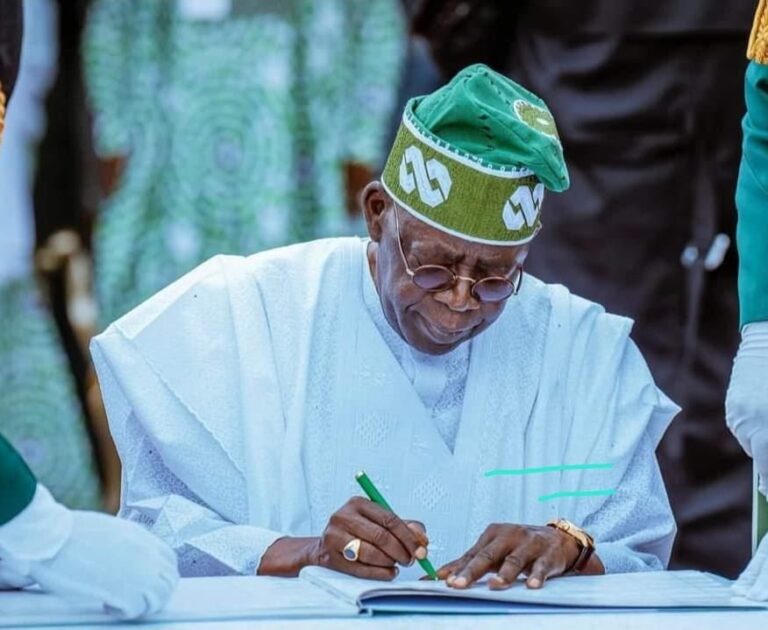
President Bola Ahmed Tinubu has signed into law the Appropriation (Amendment) (No.4) Bill, 2025, extending the implementation period of the 2025 budget from September 30, 2026 to December 31, 2026.
Presidential spokesman, Bayo Onanuga stated this in a press release on Wednesday, saying the president’s assent followed the amendment’s swift passage by both the Senate and the House of Representatives on Tuesday, September 29, 2026.
According to Onanuga, the extension gives Ministries, Departments and Agencies more time to complete ongoing capital projects. It ensures that funds already appropriated are fully put to work for Nigerians, without disrupting critical programmes.
“The President commended the leadership and members of the National Assembly for their prompt consideration of the bill, a further sign of the cooperation between the Executive and the Legislature in the service of the nation,” Onanuga said.
Governor of Rivers State, His Excellency Sir Siminalayi Fubara, has congratulated the federal government to and people of Nigeria on the occasion of the country’s 66 independence anniversary.
Fubara also called on the people of the State to embrace peace and unity, describing them as indispensable pillars for the socioeconomic development of any society.
In a goodwill message issued on Fubara’s behalf by Onwuka Nzechi, Chief Press Secretary to the Governor, he said the anniversary celebration offers an opportunity for the people to reflect on Nigeria’s journey since 1960 and to renew their commitment to peaceful coexistence.
The Governor noted that Rivers State, as the “treasure base of the nation” and a melting pot of diverse ethnic nationalities, has always thrived when its people lived in harmony. He said no meaningful development can take place in an atmosphere of rancour, division and political hostility.
According to him, while political differences are normal in a democracy, they must never be allowed to undermine the collective interest of the State. “We may disagree as politicians, but we must never disagree on the peace and progress of Rivers State,” he stated.
Governor Fubara stressed that since assumption of office, his administration has anchored its governance philosophy on peace, describing it as the most invaluable infrastructure. He said the relative peace enjoyed in the State today has made it possible for his government to attract investments and execute projects across the three senatorial districts.
He therefore appealed to youths, traditional rulers, political leaders and all stakeholders to be ambassadors of peace in their communities, wards and local government areas, stressing that no one benefits when the State is in crisis.
The Governor further urged Rivers people to continue to support the Federal Government under President Bola Ahmed Tinubu, noting that national unity and sub-national cooperation are critical to achieving the goals of the Renewed Hope Agenda.
-

 News2 years ago
Senate to speed up conclusion of Nigeria Forest Security Service Bill
-
 News1 year ago
The Many Lies Against Bashir Haske
-

 News3 years ago
Breaking: Tinubu’s authentic ministerial nominees
-
 News3 years ago
“Anytime we want to kill terrorists, President would ask us to take permission from France but they were killing our soldiers-” Niger Republic coup leader
-
 News3 years ago
“I’m leaving the Catholic church because Bishop Onah is oppressing me,” says Okunerere
-

 News3 years ago
My nude photo leak was a mistake- lawyer Ifunanya
-
 News4 months ago
See your state governor’s performance ranking
-

 News3 years ago
Radio Nigeria’s veteran broadcaster Kelvin Ugwu dies three months after retirement from service