News
What Soludo said at ex-gov Ezeife’s burial


By Bonaventure Melah
Professor Chukwuma Soludo, the Governor of Anambra State, Saturday, April 20, 2024, led thousands of ndi Anambra and others across Nigeria, to bid farewell to Chief Dr. Chukwuemeka Ezeife, a former governor of the state who died on December 14, 2023 at the age of 86.
At the event, which took place at late Ezeife’s country home, Igboukwu, Governor Soludo paid glowing tribute to the elder statesman and thanked him for his leadership attributes and selfless service to the state and humanity.
See the extempore speech:
Greetings to all!
Just two or three talking points to address you on.
The first is to join those who have spoken in welcoming all of you to this funeral service. Thank you for coming.
Thanking you for coming to honour my brother, my mentor. And thank you for coming to honour one of the finest that Anambra has given to the world; our late brother, Chief Dr. Chukwuemeka Ezeife.
I want to thank particularly, members of the Salvation Army, for leading us through this service. It’s been wonderful. And I want to thank the Lt. Col. who gave the sermon. That was very apt because you learn three things that our late brother stood for- a life of purpose, a life of service that matters and very importantly, a life in Christ. Thank you immensely for that message because for me that typifies the “Okwadike” that I knew.
To ndị banyị and to Nigerians, we had the Commendation service in his honour at the International Convention Centre just yesterday. Tributes poured in, we watched a documentary about his life and times; you could see a colossus and end of an era.
We are only praying God to bless Anambra, bless Igboukwu and bless Nigeria with thousands more of Chukwuemeka Ezeife. He seems quite irreplaceable but we pray that He might bless us with many people who are able to carry the torchlight going.
As the sermon rightly said, Dr. Chukwuemeka Ezeife lived a life of purpose. He lived a life of service and very importantly I want to add to that, for him, there is a saying that says; “be the change that you want to see”. That was what Okwadike represented!
All the time that I knew Dr. Ezeife as a brother, as a friend and as a mentor. Dr. Ezeife lived out the true meaning of not just what he said, but what he did.
The reason why Nigerian took him seriously is because he lived out what he preached. From when he served as permanent secretary par excellence and when he served as Governor of Anambra. Infact, that was when he earned the credit to speak about fairness, to speak about equity, to speak about justice for all. He earned it while in the brief period that he was Governor.
As Governor of Anambra, Dr. Ezeife did not care how you worshipped, which denomination you came from, whether you are from Anambra or not. He was a Governor for all. It was when he was Governor that two people from Abịa and Osun states respectively, were
employed into the civil service of Anambra state without minding their state of origin.
Today, as we carry the banner and baton of Ezeife forward under our own government, we’ve appointed those two persons from Abịa and Osun states as Permanent Secretaries in Anambra civil service; just living out the true essence of what Okwadike stood for.
So, when he spoke about equity, justice, fairness in Nigeria, when he spoke about excellence and merit being the basis for appointments, recruitments and so on, he lived it out. And so, when he spoke about these matters, we could believe him because he led by example. That’s what matters.
All we can say to him as we pay our final tribute is that we are carrying the banner forward. Yes! In Anambra state, we recruited five thousand teachers within my first nine months in office and these teachers happen to come from eighteen states of Nigeria. We did not ask people which state they came from or where they worship, because the interest of the Anambra child is to be taught by the best teacher in the world , not to be taught by the teacher in his village. That is what Okwadike stood for and that is the banner that we are carrying forward.
This is what we have come to celebrate as we bid him farewell. In all his life, he showed fairness, he exuded equity, transparency, justice for all, especially for the down-trodden.
We can’t miss the message that Okwadike was the change that he preached. He lived out the change that he preached. He just didn’t talk about them to get public applause, he lived it out because by their fruits, you shall know them.
In religious circle, he was not a religious bigot by any stretch. He lived for all and he ensured that there was inclusiveness of all denominations in his government. We are carrying that banner. I have appointees from various states of the federation, because for us it is about merit or what you can offer, not where you worship, not where you come from or whether you are from my village. As we make contributions for restructuring Nigeria, we kept emphasising meritocracy.
For the government of Anambra, we are carrying the banners, the message, the foundation that Okwadike, my own brother left behind. And that is a government and governance based on merit. When you do that, the result show because there is no “Anglican, Catholic, Pentecostal or Salvation Army’s way of tarring a road or teaching mathematics.
That is why we are building a state where everyone will be included. Just show us what you can do and we will deploy you to do that for the service of Anambra. That’s what Ezeife lived for, and that is why we have come here to say goodbye to him.
For those of you who have travelled far and near, the good Lord will lead you back to where you came from.
And I make this final point- the Okwadike that I knew was a stickler for process, for the law and that’s why he held Nigeria accountable to observe the principles of the federal character in everything because he believed in the law.
So all these fanfare that make burial very expensive, run contrary to the Anambra burial law which was passed three years before I became governor. I didn’t pass it. It has been there. It is the law. Those things that play no role should be avoided. All that is required is for us to respect the dead. We have given Okwadike for God to grant him eternal rest as we lay him to rest in accordance with Anambra burial law.
That law also says that all burial funerals, condolences must be for one day. You don’t have a waiver for laws, you can only waive for rules. You either obey the law or amend it. Once it remains the law, it is to be obeyed. And that’s not the society that Okwadike dreamt of. The foundation we are working on, is the one he left for us.
On behalf of myself, my family, ndị Aguata, ndị OAU, the government and great people of Anambra State, we say a big farewell to this rare soul and colossus that went through like a firmament all around Africa.
Okwadike Igbo!
Okwadike Aguata na Orumba!
Okwadike Anambra!
Okwadike Ndị Igbo!
Okwadike Nigeria!
Okwadike Africa!
Goodbye and Goodnight!
Thank you all, once more.!!!
As extracted by Soludo’s Press Secretary, Christian Aburime.
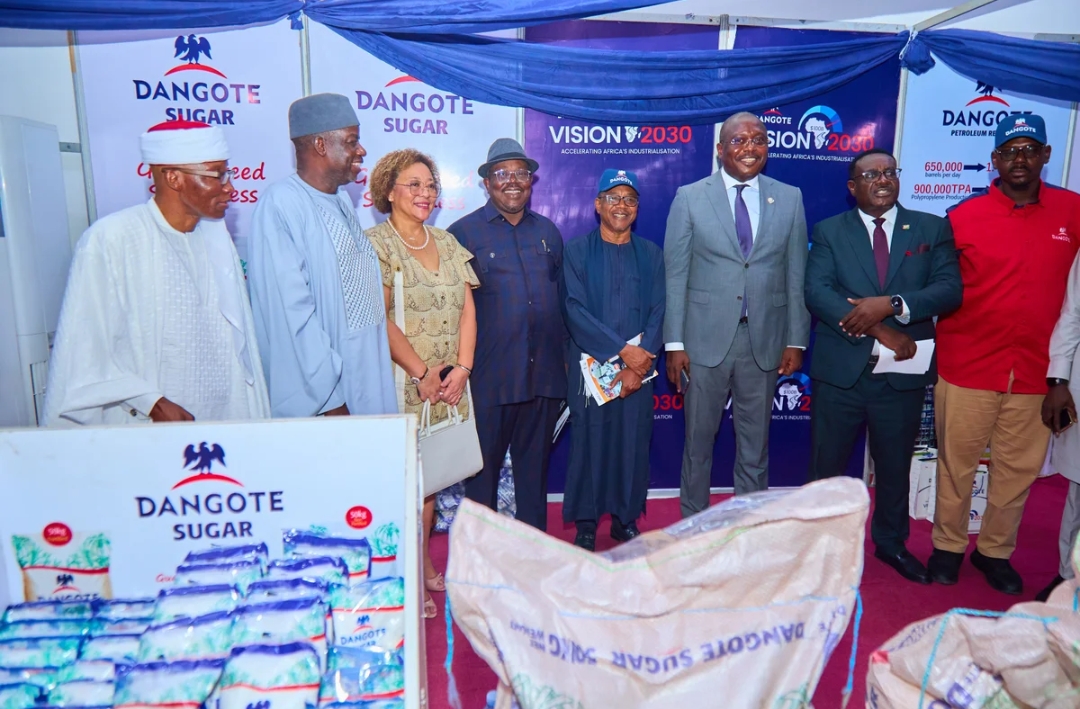
Photo caption: From Left- Co-Founder/Group Executive, ABIS Group Dr. Illiyasu B. Gashinbaki; Deputy Vice President ACCI and former Minister of Foreign Affairs Dr. Aliyu Idi Hong; Cuban Ambassador to Nigeria Miriam Morales Palmero; Perm Sec Ministry of Special Duties and Intergovernmental Affairs Dr. Onwusoro Madura Ihemelandu; Representative of Dangote Group Hashem Ahmed; President ACCI Chief Emeka Obegolu; Namibian High Commissioner to Nigeria Mr. Walde Natangwo Ndebashiya; and Mr. Abdulrazaq Sambajo of the Dangote Group, during a visit to the company pavilion at the 21st Abuja International Trade Fair on Tuesday.
Dangote Industries Limited (DIL), one of the sponsors of the 21st Abuja International Trade Fair, will spotlight the ongoing Initial Public Offering (IPO) of the Dangote Petroleum Refinery and Petrochemicals (DPRP) during the company’s Special Day.
The Dangote Special Day, scheduled for Friday October 2, will feature a high-level fireside and business interactive session bringing together representatives of Dangote Group, government, the organised private sector and business leaders to examine the transformative role of the Dangote Refinery in Nigeria’s economic development.
According to the company, the interactive session will provide prospective investors, entrepreneurs, business operators and other participants with an opportunity to engage directly with representatives of Dangote Group and gain a better understanding of the refinery’s ongoing IPO and its broader economic significance.
The session, themed “Dangote Refinery, Vision 2030, ACCI and the Economy,” will examine the refinery’s contribution to Nigeria’s energy security, industrialisation, trade, employment generation, taxation and economic growth.
Particular attention will be paid to how increased domestic refining capacity can reduce Nigeria’s dependence on imported petroleum products, conserve foreign exchange, strengthen local value chains and create new opportunities for businesses across the petroleum, petrochemical, logistics, manufacturing and services sectors.
The IPO will also feature prominently in the discussions, with participants expected to explore how the public offer can broaden participation in the ownership of one of Africa’s most significant industrial assets, deepen Nigeria’s capital market and provide eligible investors with an opportunity to participate in the country’s ongoing industrial transformation.
The fireside session will bring together senior representatives of Dangote Group, the Abuja Chamber of Commerce and Industry (ACCI), the Nigerian Association of Chambers of Commerce, Industry, Mines and Agriculture (NACCIMA), government and the wider private sector.
The company said the session would also provide an opportunity to examine Dangote Group’s Vision 2030 and its implications for industrialisation, job creation, local content development, technology transfer, investment and economic diversification.
Beyond the fireside discussion, visitors to the Trade Fair will have the opportunity to engage with the Dangote Group at its pavilion, where the company will showcase a range of products and businesses spanning cement, sugar, salt and seasoning, packaging and other sectors.
Dangote Group’s sustained participation and sponsorship of the Abuja International Trade Fair reflects its continued support for platforms that promote trade, investment, entrepreneurship and stronger linkages between the private sector and government.
The 21st Abuja International Trade Fair, organised by the Abuja Chamber of Commerce and Industry, is expected to bring together hundreds of exhibitors, businesses, investors, policymakers and members of the public, providing a platform for networking, market access, investment promotion and business-to-business engagement.
The company said it looks forward to welcoming participants to the Dangote Special Day and its pavilion to explore the Group’s products, investment opportunities and potential areas of business collaboration.
News
NiMet DG Anosike commends Minister Abubakar Kyari on climate-smart agriculture, urges stakeholders to develop practical, measurable roadmap on weather, climate services
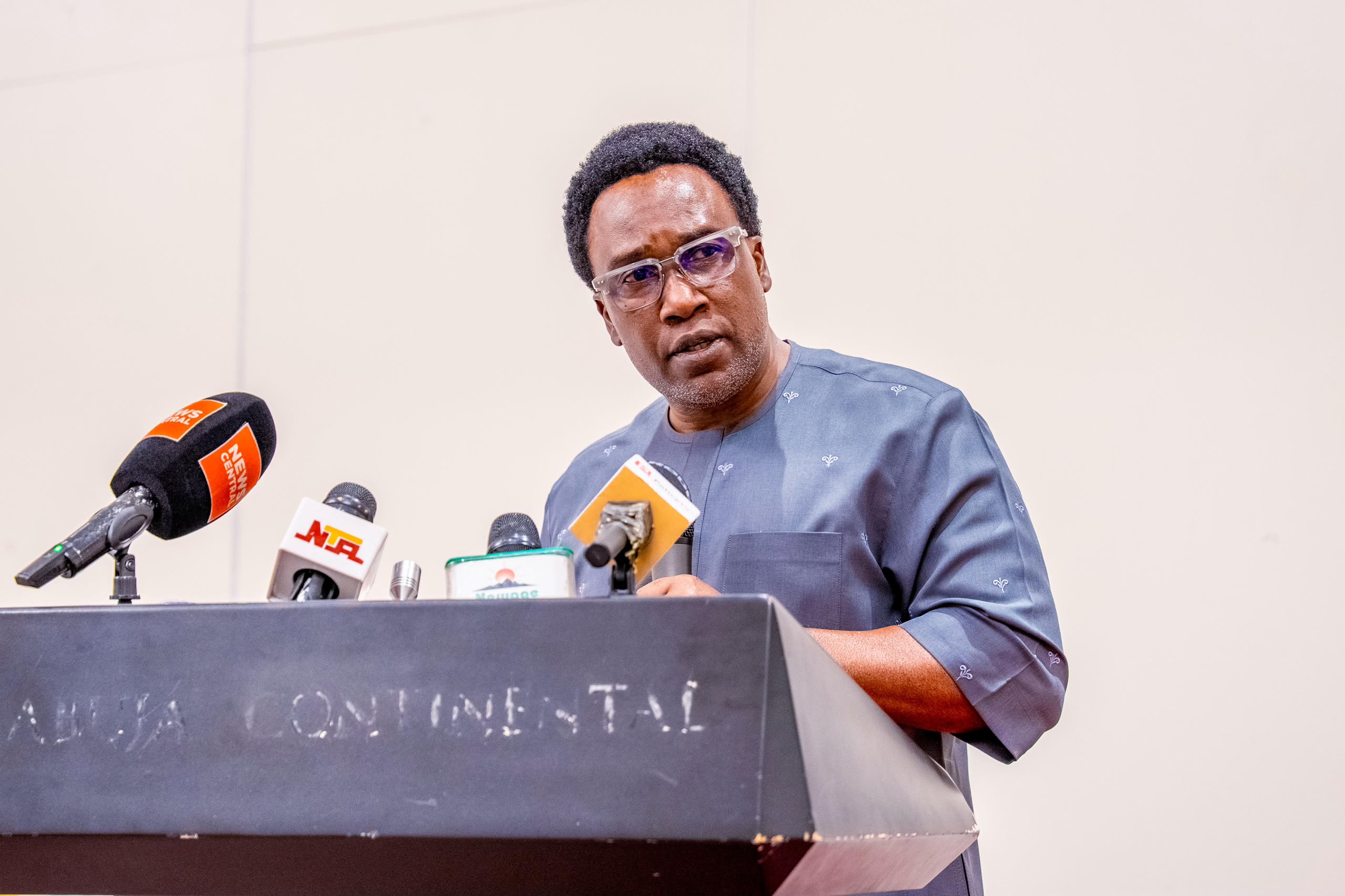
Photo caption: NiMet DG/CEO Prof. Charles Anosike speaking at the strategic dialogue.
Director General/CEO of the Nigerian Meteorological Agency (NiMet), Prof Charles Anosike, has commended the Minister of Agriculture and Food Security, Senator Abubakar Kyari, CON, for his efforts towards promoting climate-smart agriculture.
Anosike also urged stakeholders in the agriculture and good sector, to develop a practical, inclusive and measurable roadmap for integrating weather and climate services into decision-making across the sector’s value chain.
The NiMet boss stated this in his goodwill message at a National Strategic Dialogue on the Preparation of the AGROW Component 2.2 – National Implementation Strategy and Digital Agriculture Architecture, organised by the Federal Ministry of Agriculture and Food Security under the World Bank-supported Nigeria Sustainable Agricultural Value Chain (AGROW) Project.
The dialogue, held under the theme, “Building a Unified, Inclusive and Future-Ready Digital Agriculture Ecosystem for a More Productive, Resilient and Food-Secure Nigeria,” brought together key stakeholders to deliberate on strengthening Nigeria’s digital agriculture ecosystem.
Anosike confirmed NiMet’s commitment to strengthening weather and climate information services for farmers as part of efforts to build a more productive, resilient and food-secure agricultural sector in Nigeria.
He said the dialogue was important to NiMet given its mandate to provide weather and climate information that protects lives, supports livelihoods and enables informed planning across climate-sensitive sectors.
According to Anosike, climate variability, changing rainfall patterns and extreme weather events are increasingly affecting agriculture, making timely and reliable climate information critical to agricultural planning and decision-making.
He noted that NiMet provides Seasonal Climate Predictions, regular weather updates, agric meteorological services and impact-based advisories to help farmers make informed decisions on planting, water and input management, while reducing avoidable losses.
Some participants at the dialogue.
He emphasized the importance of digital agriculture as a critical pathway for translating climate information into practical, farm-level action and also highlighted NiMet’s partnerships with Tomorrow.io and MTN on the Digital Climate Advisory Services (DCAS) System, which is designed to deliver location specific weather advisories to farmers through mobile SMS.
The above, Anosike said, was in addition to NiMet’s collaboration with the Agricultural Innovation Mechanism for Scale (AIM for Scale) to strengthen the integration of AI-based weather forecasting with digital advisory systems.
He stressed the need for digital agricultural services to reach farmers through accessible and trusted channels, noting that collaboration with extension services, technology providers, telecommunications companies, community radio and farmer organisations would be essential for effective last-mile delivery.
The NiMet CEO also emphasised the importance of making such services responsive to farmers’ realities, including language, literacy, connectivity, affordability and gender inclusion, while involving farmers in the development of climate services.
He concluded his remark by expressing optimism that the dialogue would advance climate-smart, digitally enabled and farmer-centred agriculture, while reaffirming NiMet’s readiness to provide the technical leadership needed to strengthen climate services, support food security and build resilient livelihoods in Nigeria.
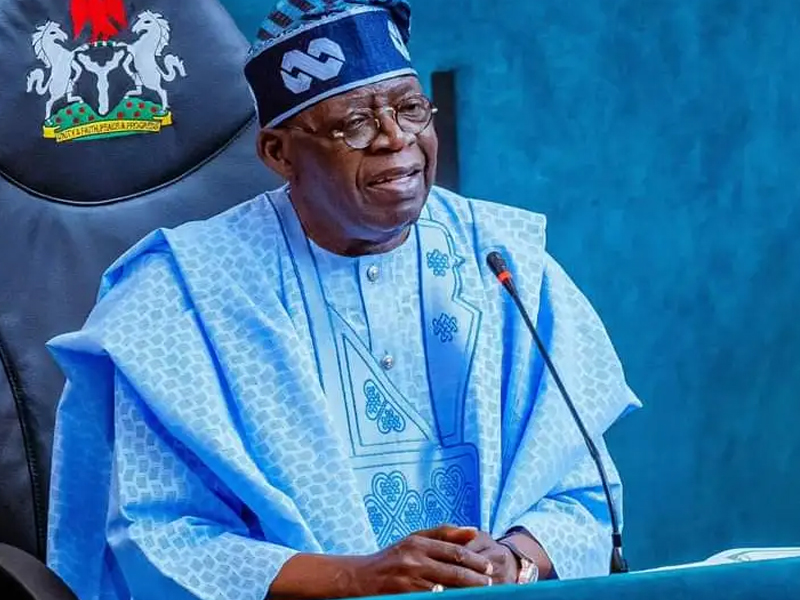
President Bola Tinubu on Monday disclosed that his government has created 650,000 jobs through its National Micro, Small and Medium Enterprises (MSME) Clinics in 19 states of the Federation and the Federal Capital Territory (FCT).
Tinubu also vowed to remove all bottlenecks militating against Nigerians turning ideas and skills into successful businesses.
The President made this known via his verified X handle, @officialABAT and explained that a tailor should not need millions of naira to buy industrial machinery before she can grow her business while a food processor should not have to build a factory before producing at scale.
This, he stated, informed why the Federal Government, “under our Renewed Hope administration, is investing in shared MSME hubs through our National MSME Clinics, giving entrepreneurs access to modern equipment, reliable power and production facilities without carrying the full cost alone.”
According to Tinubu: “Today, 21 shared facilities across 19 states and the FCT are supporting businesses and an estimated 650,000 jobs. ReadPolitical News
“Nigerians do not lack ideas, skill or ambition. Too often, they lack access to the tools and infrastructure needed to turn them into successful businesses.
“Our job is to remove those barriers.
“When small businesses can produce more, at lower cost, they become more competitive. They grow. They employ more people. They create income and opportunity for Nigerian families.
“Giving Nigerian enterprise the tools to succeed is how we build prosperity from the ground up. That is the Nigeria we are building.”
-

 News2 years ago
Senate to speed up conclusion of Nigeria Forest Security Service Bill
-
 News1 year ago
The Many Lies Against Bashir Haske
-

 News3 years ago
Breaking: Tinubu’s authentic ministerial nominees
-
 News3 years ago
“Anytime we want to kill terrorists, President would ask us to take permission from France but they were killing our soldiers-” Niger Republic coup leader
-

 News3 years ago
“I’m leaving the Catholic church because Bishop Onah is oppressing me,” says Okunerere
-

 News3 years ago
My nude photo leak was a mistake- lawyer Ifunanya
-
 News4 months ago
See your state governor’s performance ranking
-

 News3 years ago
Radio Nigeria’s veteran broadcaster Kelvin Ugwu dies three months after retirement from service