
News
With Soludo, no place for lawlessness in Anambra

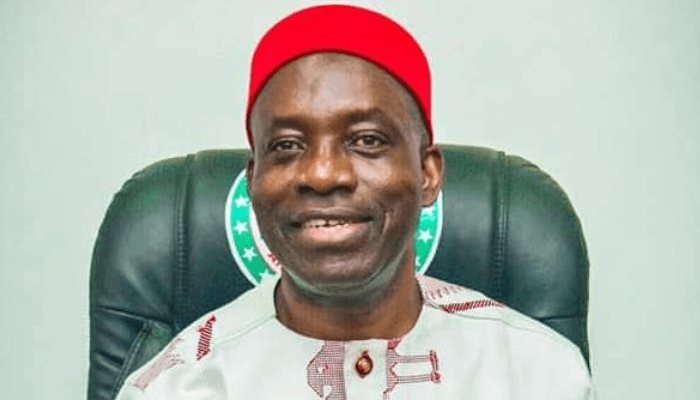
By Christian ABURIME
_“If you want to make enemies, try to change something.”– Woodrow Wilson_
When Woodrow Wilson, an American politician and academic who served as the 28th president of the United States from 1913 to 1921 said “If you want to make enemies, try to change something,” he aptly captured the resistance faced by well-intentioned governments seeking positive societal change for the benefit of the vast majority of the people.
It is indeed a truism that asserts universal relevance. When a government endeavours to disrupt established norms for the greater good, opposition arises from those entrenched in the status quo.
The resistance often stems either from a fear of the unknown, vested political interests, or just a pathological reluctance to embrace change.
In Anambra State today, the controversy surrounding Governor Charles Soludo’s resolute commitment to upholding law and order has not only sparked needless hullabaloo and wagging tongues of criticism, it has attracted a barrage of uncouth verbiage and bilious name-calling from all sorts.
Detractors now accuse the governor of neglecting crucial governance issues while focusing on what they consider ‘trivial matters’ of law enforcement.
However, a closer, objective contemplation would reveal a visionary leader dedicated to transforming Anambra into a bastion of order, progress, and prosperity. Yet, some people are resisting change and encouraging lawlessness!
The recent incident involving Prof. Lilian Orogbu, a lawmaker representing Awka North and South Federal Constituency, brought this unfortunate evolving scenario to the forefront. Her caustic condemnation of the enforcement of anti-street trading laws at Unizik Junction to Okpuno, Awka by the Awka Capital Territory Development Authority (ACTDA) may have stirred emotions, but it is imperative to dissect the facts from the political rhetoric.
The easy recourse to cheap populism of whipping up sentiments against the government is only muddling the waters of facts. Governor Soludo’s infrastructure initiatives in Awka, marked by newly constructed roads with side-walks, are aimed at ushering in a new era of development to make the vision of a modern, livable Anambra mega city a reality.
However, these well-intentioned projects are facing an unexpected challenge as hawkers and traders quickly occupy the side-walks, turning them into makeshift stalls. This not only compromise the aesthetics of the roads but also pose significant risks, with covered drainages turning into waste disposal channels and traders and pedestrians exposed to potential accidents.
To address this issue, ACTDA embarked on an aggressive public enlightenment campaign from December 15, 2023. Television, radio, social media, and mobile town criers were utilised to educate the public on the consequences of street trading and the impending enforcement measures.
Despite these efforts, some street traders engaged in a cat-and-mouse game, temporarily vacating the sidewalks only to return once the town criers had left. In the week leading up to the final enforcement, repeated warnings were issued again through town criers, emphasising the risk of errant traders losing their wares during the impending crackdown.
Regrettably, these warnings went unheeded, prompting the government to finally take decisive action. And then, the affected traders started shedding crocodile tears, accusing the government of insensitivity, while arm-chair critics quickly jumped in their defence, lampooning the government and calling the governor names.
The orchestrated resistance to government’s well-intentioned actions now reeks of mischievous aggravation and politicisation of issues. Yet, Governor Soludo’s administration is firmly grounded in five major policy pillars, one of which is the maintenance of law and order.
Contrary to accusations of neglecting essential governance matters, the government’s proactive stance on enforcing laws is a crucial step toward restoring sanity in society. A responsible government cannot stand idly by when citizens blatantly violate laws established for the greater good.
For Anambra State to progress towards becoming a livable and prosperous homeland, adherence to the rule of law is non-negotiable.
It is a paradox that Nigerians, including Ndi Anambra, awe-struck by the orderliness of developed societies when abroad, resist similar attempts at home. Let it be clear: Governor Soludo’s resolve to bring order to Anambra is not an attack on personal liberties or an attempt to render people jobless; rather, it is a commitment to creating a conducive environment for growth and progress.
By and large, critics of Anambra State government can do better employing a civilised manner of engagement with the government over contentious issues than resorting to throwing insults and accusing the governor of insensitivity, inhumanity, pettiness and misplacement of priorities. Ndi Anambra should be above such derogatory conduct.
Governor Soludo’s pursuit of law and order is in the interest of everyone, as this confirms his dedication to building a prosperous Anambra.
In conclusion, the criticisms being levied against him pale in comparison to the long-term benefits of a well-organised and law-abiding society the governor seeks. It is time for the people of Anambra State to shift their perspective of government’s actions and rally behind their governor, recognising that adherence to the rule of law is the cornerstone of progress and prosperity.
Non-adherence is an invitation to an anarchic society where anything goes and life is short, nasty and brutish. Who wants a society where anything goes? Certainly, not Governor Soludo.
…. Aburime is the Press Secretary to the Anambra state Governor.

Chairman of the Nigeria Democratic in Congress (NDC), Fiidi Council Ward in Makurdi Local Government Area of Benue State, Igbu Terhemen, has reportedly been killed by unknown assailants.
Terhemen was said to have been attacked and left unconscious in a bush near his residence around the NNPC Depot, along the Makurdi-Otukpo Road, on the outskirts of Makurdi, the state capital.
A friend of the deceased, who spoke on condition of anonymity, said Terhemen left his residence on Tuesday evening to watch a local football match in the Kanshio axis of the town but did not return home.
According to him, family members and friends became worried after the deceased failed to return and subsequently began searching for him.
He said, “He left home to watch the match Tuesday evening and he was expected back home, but nobody saw him. It was while people were looking around for him that he was discovered around 2am Wednesday in a bush near his residence unconscious.
“Unfortunately, he died before he could get medical attention. Strangely, his attackers did not take his phone, which was discovered on him when he was taken to the morgue.
“There was also a needle-like injury on his body, indicating that he could have been injected with a substance by his attackers, dumped in the bush and left to die.
“All that is left for the police to uncover in the course of their investigation because this is a sad development in the state.”
The incident has sparked concern among members of the NDC, with the state chapter condemning the alleged killing and calling on security agencies to investigate the circumstances surrounding Terhemen’s death.
In a statement issued by the party’s State Publicity Secretary, Agile Bem, the NDC described the deceased as a committed member who contributed significantly to the growth of the party in the state.
The statement said, “The Nigeria Democratic Congress (NDC), Benue State Chapter, has condemned the gruesome murder of Hon. Igbu Terhemen, who, until his death, was the NDC Chairman of Fiidi Council Ward in Makurdi Local Government Area.
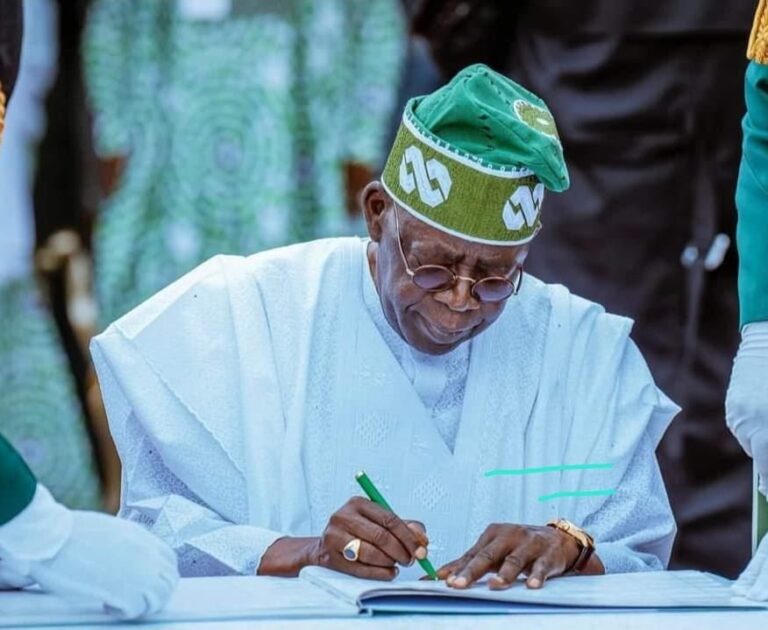
President Bola Ahmed Tinubu has signed into law the Appropriation (Amendment) (No.4) Bill, 2025, extending the implementation period of the 2025 budget from September 30, 2026 to December 31, 2026.
Presidential spokesman, Bayo Onanuga stated this in a press release on Wednesday, saying the president’s assent followed the amendment’s swift passage by both the Senate and the House of Representatives on Tuesday, September 29, 2026.
According to Onanuga, the extension gives Ministries, Departments and Agencies more time to complete ongoing capital projects. It ensures that funds already appropriated are fully put to work for Nigerians, without disrupting critical programmes.
“The President commended the leadership and members of the National Assembly for their prompt consideration of the bill, a further sign of the cooperation between the Executive and the Legislature in the service of the nation,” Onanuga said.

Governor of Rivers State, His Excellency Sir Siminalayi Fubara, has congratulated the federal government to and people of Nigeria on the occasion of the country’s 66 independence anniversary.
Fubara also called on the people of the State to embrace peace and unity, describing them as indispensable pillars for the socioeconomic development of any society.
In a goodwill message issued on Fubara’s behalf by Onwuka Nzechi, Chief Press Secretary to the Governor, he said the anniversary celebration offers an opportunity for the people to reflect on Nigeria’s journey since 1960 and to renew their commitment to peaceful coexistence.
The Governor noted that Rivers State, as the “treasure base of the nation” and a melting pot of diverse ethnic nationalities, has always thrived when its people lived in harmony. He said no meaningful development can take place in an atmosphere of rancour, division and political hostility.
According to him, while political differences are normal in a democracy, they must never be allowed to undermine the collective interest of the State. “We may disagree as politicians, but we must never disagree on the peace and progress of Rivers State,” he stated.
Governor Fubara stressed that since assumption of office, his administration has anchored its governance philosophy on peace, describing it as the most invaluable infrastructure. He said the relative peace enjoyed in the State today has made it possible for his government to attract investments and execute projects across the three senatorial districts.
He therefore appealed to youths, traditional rulers, political leaders and all stakeholders to be ambassadors of peace in their communities, wards and local government areas, stressing that no one benefits when the State is in crisis.
The Governor further urged Rivers people to continue to support the Federal Government under President Bola Ahmed Tinubu, noting that national unity and sub-national cooperation are critical to achieving the goals of the Renewed Hope Agenda.
-

 News2 years ago
Senate to speed up conclusion of Nigeria Forest Security Service Bill
-

 News1 year ago
The Many Lies Against Bashir Haske
-

 News3 years ago
Breaking: Tinubu’s authentic ministerial nominees
-

 News3 years ago
“Anytime we want to kill terrorists, President would ask us to take permission from France but they were killing our soldiers-” Niger Republic coup leader
-

 News3 years ago
“I’m leaving the Catholic church because Bishop Onah is oppressing me,” says Okunerere
-

 News3 years ago
My nude photo leak was a mistake- lawyer Ifunanya
-
 News4 months ago
See your state governor’s performance ranking
-

 News3 years ago
Radio Nigeria’s veteran broadcaster Kelvin Ugwu dies three months after retirement from service