
News
INEC suspends officer over vote information leak to Wike’s aide


The Independent National Electoral Commission (INEC) has suspended an electoral officer linked to the recent unauthorised disclosure of voter information, as investigations by security agencies and data protection regulators continue.
The development was disclosed on Thursday by Mohammed Haruna, INEC National Commissioner and Chairman of the Information and Voter Education Committee, during a fireside chat on the recently concluded Ekiti governorship election organised by the Peering Advocacy and Advancement Centre in Africa (PAACA) in Abuja.
The controversy emerged after voter registration details belonging to actor and politician Emeka Ike surfaced online during a dispute arising from a political party primary election in the Federal Capital Territory (FCT), raising concerns about the security of voter records.
INEC subsequently launched an investigation into what it described as the unauthorised release of information obtained from its Continuous Voter Registration (CVR) database.
According to the commission, preliminary findings showed that its ICT infrastructure was not hacked and that there was no wider compromise of the national voter register. Instead, the information was allegedly accessed through valid credentials assigned to personnel involved in the ongoing CVR exercise and later released without authorisation.
The commission said its internal audit system identified the user account used to retrieve the voter record, leading investigators to the personnel with access to the platform.
INEC stressed that the incident involved only a single voter record and did not affect the personal data of more than 90 million registered voters in its database.
Haruna said the commission acted immediately after discovering the breach, suspending the officer and removing him from his position pending the outcome of investigations.
“As soon as this thing happened, we were worried and took immediate steps. As I am talking to you now, the officer involved is under suspension. He is no longer functioning in that office,” he said.
He added that the commission had concluded its internal inquiry and handed the matter over to relevant authorities for further action.
Haruna revealed that the officer admitted involvement in the incident and allegedly acted out of personal grievances linked to previous interactions with political actors.
While declining to disclose further details due to ongoing investigations, he said the matter had been reported to data protection regulators, while the Nigeria Police Force and the Department of State Services (DSS) were conducting separate probes.
“The police have done their own investigation. The DSS has also conducted investigations. We have completed our internal investigation and suspended the officer. We are waiting for the final reports before taking the next step,” he said.
The INEC commissioner maintained that the incident should not be interpreted as evidence of systemic weaknesses in the commission’s data management system.
He said the electoral body would continue strengthening safeguards around voter information and remain committed to protecting the personal data of Nigerians.
Haruna also called for greater public understanding of how voter information is collected, stored and managed, arguing that increased awareness would help counter misinformation about election technology and data security.
According to him, INEC will continue working with data protection regulators, civil society groups and security agencies to strengthen public confidence in the management of voter information ahead of future elections.
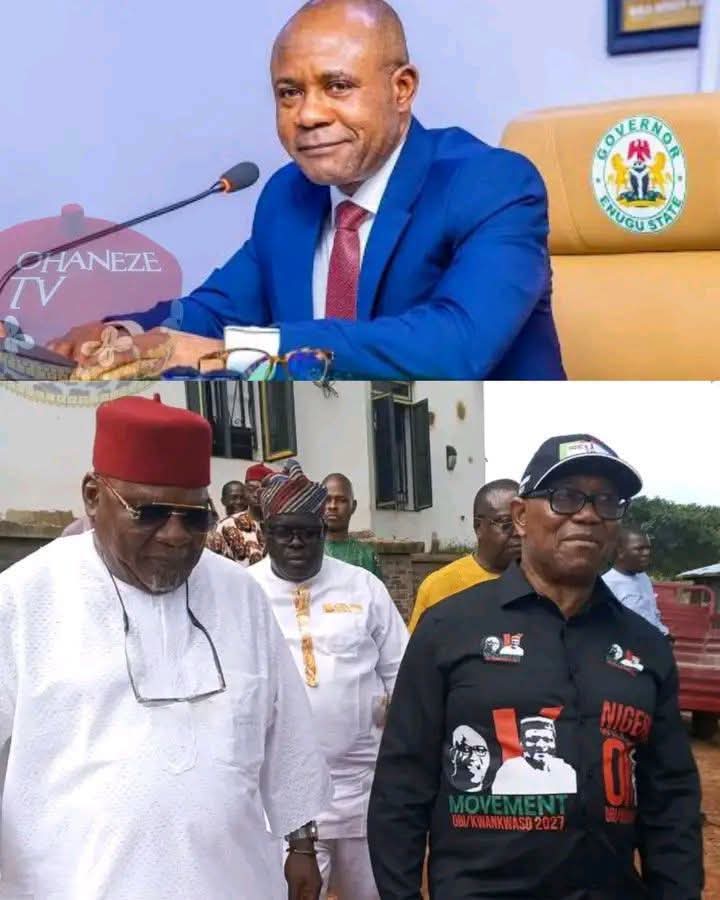
The Enugu State Government has suspended His Royal Majesty, Igwe Eze William Ezugwu, the traditional ruler of Ibagwa Ogbozalla Opi Autonomous Community, in Nsukka Local Government Area of Enugu state.
The state government accused Igwe Ezugwu of violating provisions of the state’s Traditional Rulers Law.
In a letter of suspension dated September 24, the Enugu State Government cited his alleged failure to constitute his cabinet, failure to establish a Town Union governing body, and persistent conduct deemed inconsistent with the laws governing traditional rulers in the state.
The suspension comes barely three weeks after Igwe William Ezugwu received NDC presidential candidate Peter Obi at his palace in Opi, Nsukka LGA, where he reportedly blessed Obi’s presidential ambition.
The Deputy Commander of Operation Rainbow, CSP (Chief Superintendent of Police) Dennis David Babale, has been killed after gunmen suspected to be Fulani Bandits ambushed personnel of the security outfit along the Bokkos-Barkin Ladi road in Barkin Ladi Local Government Area of Plateau State.
Operation Rainbow is a State-backed community security and intelligence-gathering outfit in Plateau State, Nigeria, originally established in 2010 under former Governor Jonah Jang and recently revamped by Governor Caleb Mutfwang to combat rural violence and beef up grassroots security.
The incident reportedly occurred at about 4:06 p.m. on Tuesday, September 22, 2026 when the personnel, travelling in a Toyota Hilux vehicle, came under attack by unidentified gunmen.
Troops of Sector 4, Operation ENDURING PEACE (OPEP), responded to a distress report and moved to the location of the attack.
Sources told reporters that Babale sustained gunshot wounds during the ambush and was evacuated to the General Hospital, Barkin Ladi, for medical attention.
Following the attack, troops, working alongside personnel of other security agencies, launched offensive operations and a manhunt for the assailants within the general area.
Security forces have intensified efforts to track the attackers and prevent further attacks along the route.

Director General/CEO of the Nigerian Meteorological Agency (NiMet) and Nigeria’s Permanent Representative at the World Meteorological Organization, Prof. Charles Anosike and other Chief Executive Officers of similar agencies across the world, have concluded a one week high level dialogue on Climate Science Information for Climate Finance and the 53rd Senior Official Field Exchange (SOFE) in Beijing, China.
The event which was hosted by World Meteorological Organization (WMO), took place from September 14 to 18, 2026 and featured discussions on: strengthening the role and leadership development of National Meteorological and Hydrological Services (NMHSs) in mobilizing climate finance; aligning scientific and technical capabilities with risk-informed, people-centred early warning systems; shifting from technical assistance to sustainable investments by expanding practical cooperation between meteorological frameworks and multilateral financing entities; and support to NMHSs leadership on strengthening strategic thinking and fostering productive partnerships.
Held back-to-back with the High-level dialogue was the 53rd Senior Official Field Exchange to Fujian Province for first-hand exposure to the implementation of Multi-hazard, Alert, Zero-gap and Universal (MAZU) platform – China’s AI-driven meteorological early warning solution in support of the Early Warnings for All (EW4All) initiative and disaster risk reduction practices through technical exchanges, field visits and peer learning.
-

 News2 years ago
Senate to speed up conclusion of Nigeria Forest Security Service Bill
-

 News1 year ago
The Many Lies Against Bashir Haske
-

 News3 years ago
Breaking: Tinubu’s authentic ministerial nominees
-
 News3 years ago
“Anytime we want to kill terrorists, President would ask us to take permission from France but they were killing our soldiers-” Niger Republic coup leader
-

 News3 years ago
“I’m leaving the Catholic church because Bishop Onah is oppressing me,” says Okunerere
-

 News3 years ago
My nude photo leak was a mistake- lawyer Ifunanya
-
 News4 months ago
See your state governor’s performance ranking
-

 News3 years ago
Radio Nigeria’s veteran broadcaster Kelvin Ugwu dies three months after retirement from service