
News
Kali Shani Vs Mike Ozekhome: How a Legal Mole- Hill was Turned into a Mountain


By Abubakar D. Sani, Esq
INTRODUCTION
News of the decision of a British Tribunal in respect of a property situate in London, the UK’s capital, whose ownership was disputed has gained much publicity since it was delivered in the second week of September 2025. For legal reasons, the charges brought against prominent lawyer, Chief Mike Ozekhome, SAN, based on same is the most that can be said of it as no arraignment was made before Hon. Justice Kekemeke of the High court of the FCT, Abuja, sitting in Maitama.
Accordingly, this intervention will be limited to interrogating the common, but false belief (even in legal circles), that the Tribunal somehow indicted him with conclusive ‘guilt’. I intend to argue that this belief is not correct; and that, on the contrary, nothing could be further from the truth. For the sake of context, therefore, it is necessary to refer to relevant portions of the decision of Judge Paton (the name of the Tribunal’s presiding officer), which completely exonerated Chief Ozekhome, but which his detractors have always conveniently suppressed.
WHAT DID THE TRIBUNAL SAY?
Not a few naysayers, smart-alecs, emergency analysts and self-appointed pundits have been quick to latch on to some passages in the judgement of the Tribunal which disagreed with Ozekhome’s testimony to justify their crucifixion of Chief Ozekhome – even without hearing his side of the story or his version of events. This is a pity, of course, especially for the supposedly learned senior lawyers among them who, by ignoring the age-old principle of fair hearing famously captured as audi alterem partem (hear the other side) have unwittingly betrayed patent bias, malice, malevolence and utter lack of bona fides as the major, if not exclusive, motivator of their view-points and opinions. I have particularly watched about five of such senior lawyers shop from one platform to another, with malicious analysis to achieve nothing, but reputational damage. They know themselves.
Before proceeding to those portions, it is important to acknowledge that the Tribunal conducted a review of the evidence placed before it. The proceedings afforded all parties the opportunity to present their respective cases. The learned Judge carefully evaluated the testimonies, documentary exhibits and surrounding circumstances and rendered a reasoned decision based on the materials before the Tribunal.
It is also not in doubt that the Tribunal made certain critical observations in the course of assessing the credibility of the witnesses and the plausibility of their explanations. Such evaluative comments are a normal and inevitable feature of judicial fact-finding, particularly in property tribunals in contested proceedings involving complex transactions and disputed narratives. They do not amount to indictment.
It is precisely the improper isolation and mischaracterization of some of these observations that have given rise to the present misconception that the Tribunal somehow pronounced a verdict of guilt on Chief Ozekhome. It is therefore necessary to place the relevant excerpts in their proper legal and factual context, so as to demonstrate how the self-same tribunal exonerated Ozekhome.
“Paragraph 98: Once one steps back from that material, and considers the Respondent’s own direct personal knowledge of relevant matters relating to this property, this only commences in 2019. That is, he confirmed, when he was first introduced to Mr. Tali Shani – he thought in about January of that year. He did not therefore know him in 1993, or at any time before January 2019. He could not therefore have any direct knowledge of the circumstances of the purchase of this property, or its management prior to 2019. He had, however, known the late General Useni for over 20 years prior to his death, as both his lawyer and friend.
“Paragraph 103: Such of the Respondent’s written evidence had been about the very recent management of the property, and in particular his dispute over its management (and collection of rents) with one Nicholas Ekhorutowen, who provided no evidence in this case. The Respondent confirmed in oral evidence that it was upon the execution of the powers of attorney that he came into possession of the various pre registration title and conveyancing documents which formed part of his disclosure. These had been handed over to him by the next witness who gave evidence, Mr. Akeem Johnson.
“Paragraph 168: Unlike the fictitious “Ms. Tali Shani”, a man going by the name of Mr. Tali Shani exists and gave evidence before me in that name. A certified copy of an official Nigerian passport was produced both to the Land Registry and this Tribunal, stating that Mr. Tali Shani was born on 2nd April 1973. I do not have the evidence, or any sufficient basis, to find that this document – unlike the various poor and pitiful forgeries on the side of the “Applicant” – is forged, and I do not do so.
“Paragraph 200: First, I find that General Useni, since he was in truth the sole legal and beneficial owner of this property (albeit registered in a false name), must in some way have been connected to this transfer, and to have directed it. He was clearly close to, and on good terms with, the Respondent. There is no question of this being some sort of attempt by the Respondent to steal the general’s property without his knowledge.
“Paragraph 201: As to precisely why General Useni chose to direct this transfer to the Respondent, I do not need to (and indeed cannot) make detailed findings. I consider that it is highly possible that it was in satisfaction of some debt or favour owed. The Respondent initially angrily denied the allegation (made in the various statements filed on behalf of the “Applicant”) that this was a form of repayment of a loan of 54 million Naira made during the general’s unsuccessful election campaign. In his oral evidence, both he and his son then appeared to accept that the general had owed the Respondent some money, but that it had been fully paid off. The general himself, when asked about this, said that he “did not know how much money he owed” the Respondent.
“Paragraph 202: I do not, however, need to find precisely whether (and if so, how much) money was owed. The transfer may have been made out of friendship and generosity, or in recognition of some other service or favour. The one finding I do make, however, is that it was the decision of General Useni to transfer the property to the Respondent.”
It must be emphasised that even where a court finds that a witness has given inconsistent, fluctuating, or implausible testimony, as some have latched on, such a finding does not, without more, translate into civil or criminal liability. At best, it affects the weight and credibility to be attached to such evidence. It does not constitute proof of fraud, conspiracy, or criminal intent. See MANU v. STATE (2025) LPELR-81120(CA) and IKENNE vs. THE STATE (2018) LPELR-44695 (SC)
Notwithstanding the Tribunal’s engagement with the evidence, certain passages had been selectively extracted and sensationalised by critics. On the ipssisima verba (precise wordings) of the Tribunal, only the above paragraphs which are always suppressed clearly stand out in support of Chief Ozekhome’s case, as the others were more like opinions.
Some paragraphs in the judgement in particular, appear to have been carefully selected as “weapons” in Chief Ozekhome’s enemies’ armoury, as they are most bandied about in the public space. The assumption appears to be that such findings are conclusive of his guilt in a civil property dispute. This is unfortunate, as the presumption of innocence is the bedrock of our adversarial criminal jurisprudence. It is a fundamental right guaranteed under section 36 of the Constitution and Article 7 of the African Charter which, regrettably, appear to have been more observed in the breach in his case.
More fundamentally, the selective reliance on few passages that disagreed with his evidence or testimony and that of Mr. Tali Shani, ignore the above wider and more decisive findings of the Tribunal itself. A holistic reading of the judgment reveals that the Tribunal was far more concerned with exposing an elaborate scheme of impersonation, forgery, and deception orchestrated in the name of a fictitious Applicant, Ms Tali Shani, and not Mr. Tali Shani (Ozekhome’s witness), who is a living human being. These findings, which have been largely ignored in public discourse, demonstrate that the gravamen of the Tribunal’s decision lay not in any indictment of Chief Ozekhome, but in the collapse of a fraudulent claim against him, which was founded on false identity and fabricated documents.
The Tribunal carefully distinguished a fake “Ms” Tali Shani (the Applicant), who said she was General Useni’s mistress and owner of the property, and the real owner, Mr Tali Shani, who was Chief Ozekhome’s witness before the Tribunal. It was the Tribunal’s finding that she was nothing but a phantom creation and therefore rejected her false claim to the property (par. 123). It also rejected the evidence of her so called cousin (Anakwe Obasi) and purported son (Ayodele Obasi) (par. 124).
The Tribunal further found that it was the Applicant and her cohorts that engaged in diverse fraud with documents such as a fraudulent witness statement purportedly from General Useni; all alleged identity documents; fabricated medical correspondence; the statement of case and witness statements; a fake death certificate; and a purported burial notice. (Paragraph 125). Why are these people not concerned with Barrister Mohammed Edewor, Nicholas Ekhoromtomwen, Ayodele Damola, and Anakwe Obasi? Why mob-lynching Chief Ozekhome?
The Tribunal found that the proceedings amounted to an abuse of process and a deliberate attempt to pervert the course of justice. It therefore struck out the Applicant’s claim (Paragraphs 130–165). The Tribunal significantly found that Mr Tali Shani exists as a human being and had testified before it in June, 2024. It accepted a certified Nigerian passport he produced, and accepted its authenticity and validity (Paragraph 168). Can any objective person hold that Ozekhome forged any passport as widely reported by his haters when the maker exists?
Having examined the factual findings of the Tribunal and their proper context, the next critical issue is the legal status and probative value of such findings. The central question, therefore, is whether the observations and conclusions of a foreign tribunal, made in the course of civil proceedings, are sufficient in law to establish civil or criminal liability against a person in subsequent proceedings.
STATUS OF JUDGEMENTS UNDER THE LAW
The relevant statutory provisions in Nigeria are sections 59, 60, 61, 173 and 174 of the Evidence Act 2011, provide as follows, respectively:
Section 59: “The existence of any judgment, order or decree which by law prevents any court from taking cognisance of a suit or holding a trial, is a relevant fact, evidence of which is admissible when the question is whether such court ought to take cognisance of such suit or to hold such trial”;
Section 60(I): “A final judgment, order or decree of a competent court, in the exercise of probate. Matrimonial, admiralty or insolvency jurisdiction, which confers upon or takes away from any person any legal character. or which declares any person to be entitled to any such character or to be entitled to any specific thing, not as against any specified person but absolutely, is admissible when the existence of any such legal character, or the title of any such legal persons to an) such thing, is relevant (2) Such judgment, order or decree is conclusive proof (a)that any legal character which it confers accrued at the time when such judgment, order or decree came into operation; (b) that any legal character. to which it declares any such person to be entitled. accrued to that person at the time when such judgment order or decree declares it to have accrued to that person; (c) that any legal character which it takes away from any such person ceased at the time from which such judgment, order or decree declared that it had ceased or should cease; and (d) that anything to which it declares any person to be so entitled was the property of that person at the time from which such judgment. order or decree declares that it had been or should be his property”;
Section 61: “Judgments, orders or decrees other than those mentioned in section 60 are admissible if they relate to matters of a public nature relevant to the inquiry; but such judgments, orders or decrees are not conclusive proof of that which they state”
Section 173: “Every judgment is conclusive proof, as against parties and privies. of facts directly in issue in the case, actually decided by the court. and appearing from the judgment itself to be the ground on which it was based; unless evidence was admitted in the action in which the judgment was delivered which is excluded in the action in which that judgment is intended to be proved”.;
Section 174(1): “If a judgment is not pleaded by way of estoppel it is as between parties and privies deemed to be a relevant fact, whenever any matter, which was or might have been decided in the action in which it was given, is in issue, or is deemed to be relevant to the issue in any subsequent proceeding”;
(2):”Such judgment is conclusive proof of the facts which it decides, or might have decided, if the party who gives evidence of it had no opportunity of pleading it as an estoppel”.
It can be seen that the decision of the Tribunal falls under the purview of section 61 of the Evidence Act, as the provisions of sections 59 and 60 and of sections 173 and 174 thereof, are clearly inapplicable to it. In other words, even though some Judge Paton’s findings in respect of Chief Ozekhome’s testimony at the Tribunal relate to matters of public nature (i.e., the provenance and status of No. 79 Randall Avenue, Neasden, London, U.K and the validity of his application for its transfer to him) none of those comments or even findings is in any way conclusive of whatever they may assert or state (to use the language of section 60 of the Evidence Act).
In this regard, see the case of DIKE V NZEKA (1986) 4 NWLR pt.34 pg. 144 @ 159 where the Supreme Court construed similar provisions in section 51 of the old Evidence Act, 1948. I agree with Tar Hon, SAN (S. T. Hon’s Law of Evidence in Nigeria, 3rd edition, page 1041) that the phrase ‘public nature’ in the provision is satisfied where the judgement is clearly one in rem as opposed to in personam. It is pertinent to say a few words about both concepts, as they differ widely in terms of scope. The former determines the legal status of property, a person, a particular subject matter, or object, against the whole world, and is binding on all persons, whether they were parties to the suit or not. See OGBORU V IBORI (2005) 13 NWLR pt. 942 pg. 319 @407-408 per I. T. Muhammed, JCA (as he then was).
This was amplified by the apex court in OGBORU V UDUAGHAN (2012) LLJR -SC, where it held, per Adekeye, JSC that: “A judgment in rem maybe defined as the judgment of a court of competent jurisdiction determining the status of a person or thing as distinct from the particular interest of a party to the litigation. Apart from the application of the term to persons, it must affect the “res” in the way of condemnation forfeiture, declaration, status or title”.
By contrast, “Judgments ‘in personam’ or ‘inter partes’, as the name suggests, are those which determine the rights of parties as between one another to or in the subject matter in dispute, whether it be corporeal property of any kind whatever or a liquidated or unliquidated demand but which do not affect the status of either things or persons or make any disposition of property or declare or determine any interest in it except as between the parties (to the litigation). See HOYSTEAD V TAXATION COMMISSIONERS (1926) A. C. 155. These include all judgments which are not judgments in rem. None of such judgments at all affects any interest which third parties may have in the subject matter. As judgment inter partes, though binding between the parties and their privies, they do not affect the rights of third parties. See CASTRIQUE V IMRIE 141 E. R. 1062; (1870) L. R. 4H. L. 414”.
Suffice it to say that the decision of the London Property Tribunal was, in substance, one affecting proprietary rights in rem, in the sense that it determined the status and registrability of the property in dispute. However, it did not determine any civil or criminal liability, nor did it pronounce on the personal culpability of any party. The implication of this is that, even though the decision was in respect of a matter of a public nature, it was, nonetheless, not conclusive as far as proof of the status of the property, or – more importantly – Chief Ozekhome’s role in relation to it. Indeed, the property involved was not held to have been traced to the owner (General Useni) as having ever tried or convicted for owning same. I submit that the foregoing is the best case scenario in terms of the value of Judge Paton’s said decision, because under section 62 of the Evidence Act, (depending, of course, on its construction), it will fare even worse, as it provides that judgments “other than those mentioned in sections 59. 60 and 61 are inadmissible unless the judgment, etc is a fact in issue or is admissible under some other provision of this or any other Act”.
CONCLUSION
Some people’s usual proclivity to rush to judgment and condemn unheard any person (especially a high profile figure like Chief Ozekhome), has exposed him to the worst kind of unfair pedestrian analysis, malice, mud-slinging and outright name-calling especially by those who, by virtue of their training, ought to know better, and, therefore, be more circumspect, restrained and guarded in their utterances. This is all the more so because, no court of competent jurisdiction has tried or pronounced him guilty. It is quite unfortunate how some select lawyers are baying for his blood.
The decision of the London Tribunal remains what it is: a civil determination on attempted transfer of a property based on the evidence before it. It is not, and cannot be, a substitute for civil or criminal adjudication by a competent court. The presumption of innocence under Nigerian laws remains inviolable. Any attempt by commentators to usurp that judicial function through premature verdicts is not only improper, but inimical to the fair administration of justice.
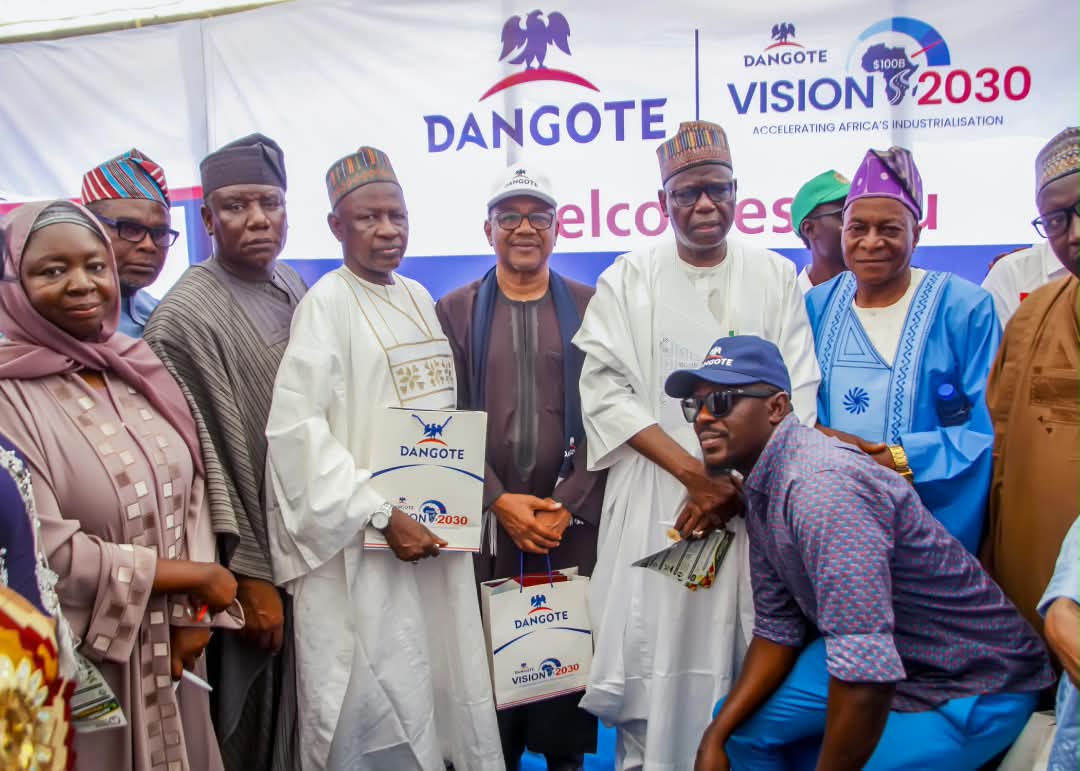
Photo caption: From L-R: General Manager, Government Relations, Dangote Group. Hashim Ahmed, with National President of AFAN. Hon Muhammad Magaji during the official opening ceremony of the 2026, National Agricultural Show in Keffi Nasarawa State… Tuesday.
Industry leaders and key stakeholders in Nigeria’s agricultural sector have applauded Dangote Group for its strategic investments and contributions to agricultural development, food security and agro-industrial growth, describing the conglomerate’s initiatives as critical to unlocking Africa’s vast agricultural potential.
The commendation came at the 2026 National Agricultural Show, organised by the National Agricultural Foundation of Nigeria (NAFN), where stakeholders highlighted Dangote Group’s investments across the agricultural value chain, particularly in fertiliser production, rice cultivation and processing, sugar production, mechanised farming and backward integration.
This is coming as the Nigerian industrialist Aliko Dangote is in discussions with the Ghanaian government over a proposed arrangement to process 500,000 metric tonnes of cocoa locally.
The development comes as Ghana intensifies efforts to boost domestic cocoa processing and add value to its cocoa beans instead of exporting them predominantly in their raw form.
Dangote Industries Limited is driving Nigeria’s agricultural self-sufficiency through multibillion-dollar investments in fertiliser manufacturing, large-scale commercial farming, and agro-processing for rice and sugar to reduce food import dependence.
The National Coordinator of NAFN, Hajiya Aishatu Rufa’i Ibrahim, described the partnership between the Foundation and Dangote Group as instrumental to its success in promoting private-sector participation in agricultural development, industrialisation and food security.
Speaking at the official opening of the 2026 National Agricultural on Tuesday, Mrs Ibrahim commended the Group for its contributions to Nigeria’s economic development and urged its President, Alhaji Aliko Dangote, to further expand his investments in the agricultural sector.
According to her, Dangote’s experience in large-scale industrial investments could help transform agriculture through mechanisation, agro-processing, storage, logistics and commodity production.
She called on more indigenous investors to emulate Dangote Group by viewing agriculture as a viable business opportunity capable of generating wealth, creating jobs and securing Nigeria’s food future.
Hajiya Ibrahim explained that this year’s Show, themed “Building a Resilient Nigerian Agrifood System: Empowering Farmers, Mobilising Investment and Driving Innovation for Food Security and Shared Prosperity,” goes beyond the traditional exhibition of agricultural products by providing a strategic platform for connecting farmers, investors, policymakers and technology providers to develop practical solutions to Nigeria’s food security challenges.
The National President of the All Farmers Association of Nigeria (AFAN), Hon. Muhammad Magaji Gettado, also commended Dangote Group for its investments in the agricultural sector, noting that the participation of major private-sector players such as the Group was essential to accelerating Nigeria’s agricultural transformation.
He said the agricultural programmes and policies of the President Bola Ahmed Tinubu-led Federal Government were yielding positive results, but stressed the need for stronger collaboration among government, private-sector investors such as Dangote Group, commercial farmers and small holder farmers to enhance productivity, boost food production and strengthen food security.
Similarly, the representative of the Nasarawa State Governor and Commissioner for Agriculture, Mohammed Iyimoga Oyigye, acknowledged the importance of private-sector investments, particularly those of Dangote Group, in advancing agricultural development and strengthening Nigeria’s food production capacity.
He said Governor Abdullahi Sule had made significant investments in the science, practice and business of agriculture in the state, adding that partnerships with major investors such as Dangote Group would further accelerate the state’s agricultural ambitions.
He expressed confidence that, with sustained investments and the implementation of ongoing agricultural initiatives, Nasarawa State would, in the nearest future, be capable of producing enough food to feed Nigeria and contribute to global food supply.
Declaring the 2026 National Agricultural Show open on behalf of the Minister of Agriculture and Food Security, Senator Abubakar Kyari, the Ministry’s Director, Malam Bukar Musa, highlighted the importance of private-sector investments, including those of Dangote Group, in driving agricultural modernisation and industrial development.
He said the future of agriculture in Nigeria depended on the country’s ability to embrace science, precision agriculture and mechanised farming, noting that investments in modern technology and agro-industrial infrastructure were essential to improving productivity, reducing production costs and building a resilient agricultural sector.
He stressed that strategic investments by companies such as Dangote Group could complement government efforts to modernise agriculture, strengthen local production and meet the country’s growing food needs.
In her goodwill message, Dangote Group’s Regional Director and Senior Adviser to the Group President, Mrs Fatima Wali-Abdurrahman, said agriculture remained a strategic pillar of Nigeria’s industrialisation, economic diversification, food security and job creation.
Mrs Wali-Abdurrahman, who was represented by the General Manager, Government Relations, Mallam Hashem Ahmed, said the Group remained committed to supporting Nigeria’s agricultural transformation through strategic investments, partnerships and initiatives across the agricultural value chain.
She noted that the Group’s investments in fertiliser production, rice cultivation and processing, sugar production and backward integration, mechanised agriculture and other agro-industrial initiatives reflected its commitment to strengthening domestic food production and building a competitive agricultural economy.
According to her, Dangote Group is also advancing rice production and processing initiatives in Northern Nigeria as part of efforts to stimulate local production, support farmers, promote agro-industrial development and create sustainable employment opportunities, particularly for young people and women.
She commended the Federal Government, under President Bola Ahmed Tinubu, for prioritising food security and agricultural transformation, particularly through initiatives aimed at boosting domestic food production, promoting mechanisation, improving access to agricultural inputs, expanding irrigation and attracting private-sector investments.
She, however, emphasised the need for sustained collaboration, improved rural infrastructure, access to affordable financing, enhanced security in farming communities and policies that encourage long-term investments.
She reaffirmed Dangote Group’s commitment to working with government and other stakeholders to transform Nigeria’s agricultural potential into sustainable economic opportunities, strengthen food security and position the country as a leading agricultural and agro-industrial powerhouse in Africa.
News
Lagos–Abuja travellers to enjoy nine daily flights from Air Peace as airline expands connectivity

Air Peace Limited has further strengthened air connectivity between Lagos and Abuja with an increase in flight frequency with up to nine daily services, effective November 17, 2026, offering passengers greater travel flexibility, convenient departure options and enhanced connectivity between Nigeria’s two major commercial and administrative centres.
The increased frequency underscores the airline’s commitment to strengthening its domestic operations, expanding passenger travel options and responding to the growing demand for efficient air transportation along one of Nigeria’s busiest aviation corridors.
With up to nine daily flights and prime-time departures from both cities, passengers can now enjoy greater flexibility in planning their journeys, whether for business engagements, official assignments, corporate meetings, leisure or personal travel.
The enhanced schedule is particularly beneficial to business travellers, corporate executives and government officials who require convenient travel arrangements, providing more opportunities to plan same-day engagements and return journeys between Lagos and the Federal Capital Territory.
Beyond passenger convenience, the increased frequency is expected to facilitate commercial activities, strengthen business relationships and support economic interactions between both cities, reinforcing the airline’s role as a critical enabler of domestic mobility and national economic development.
The development further reflects Air Peace’s sustained drive towards network optimisation, capacity enhancement and service excellence, as the airline continues to consolidate its leadership in Nigeria’s aviation industry through strategic route expansion and increased flight frequencies.
Bookings are currently open, with passengers able to secure their preferred flights through www.flyairpeace.com, the Air Peace mobile application or accredited travel agents.
While announcing the latest developments, Air Peace said it remains committed to providing safe, reliable and convenient air travel while continually expanding its operations to meet the evolving travel needs of passengers across Nigeria and beyond.

A British Airways flight bound for Lagos was forced to abort its journey on Tuesday after the aircraft veered off a taxiway at London Heathrow Airport, leaving its nose landing gear stuck in a grass verge.
The incident, which involved flight BA75, occurred as the Boeing 787-10 Dreamliner prepared to depart Heathrow for the Murtala Muhammed International Airport, Lagos, with 215 passengers on board.
Although the incident disrupted the passengers’ travel plans, no injuries were reported among those on board or the crew.
The aircraft, with registration number G-ZBLF, had pushed back from Terminal 5, Gate C56, at about 10:40 a.m. local time.
It was taxiing towards the runway when it suddenly veered off the designated path, sending its nose wheel into a grass verge.
-

 News2 years ago
Senate to speed up conclusion of Nigeria Forest Security Service Bill
-

 News1 year ago
The Many Lies Against Bashir Haske
-
 News3 years ago
“Anytime we want to kill terrorists, President would ask us to take permission from France but they were killing our soldiers-” Niger Republic coup leader
-

 News3 years ago
Breaking: Tinubu’s authentic ministerial nominees
-
 News6 months ago
See your state governor’s performance ranking
-
 News3 years ago
“I’m leaving the Catholic church because Bishop Onah is oppressing me,” says Okunerere
-

 News4 years ago
My nude photo leak was a mistake- lawyer Ifunanya
-

 News3 years ago
Radio Nigeria’s veteran broadcaster Kelvin Ugwu dies three months after retirement from service