News
More Feathers for Anosike as NiMet emerges among Top 10 on ICPC’s Ethics and Integrity Compliance Scorecard


By Bonaventure Phillips Melah
The Independent Corrupt Practices and Other Related Offences Commission (ICPC) has rated the Nigerian Meteorological Agency (NiMet) as one of the best performing institutions in the country, with a high mark of 82.65% on its Ethics and Integrity Compliance Scorecard (EICS) for 2025.
NiMet is the first and only agency in the entire aviation sector to receive this category of ranking and recognition as contained in a letter from ICPC, dated 29 December 2025 and ranked NiMet among the top 10 out of a total of 344 MDAs that were assessed nationwide, adding that the agency also made “Substantial Compliance,” emerging 11th out of 356 MDAs on the ACTU Effectiveness Index (AEI) where it garnered 82.50%.
The letter said by its performance, NiMet earned a “Very Effective” status for its Anti-Corruption and Transparency Unit (ACTU).
Available records show that the ICPC EICS evaluation was based on key pillars of Management Culture and Structure; Financial Management Systems; Administrative Systems; and the effectiveness of Anti-Corruption and Transparency Units, adding that it affirms the strength of the Agency’s compliance framework, governance mechanisms and the effectiveness of its operational systems.
According to the letter, which was signed by the Chairman of the ICPC, Dr. Musa Adamu Aliyu, SAN, NiMet was commended for the structures and processes it has put in place to promote efficiency and integrity, while its Management was encouraged to sustain the standard achieved to ensure consistency in ratings and continued improvement in service delivery.
Reacting to latest rating, the Director General/CEO of NiMet, Professor Charles Anosike, welcomed the development, saying however that it is rather a challenge for him and the management of the agency to do more. He said that NiMet remains committed to upholding the principles of transparency, accountability, and professionalism in the discharge of its mandate, and will continue to strengthen its institutional processes in line with national integrity standards.
In 1968, a prolific Ghanaian author and poet, Ayi Kwei Armah, wrote that masterpiece titled- ‘The Beautiful Ones are Not Yet Born.’ While many, out of generations of literature students saw the work of fiction as a love story, the author was actually lamenting the absence of committed, disciplined and selfless leaders in his country and by extension, Africa. Back home, Nigeria has had more than a fair share of ugly ones- kindred of unserious, greedy and corrupt leaders without idea of how to positively impact the lives of the people they were meant to serve.
But as they say in Nigeria, much water has passed under the bridge and change is here. Today, there are many well-educated, well-informed professionals serving as Chief Executive Officers, both in the private and public sectors, that are deploy their intellectual capacities, to transform organisations entrusted in their care. Prof. Charles Anosike is one of the beautiful ones.
When Anosike assumed office as the CEO of NiMet in December 2023, he was confronted with several institutional challenges including lack of leadership drive, slow and ineffective migration to modern technologies and a demoralized workforce that were denied series of entitlements and claims.
Within the past two years, Prof. Anosike has combined several ‘Cs’ of leadership- including competence, Courage, Consistency, Commitment, Character, Communication and Clarity to chart a new route of goal-setting and achievements for the organization. He has also Leveraged digital innovations and forged strategic partnerships with local and international institutions, to close critical gaps and achieved remarkable milestones for the organization.
His ability to draw strength from a twin-chain that include inspiration from President Bola Tinubu’s Renewed Hope Agenda that hammers on providing best quality service to the people and submission to the strict supervisory approach of the Minister of Aviation and Aerospace Development, Barrister Festus Keyamo, SAN, who does not brood indolence and would not suffer non-compliance to highest operational standards, has contributed in no small measures to the massive achievements recorded by NiMet’s management under his leadership.
As it stands today, NiMet has witnessed series of transformations that have ensured Nigeria’s weather services are more accurate, reliable, and impactful than ever before. The agency actively works with the World Meteorological Organization (WMO) and other partners to improve communication of climate information to the public as well as playing crucial role in supporting the Sustainable Development Goals (SDGs) by providing essential data to combat desertification and restore land affected by drought, thereby establishing itself as an authority with clear understanding that its responsibilities go beyond daily weather reports, but include long-term climate and environmental protection.
Identifying synergy with other organisations as essential to achieving set goals, Anosike’s management has signed partnerships agreement with sister government agencies as well as universities and research institutions within Nigeria and across the world. He sees these collaborations as vital in building a climate-resilient society and mitigating the impact of extreme weather.
Among his most significant milestones is digitalization of operations as NiMet has replaced its traditional manual flight folder system with an electronic flight folder also known as e-flight folder.
This cutting-edge tool provides virtual access to a comprehensive suite of flight briefing applications, including weather reports, to pilots and airlines, thereby facilitating informed decision-making and enhancing safety protocols.
As at today, NiMet has a world-class weather presentation infrastructure which Anosike’s management upgraded to 4K resolution. The transformative initiative was achieved in partnership with global technology leader Chyron. The cutting-edge facility plays pivotal role in NiMet’s current weather presentation capabilities and therefore a critical milestone in the agency’s commitment to delivering world-class meteorological services.
The agency has also completed full audit of dilapidated infrastructures and ill-conceived projects as well as unveiled the Aeronautical Meteorology Bulletin, a groundbreaking publication designed to promote a deeper understanding of meteorology in the aviation industry. The bulletin aims to empower airlines, pilots, air traffic controllers, and ground services to anticipate and manage weather-related challenges more effectively.
Another area of pride for NiMet is the agency’s flagship product, the Seasonal Climate Prediction (SCP), a vital early warning tool for farmers, livestock practitioners, and other sectors of the economy as well as the implementation of a co-production process, engaging relevant stakeholders in weather-sensitive sectors to craft informed, user-tailored weather forecasts. These forecasts are translated into Hausa, Yoruba, Igbo, and Pidgin to enhance uptake and facilitate better planning and climate-smart decision-making.
The agency also successfully launched a centralised Secure Aviation Data Information Service (SADIS) Application Programming Interface (API) platform aimed at boosting Aviation safety efficiency in Nigeria. It was part of the overall modernisation of the country’s aviation weather services with Nigeria becoming a trailblazer in Africa.
Not long ago, NiMet took a major step toward sustainable innovation with the deployment of electric vehicles (EVs) for airside operations across Nigeria’s five international airports — Lagos, Abuja, Kano, Port Harcourt, and Enugu. The development marked the first deployment of EVs in the nation’s aviation sector, positioning NiMet at the forefront of environmental transformation and operational efficiency which aligns with President Bola Ahmed Tinubu’s Renewed Hope Agenda on clean energy and climate resilience. The vehicles are capable of covering up to 200 kilometers on a single charge and are supported by dedicated charging stations at each airport.
Furthermore, NiMet and other stakeholders in the aviation industry concluded nationwide Quality Management System (QMS) Engagement across major airports as part of efforts to strengthen service delivery, improve aviation safety, and sustain its ISO 9001:2015 certification for aeronautical meteorological services.
Also, NiMet, Sahel, IRI and Gates Foundation launched ‘ENACTS Initiative’ to strengthen access to climate data. The event held in Abuja under the Building Agricultural Systems Resilience in Nigeria Project financed by the Bill & Melinda Gates Foundation and featured a Project Review Workshop with stakeholders across agriculture, health, water resources, blue economy and disaster management, among others.
NiMet was also part of an Investor Roundtable hosted by the Nigerian Exchange Group (NGX) to commemorate the International Sustainability Standards Board (ISSB) Preparers Readiness Programme and strengthen partnerships and networking for agencies with similar objectives.
NiMet also entered into partnership with the Kingdom of Morocco on AI-Based Weather Forecast, Early Warning Systems at an event where Anosike and his Moroccan counterpart, Mohammed Dhkissi, pledged to deepen bilateral cooperation between the two institutions, particularly in the area of Artificial Intelligence (AI)-driven weather forecasting and early warning systems for enhanced climate resilience.
To further bolster its ICT capacity aimed at greater efficiency, NiMet entered a strategic alliance with the National Information Technology Development Agency (NITDA) with Anosike saying the goal was to foster collaboration and explore strategic areas between the two key government institutions which aims to enhance the credibility of NiMet’s services.
Simultaneously also, was the signing of MoU between NiMet Landmark University aimed at advancing meteorological research and deepening climate science education in Nigeria which seeks to enhance the collection and analysis of climate data and support initiatives that promote environmental resilience and sustainable national development.
The standing ovations being given to NiMet at several national and international gatherings as well as awards and accolades, are part of the various testimonies of Anosike’s bold footprints at the agency.
Within the past twenty-four months, Anosike has received several prestigious awards including “Best Federal MDA in Open Data Excellence” by Nigeria GovTech Public Service Awards 2025 which also decorated him with the ‘Distinguished GovTech Trailblazer’s Award;’ ‘Aviation Sector CEO of the Year 2024;’ the 2025 ‘African Public Sector Leadership Impact Award’ for his transformational leadership, organized by the African Leadership Magazine at an event held in Casablanca, Morocco, where Anosike was honoured alongside other notable dignitaries including serving presidents of two African countries and the MD/CEO of First Bank of Nigeria Plc. The National Association of Nigerian Students (NANS) also honoured Anosike with ‘Outstanding Mentorship Award.’
The emergence of NiMet among the top 10 out of 344 MDAs on ICPC’s Ethics and Integrity Compliance Scorecard (EICS) is a pleasant icing on the agency’s cake and a shouting testimony that a great future awaits NiMet and its staff while at the same time reinforces the hope of patriotic Nigerians that the the and is truly Green.
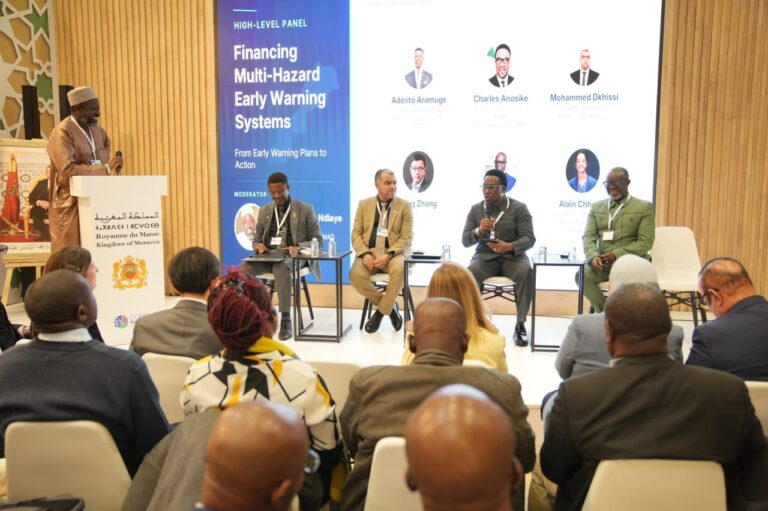
Photo caption: L-R Aderito Aramuge Vice-President of RA1 and PR of Mozambique, RA1, Mohammed Dkhissi Director General of Meteorology and PR of Morocco, Morocco Meteorological General Direction, Prof. Charles Anosike, Director -General/CEO NiMet and PR of Nigeria, Dr. Eric Asuman Director-General of the Ghana Meteorological Agency (GMet)
Prof. Charles Anosike, the Director-General/CEO, Nigerian Meteorological Agency (NiMet), has called for stronger regional cooperation among African countries to improve weather observations, strengthen multi-hazard early warning systems and ensure the long-term sustainability of National Meteorological and Hydrological Services (NMHSs).
Anosike, who is also Nigeria’s Permanent Representative with the World Meteorological Organisation (WMO), made the call at the ongoing 31st United Nations Climate Change Conference (COP31) in Antalya, Türkiye.
He spoke during a high-level side event hosted at the Morocco Pavilion, organised by the General Directorate of Meteorology (DGM) in collaboration with Morocco’s Ministry of Equipment, Water and Forests.
The event featured a high-level panel session on financing multi-hazard early warning systems, where participants discussed strategies for mobilising resources, strengthening meteorological infrastructure and ensuring that countries have the capacity to provide reliable and timely climate information.
Speaking at the session, Anosike identified three major priorities guiding NiMet’s resource mobilisation strategy, stressing that sustained investment in human capacity, observation infrastructure and strategic partnerships was essential to improving the delivery of meteorological services.
According to him, the agency is prioritising investment in its workforce through employee growth and improved welfare, the continuous expansion of its weather observation networks and systems, as well as the strengthening of partnerships that would enable it to translate climate data into practical and actionable information for Nigerians and the national economy.
While acknowledging the importance of government budgetary allocations in funding meteorological services, the NiMet boss argued that government financing alone would not be sufficient to guarantee the long-term sustainability of National Meteorological and Hydrological Services.
He maintained that greater private sector participation was necessary, particularly as climate-related risks increasingly carry significant financial implications for businesses, governments and communities.
Anosike said meteorological agencies must begin to develop business portfolios capable of attracting private sector investment and encouraging businesses to participate in discussions about climate risk management.
He explained that physical climate risks have financial costs, making it imperative for weather and climate service providers to demonstrate the economic value of their services to potential investors and commercial partners.
He disclosed that NiMet was already engaging private sector organisations, including insurance companies, to explore opportunities for sharing climate-related risks and reducing the long-term financial burden associated with climate-induced damages.
The engagement, he indicated, was part of efforts to establish mutually beneficial partnerships through which meteorological information could support better risk assessment, planning and decision-making in the private sector.
The NiMet Director-General also stressed that no country could independently shoulder the financial and technical responsibilities involved in generating and disseminating reliable weather and climate information.
He noted that weather systems and climate-related hazards do not respect national boundaries, making cross-border cooperation indispensable for effective forecasting, preparedness and disaster risk reduction.
According to him, meteorological observations and data must be shared across regions and converted into timely, actionable warnings by National Meteorological and Hydrological Services to protect lives, property and economic activities.
He therefore called for stronger regional collaboration among African countries to reduce the financial burden of maintaining weather observation infrastructure.
Such cooperation, he said, would allow countries to pool resources, standardise operational processes and establish regional frameworks capable of unlocking multiple cost-saving opportunities while improving the quality and availability of meteorological information.
Anosike further advocated increased support for regional and continental meteorological institutions, particularly the African Centre of Meteorological Applications for Development (ACMAD).
He described such institutions as critical to harmonising regional frameworks and creating an enabling environment for countries to access and effectively utilise climate finance.
He noted that stronger continental institutions would help address institutional and technical gaps, improve coordination among national meteorological agencies and facilitate the mobilisation and absorption of financial resources required to strengthen climate services across Africa.
The discussions also underscored the importance of collaboration among governments, international organisations, development partners, financial institutions and private sector operators in building effective multi-hazard early warning systems.
The event attracted representatives of the Moroccan Government, the WMO and partners under the Early Warnings for All (EW4All) initiative, including the United Nations Office for Disaster Risk Reduction (UNDRR), WMO, International Telecommunication Union (ITU) and International Federation of Red Cross and Red Crescent Societies (IFRC).
Also in attendance were Permanent Representatives with WMO, directors of African National Meteorological and Hydrological Services, multilateral development banks, climate funds, bilateral development partners, United Nations agencies, regional institutions, scientific and technical organisations, private sector partners and other relevant national stakeholders.
Anosike’s intervention at the conference reflects growing efforts to strengthen cooperation between African meteorological institutions, mobilise sustainable financing and improve the availability of weather and climate information needed to address the continent’s increasing exposure to climate-related hazards.

Strong indications has emerged that the use of a generator in a poorly ventilated environment may have caused the death of some students of the University of Nigeria, Nssuka.
The suspicion emerged after a survivor of the incident disclosed that a generator was operating outside the corridor of the apartment where they gathered, while the doors and windows remained shut.
According to the 24-year-old survivor, an Art Education student, about 10 people attended the party organised by his friend, David, to celebrate the completion of his final examinations.
The gathering reportedly started around 11:30 a.m. at the host’s residence in the Hilltop area of Nsukka, with participants sharing alcoholic drinks and playing Truth or Dare.
Recounting his experience, the survivor said he suddenly lost consciousness after helping one of the participants who had vomited and returning to clean the floor.
He disclosed that his legs had become stiff and he could no longer walk before eventually passing out. The student said he regained consciousness at about 9 p.m., only to discover that his friends were lying motionless on the floor.
“When I regained consciousness at about 9 p.m., I heard someone saying that the host was shaking. I woke up and managed to look into the parlour, where I saw the host and other participants lying on the floor,” he recounted.
He said he subsequently contacted friends for assistance, before one of them eventually helped convey the affected students to Bishop Shanahan Hospital and other medical facilities in Nsukka.
The survivor further explained that the apartment was poorly ventilated, with the doors and windows shut, while a generator was running outside in the corridor. A fan was also operating inside the room.

Nigerian singer, Darlington Okoye popularly known as Speed Darlington, has apologised to Grammy-winning musician, Damini Ogulu, popularly known as Burna Boy, asking him to withdraw the charges against him and promising to stop making comments about his sexuality.
Speed Darlington made the appeal in a video posted on his Instagram page on Thursday, in which he expressed regret over the pain and embarrassment he might have caused the singer.
“This video is for Burna Boy. Burna, this is an apology video. I apologise for any pain that I have caused you. Any shame that I have caused you,” he said.
The singer admitted that he was wrong to assume that everyone had the same temperament, adding that he wanted an end to their disagreement.
“I made the mistake of thinking that everybody vibrates at the same frequency. That’s wrong of me. I apologise, Burna Boy,” he added.
He further pledged to refrain from making both direct and indirect comments about Burna Boy’s sexuality, making the withdrawal of the charges a condition for his promise.
“I give you my word that if you withdraw all charges and let everything die, I give you my word that I will never make any direct comment regarding your sexuality. “Even indirect comment. I will no longer try sustain. I give you my word. Let peace reign,” he said.
Speed Darlington also promised not to mention the singer’s name again if the legal dispute was resolved.
“I promise I will never use my mouth to mention your name,” he added.
-

 News2 years ago
Senate to speed up conclusion of Nigeria Forest Security Service Bill
-

 News1 year ago
The Many Lies Against Bashir Haske
-

 News3 years ago
“Anytime we want to kill terrorists, President would ask us to take permission from France but they were killing our soldiers-” Niger Republic coup leader
-

 News3 years ago
Breaking: Tinubu’s authentic ministerial nominees
-
 News6 months ago
See your state governor’s performance ranking
-

 News3 years ago
“I’m leaving the Catholic church because Bishop Onah is oppressing me,” says Okunerere
-

 News3 years ago
My nude photo leak was a mistake- lawyer Ifunanya
-

 News3 years ago
Radio Nigeria’s veteran broadcaster Kelvin Ugwu dies three months after retirement from service