News
Breaking: NHRC records 3.7 million complaints on human rights abuses, draws roadmap for 2026


The National Human Rights Commission (NHRC) says it received 3,724,822 complaints bothering on all forms of human rights abuses in 2025.
Dr. Tony Ojukwu, SAN, made this disclosure on Tuesday, during the December 2025 human rights Dashboard which has just commenced at the headquarters of the Commission in Abuja.
He said although the event was to review data obtained in December 2025, the Commission intends the draw a roadmap for 2026.
Stakeholders who have gathered for the event include the UN bodies related to human rights, Police Services Commission, the Embassy of Norway, HRAN and others.
Among dignitaries at the programme are Mr. Hillary Ogbonna, Director, Human Rights Department and Special Adviser on Human Rights to the Commission, the Director of Finance and others as well as journalists and and
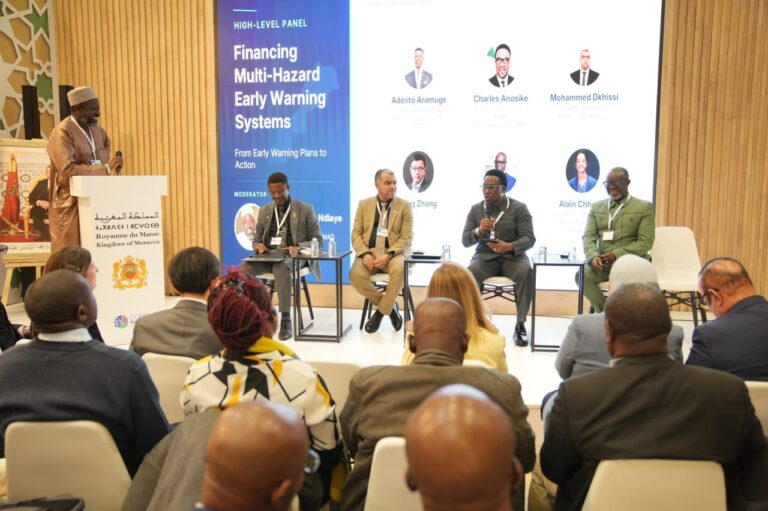
Photo caption: L-R Aderito Aramuge Vice-President of RA1 and PR of Mozambique, RA1, Mohammed Dkhissi Director General of Meteorology and PR of Morocco, Morocco Meteorological General Direction, Prof. Charles Anosike, Director -General/CEO NiMet and PR of Nigeria, Dr. Eric Asuman Director-General of the Ghana Meteorological Agency (GMet)
Prof. Charles Anosike, the Director-General/CEO, Nigerian Meteorological Agency (NiMet), has called for stronger regional cooperation among African countries to improve weather observations, strengthen multi-hazard early warning systems and ensure the long-term sustainability of National Meteorological and Hydrological Services (NMHSs).
Anosike, who is also Nigeria’s Permanent Representative with the World Meteorological Organisation (WMO), made the call at the ongoing 31st United Nations Climate Change Conference (COP31) in Antalya, Türkiye.
He spoke during a high-level side event hosted at the Morocco Pavilion, organised by the General Directorate of Meteorology (DGM) in collaboration with Morocco’s Ministry of Equipment, Water and Forests.
The event featured a high-level panel session on financing multi-hazard early warning systems, where participants discussed strategies for mobilising resources, strengthening meteorological infrastructure and ensuring that countries have the capacity to provide reliable and timely climate information.
Speaking at the session, Anosike identified three major priorities guiding NiMet’s resource mobilisation strategy, stressing that sustained investment in human capacity, observation infrastructure and strategic partnerships was essential to improving the delivery of meteorological services.
According to him, the agency is prioritising investment in its workforce through employee growth and improved welfare, the continuous expansion of its weather observation networks and systems, as well as the strengthening of partnerships that would enable it to translate climate data into practical and actionable information for Nigerians and the national economy.
While acknowledging the importance of government budgetary allocations in funding meteorological services, the NiMet boss argued that government financing alone would not be sufficient to guarantee the long-term sustainability of National Meteorological and Hydrological Services.
He maintained that greater private sector participation was necessary, particularly as climate-related risks increasingly carry significant financial implications for businesses, governments and communities.
Anosike said meteorological agencies must begin to develop business portfolios capable of attracting private sector investment and encouraging businesses to participate in discussions about climate risk management.
He explained that physical climate risks have financial costs, making it imperative for weather and climate service providers to demonstrate the economic value of their services to potential investors and commercial partners.
He disclosed that NiMet was already engaging private sector organisations, including insurance companies, to explore opportunities for sharing climate-related risks and reducing the long-term financial burden associated with climate-induced damages.
The engagement, he indicated, was part of efforts to establish mutually beneficial partnerships through which meteorological information could support better risk assessment, planning and decision-making in the private sector.
The NiMet Director-General also stressed that no country could independently shoulder the financial and technical responsibilities involved in generating and disseminating reliable weather and climate information.
He noted that weather systems and climate-related hazards do not respect national boundaries, making cross-border cooperation indispensable for effective forecasting, preparedness and disaster risk reduction.
According to him, meteorological observations and data must be shared across regions and converted into timely, actionable warnings by National Meteorological and Hydrological Services to protect lives, property and economic activities.
He therefore called for stronger regional collaboration among African countries to reduce the financial burden of maintaining weather observation infrastructure.
Such cooperation, he said, would allow countries to pool resources, standardise operational processes and establish regional frameworks capable of unlocking multiple cost-saving opportunities while improving the quality and availability of meteorological information.
Anosike further advocated increased support for regional and continental meteorological institutions, particularly the African Centre of Meteorological Applications for Development (ACMAD).
He described such institutions as critical to harmonising regional frameworks and creating an enabling environment for countries to access and effectively utilise climate finance.
He noted that stronger continental institutions would help address institutional and technical gaps, improve coordination among national meteorological agencies and facilitate the mobilisation and absorption of financial resources required to strengthen climate services across Africa.
The discussions also underscored the importance of collaboration among governments, international organisations, development partners, financial institutions and private sector operators in building effective multi-hazard early warning systems.
The event attracted representatives of the Moroccan Government, the WMO and partners under the Early Warnings for All (EW4All) initiative, including the United Nations Office for Disaster Risk Reduction (UNDRR), WMO, International Telecommunication Union (ITU) and International Federation of Red Cross and Red Crescent Societies (IFRC).
Also in attendance were Permanent Representatives with WMO, directors of African National Meteorological and Hydrological Services, multilateral development banks, climate funds, bilateral development partners, United Nations agencies, regional institutions, scientific and technical organisations, private sector partners and other relevant national stakeholders.
Anosike’s intervention at the conference reflects growing efforts to strengthen cooperation between African meteorological institutions, mobilise sustainable financing and improve the availability of weather and climate information needed to address the continent’s increasing exposure to climate-related hazards.
Strong indications has emerged that the use of a generator in a poorly ventilated environment may have caused the death of some students of the University of Nigeria, Nssuka.
The suspicion emerged after a survivor of the incident disclosed that a generator was operating outside the corridor of the apartment where they gathered, while the doors and windows remained shut.
According to the 24-year-old survivor, an Art Education student, about 10 people attended the party organised by his friend, David, to celebrate the completion of his final examinations.
The gathering reportedly started around 11:30 a.m. at the host’s residence in the Hilltop area of Nsukka, with participants sharing alcoholic drinks and playing Truth or Dare.
Recounting his experience, the survivor said he suddenly lost consciousness after helping one of the participants who had vomited and returning to clean the floor.
He disclosed that his legs had become stiff and he could no longer walk before eventually passing out. The student said he regained consciousness at about 9 p.m., only to discover that his friends were lying motionless on the floor.
“When I regained consciousness at about 9 p.m., I heard someone saying that the host was shaking. I woke up and managed to look into the parlour, where I saw the host and other participants lying on the floor,” he recounted.
He said he subsequently contacted friends for assistance, before one of them eventually helped convey the affected students to Bishop Shanahan Hospital and other medical facilities in Nsukka.
The survivor further explained that the apartment was poorly ventilated, with the doors and windows shut, while a generator was running outside in the corridor. A fan was also operating inside the room.

Nigerian singer, Darlington Okoye popularly known as Speed Darlington, has apologised to Grammy-winning musician, Damini Ogulu, popularly known as Burna Boy, asking him to withdraw the charges against him and promising to stop making comments about his sexuality.
Speed Darlington made the appeal in a video posted on his Instagram page on Thursday, in which he expressed regret over the pain and embarrassment he might have caused the singer.
“This video is for Burna Boy. Burna, this is an apology video. I apologise for any pain that I have caused you. Any shame that I have caused you,” he said.
The singer admitted that he was wrong to assume that everyone had the same temperament, adding that he wanted an end to their disagreement.
“I made the mistake of thinking that everybody vibrates at the same frequency. That’s wrong of me. I apologise, Burna Boy,” he added.
He further pledged to refrain from making both direct and indirect comments about Burna Boy’s sexuality, making the withdrawal of the charges a condition for his promise.
“I give you my word that if you withdraw all charges and let everything die, I give you my word that I will never make any direct comment regarding your sexuality. “Even indirect comment. I will no longer try sustain. I give you my word. Let peace reign,” he said.
Speed Darlington also promised not to mention the singer’s name again if the legal dispute was resolved.
“I promise I will never use my mouth to mention your name,” he added.
-

 News2 years ago
Senate to speed up conclusion of Nigeria Forest Security Service Bill
-

 News1 year ago
The Many Lies Against Bashir Haske
-
 News3 years ago
“Anytime we want to kill terrorists, President would ask us to take permission from France but they were killing our soldiers-” Niger Republic coup leader
-

 News3 years ago
Breaking: Tinubu’s authentic ministerial nominees
-
 News6 months ago
See your state governor’s performance ranking
-

 News3 years ago
“I’m leaving the Catholic church because Bishop Onah is oppressing me,” says Okunerere
-

 News3 years ago
My nude photo leak was a mistake- lawyer Ifunanya
-

 News3 years ago
Radio Nigeria’s veteran broadcaster Kelvin Ugwu dies three months after retirement from service