News
How Buhari threatened me on fuel subsidy removal – ex-minister Kachikwu

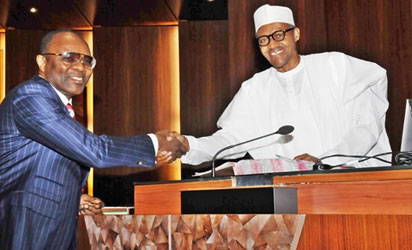
Dr. Ibe Kachikwu, a former Minister of State for Petroleum Resources, on Monday, alleged that former President, the late Muhammadu Buhari, threatened to sack him should his (Kachikwu) push to remove the petrol subsidy during Buhari’s tenure go wrong.
Kachikwu was the Minister of State for Petroleum Resources from 2016 to 2019. He spoke at a business mentorship lecture series organised virtually by the Nigerian Content Development and Monitoring Board.
He noted that his greatest challenge when he assumed office as Group Managing Director of the Nigerian National Petroleum Company in 2015 was the persistent fuel queues that grounded economic activities nationwide and recalled that despite sleepless nights and efforts to ease the crisis, much of the subsidised petrol imported into Nigeria was being smuggled across the borders, making scarcity inevitable.
“The greatest challenge that I had when I resumed as GMD was the issue of long queues at petrol stations. Very few Nigerians realise how much of a traumatic experience it is for a minister or a GMD, who’s committed, to get up in the morning and find out the whole country is grounded. Of course, I’ll go to filling stations, try to help them fill, and try to make sure there are no unnecessary traffic obstructions. At the end of the day, every time that happened, I had no sleep.
“When I then did my investigation, it was clear that a lot of the products we were bringing were crossing the border at subsidised rates. No matter how much I tried to work with customs, work with the ministry, or work with everybody, it just never happened. It just kept going because the position didn’t have the political or security resources to police Nigeria’s borders.”
According to him, he repeatedly approached Buhari to allow a review of pump prices to end the losses, but the President, who held a populist stance, resisted any adjustment.
“I went to the President very many times, and I said, ‘Look, I need to move up on price. He resisted that very much because of his populist-type position. Eventually, he said, ‘Okay, you know what? I’ll leave you to take the risk. If you take the risk and it works, fine. If it doesn’t work, I fire you.’ That’s all well and good for me. And I did,” Kachikwu said.
The former minister explained that he introduced what he termed ‘price modulation’, a policy that allowed petrol prices to reflect international market realities. He said the slight adjustment not only removed the subsidy but also cleared fuel queues across the country within 48 hours.
“That singular price adjustment removed the subsidy. There was no more subsidy. And within 48 hours, magically, every queue in the country stopped. It never happened again until I left. So, that was how I could, at least, sleep better, and the government was willing to make more money,” he added.
Kachikwu added that he refused to pay billions of naira in outstanding subsidy arrears he inherited, insisting that most of the claims were unverifiable.
“We didn’t pay the arrears of subsidy because my position was that I could not audit the transparency of the subsidy claims. So, I preferred not to deal with those issues,” he said.
Kachikwu maintained that subsidy removal by the President Bola Tinubu administration was inevitable but should have been accompanied by clear plans for refineries, infrastructure, transporters, and oil-producing communities.
Chairman of the Nigeria Democratic in Congress (NDC), Fiidi Council Ward in Makurdi Local Government Area of Benue State, Igbu Terhemen, has reportedly been killed by unknown assailants.
Terhemen was said to have been attacked and left unconscious in a bush near his residence around the NNPC Depot, along the Makurdi-Otukpo Road, on the outskirts of Makurdi, the state capital.
A friend of the deceased, who spoke on condition of anonymity, said Terhemen left his residence on Tuesday evening to watch a local football match in the Kanshio axis of the town but did not return home.
According to him, family members and friends became worried after the deceased failed to return and subsequently began searching for him.
He said, “He left home to watch the match Tuesday evening and he was expected back home, but nobody saw him. It was while people were looking around for him that he was discovered around 2am Wednesday in a bush near his residence unconscious.
“Unfortunately, he died before he could get medical attention. Strangely, his attackers did not take his phone, which was discovered on him when he was taken to the morgue.
“There was also a needle-like injury on his body, indicating that he could have been injected with a substance by his attackers, dumped in the bush and left to die.
“All that is left for the police to uncover in the course of their investigation because this is a sad development in the state.”
The incident has sparked concern among members of the NDC, with the state chapter condemning the alleged killing and calling on security agencies to investigate the circumstances surrounding Terhemen’s death.
In a statement issued by the party’s State Publicity Secretary, Agile Bem, the NDC described the deceased as a committed member who contributed significantly to the growth of the party in the state.
The statement said, “The Nigeria Democratic Congress (NDC), Benue State Chapter, has condemned the gruesome murder of Hon. Igbu Terhemen, who, until his death, was the NDC Chairman of Fiidi Council Ward in Makurdi Local Government Area.
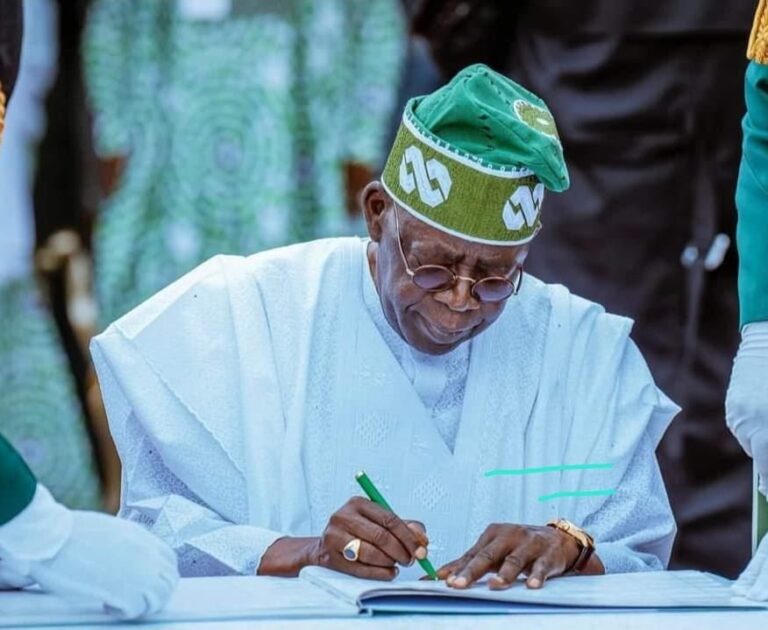
President Bola Ahmed Tinubu has signed into law the Appropriation (Amendment) (No.4) Bill, 2025, extending the implementation period of the 2025 budget from September 30, 2026 to December 31, 2026.
Presidential spokesman, Bayo Onanuga stated this in a press release on Wednesday, saying the president’s assent followed the amendment’s swift passage by both the Senate and the House of Representatives on Tuesday, September 29, 2026.
According to Onanuga, the extension gives Ministries, Departments and Agencies more time to complete ongoing capital projects. It ensures that funds already appropriated are fully put to work for Nigerians, without disrupting critical programmes.
“The President commended the leadership and members of the National Assembly for their prompt consideration of the bill, a further sign of the cooperation between the Executive and the Legislature in the service of the nation,” Onanuga said.
Governor of Rivers State, His Excellency Sir Siminalayi Fubara, has congratulated the federal government to and people of Nigeria on the occasion of the country’s 66 independence anniversary.
Fubara also called on the people of the State to embrace peace and unity, describing them as indispensable pillars for the socioeconomic development of any society.
In a goodwill message issued on Fubara’s behalf by Onwuka Nzechi, Chief Press Secretary to the Governor, he said the anniversary celebration offers an opportunity for the people to reflect on Nigeria’s journey since 1960 and to renew their commitment to peaceful coexistence.
The Governor noted that Rivers State, as the “treasure base of the nation” and a melting pot of diverse ethnic nationalities, has always thrived when its people lived in harmony. He said no meaningful development can take place in an atmosphere of rancour, division and political hostility.
According to him, while political differences are normal in a democracy, they must never be allowed to undermine the collective interest of the State. “We may disagree as politicians, but we must never disagree on the peace and progress of Rivers State,” he stated.
Governor Fubara stressed that since assumption of office, his administration has anchored its governance philosophy on peace, describing it as the most invaluable infrastructure. He said the relative peace enjoyed in the State today has made it possible for his government to attract investments and execute projects across the three senatorial districts.
He therefore appealed to youths, traditional rulers, political leaders and all stakeholders to be ambassadors of peace in their communities, wards and local government areas, stressing that no one benefits when the State is in crisis.
The Governor further urged Rivers people to continue to support the Federal Government under President Bola Ahmed Tinubu, noting that national unity and sub-national cooperation are critical to achieving the goals of the Renewed Hope Agenda.
-

 News2 years ago
Senate to speed up conclusion of Nigeria Forest Security Service Bill
-
 News1 year ago
The Many Lies Against Bashir Haske
-

 News3 years ago
Breaking: Tinubu’s authentic ministerial nominees
-
 News3 years ago
“Anytime we want to kill terrorists, President would ask us to take permission from France but they were killing our soldiers-” Niger Republic coup leader
-
 News3 years ago
“I’m leaving the Catholic church because Bishop Onah is oppressing me,” says Okunerere
-

 News3 years ago
My nude photo leak was a mistake- lawyer Ifunanya
-
 News4 months ago
See your state governor’s performance ranking
-

 News3 years ago
Radio Nigeria’s veteran broadcaster Kelvin Ugwu dies three months after retirement from service