
News
Whatever Matawalle Is Doing, He Is Doing Right


On the 30th of September 2024, a video surfaced online, featuring the notorious terrorist Bello Turji—this time, not with his characteristic bravado, but in a startling display of vulnerability. The once-defiant bandit was seen pleading for forgiveness and calling for dialogue with the Federal Government, signaling his desire to end armed violence in Zamfara State. He accused the Governor of Zamfara, Dauda Lawal, and the Minister of State for Defence, Dr. Bello Matawalle, of politicizing insecurity, yet conveniently neglected to acknowledge the undeniable military gains made since Matawalle led the Service Chiefs to Sokoto.
Governor Lawal, despite his criticisms of Matawalle, has repeatedly traveled to Abuja, over 500 kilometers from his state capital, to launch a series of unfounded accusations against the Minister, blaming him for the state’s security challenges while conspicuously omitting recognition of the notable victories that have been achieved since Matawalle’s intervention.
In response, Dr. Bello Matawalle delivered a candid and unyielding rebuttal, presenting the facts to the Nigerian public. He reminded the nation that he is the only political figure from Zamfara State who has taken a solemn oath on the Holy Quran, categorically denouncing any association with banditry or its supporters. In a bold challenge, he called upon his critics, including Dauda Lawal and Gen. Aliyu Gusau, to do the same—if indeed they are free from any connections to the bandits. To date, none have accepted this challenge, leaving much to be inferred about their support for the insurgency in the region.
But I digress. Let us return to the matter at hand—the sudden shift in Turji’s stance. For a terrorist leader who, only weeks ago, boasted of his capacity to challenge the Nigerian Armed Forces, this reversal is no coincidence. Something significant has clearly shaken him.
Consider the context: six days before Turji’s plea, his associate, Kachalla Sani-Black—a feared bandit leader commanding over 150 loyal men—was neutralized in a precisely executed ambush by the local police in Maru Local Government Area of Zamfara State. Not only was Sani-Black eliminated, but his sons also met their demise alongside him, sending a powerful message to other criminal elements.
Before Sani-Black’s elimination, another key bandit leader, Baleri Fakai, along with 30 of his strongest fighters, was taken down in the same region. Days prior, on the 12th of September, the Nigerian Air Force Special Forces struck a decisive blow by eliminating the infamous Halilu Sububu, a terrorist whose attacks on a military base in Katsina in 2021 resulted in the deaths of numerous soldiers. Sububu had since unleashed terror across Sokoto, Niger, and Kaduna States. His demise, followed by the neutralization of another bandit, Halilu Buzu, demonstrated the coordinated efforts of Nigeria’s military forces in dismantling the leadership of these insurgent groups.
Then came the elimination of Sani Wala Burki, a notorious terrorist responsible for years of violence in the Safana and Batsari Local Government Areas of Katsina State. His death on the 14th of September was yet another major victory achieved by the Nigerian Armed Forces.
So, what explains this sudden spate of victories? What transformed the tide of battle in the North-Western region, where terrorists have been neutralized one after the other?
The turning point came on the 1st of September 2024, when Dr. Bello Matawalle, Minister of State for Defence, led the Chief of Defence Staff, General Christopher Musa, and other senior military leaders to Sokoto on a Presidential directive. Tasked with the mission of eradicating banditry in the North-West, Matawalle, a leader known for his courage and resolve, embarked on an intensive operational tour with the service chiefs. He spent over a week on the ground, receiving strategic briefings and collaborating with troops to craft a comprehensive plan to restore peace in the region.
It was in the aftermath of this high-level visit that Nigerians began to witness the cascading military successes that have since garnered national attention. Whatever strategic directives Matawalle provided to the troops, they executed them with precision, delivering the results he has since reported back to President Tinubu.
For those observant enough to read between the lines, the attacks on Dr. Bello Matawalle by his predecessor, Dauda Lawal, reek of jealousy—an attempt to detract from the remarkable progress achieved under Matawalle’s leadership. The spate of victories over banditry is undeniable, and attempts to undermine these achievements are little more than distractions.
Even Senator Shehu Sani, a known critic of Nigeria’s political elite, commended Matawalle’s efforts. In a recent statement, he dismissed the criticisms aimed at the Minister of State for Defence and the National Security Adviser, Nuhu Ribadu, as counterproductive distractions in the ongoing fight against terrorism. “Why are some people unhappy that bandit leaders are being eliminated?” Sani asked. “Anyone genuinely committed to ending the reign of kidnappers and murderers should support these efforts, not engage in frivolous criticisms.”
It is evident that individuals like Governor Dauda Lawal are less than pleased with the recent military successes in Zamfara and beyond. But as history has shown, true leadership rises above such petty grievances.
In the coming days and weeks, it is widely expected that the once loquacious Bello Turji’s fate will be sealed, and the Nigerian Armed Forces will continue their pursuit of him until he, too, is eliminated. The momentum generated since Dr. Matawalle’s strategic tour of the North-West has reinvigorated the morale of our troops. This is the unmistakable hallmark of effective leadership.
On the 2nd of October 2024, as President Bola Ahmed Tinubu departed for his annual leave in the United Kingdom, he was seen exchanging firm handshakes with Dr. Bello Matawalle and National Security Adviser Nuhu Ribadu. The confidence in their exchange was palpable, and one could almost imagine the President’s words: “Whatever you’re doing, you’re doing it right. Finish the job, Matawalle. Bring Turji to his knees and secure our nation.”
Nathaniel C. Adoji writes from Kaduna State.


Benue State Police Command has condemned the killing of the Chairman of the Miyetti Allah Cattle Breeders Association of Nigeria (MACBAN), Benue State chapter, Ardo Rabo Mohammed, and another man, Yakubu Isa, describing the attack as a senseless criminal act capable of undermining ongoing peace and security efforts in the state.
The victims were reportedly attacked by gunmen while returning from a security meeting along the Okwudu-Ogoli Road in Otukpo Local Government Area.
In a statement issued on Saturday, the Police Public Relations Officer, DSP Udeme Edet, said the Commissioner of Police, CP Cletus C.N. Nwadiogbu, condemned the killings and expressed condolences to the families of the deceased.
“The Commissioner of Police strongly condemns in its entirety the brutal killing of the Chairman of Miyetti Allah Cattle Breeders Association of Nigeria (MACBAN), Benue State chapter, Ardo Rabo Mohammed, and one Yakubu Isa, who were reportedly attacked by unknown assailants while returning from a security meeting along Okwudu-Ogoli Road, Otukpo,” the statement read.
According to the police, the command has commenced a full-scale investigation into the incident, with tactical and intelligence teams deployed to track down those responsible.
The Commissioner assured residents that the command would leave no stone unturned in ensuring the perpetrators are identified, arrested and prosecuted.
He appealed to members of the public to remain calm, avoid taking the law into their own hands, and refrain from spreading unverified information capable of escalating tensions.
The police also urged anyone with credible information that could aid the investigation to report to the nearest police station or contact the command through its emergency lines.
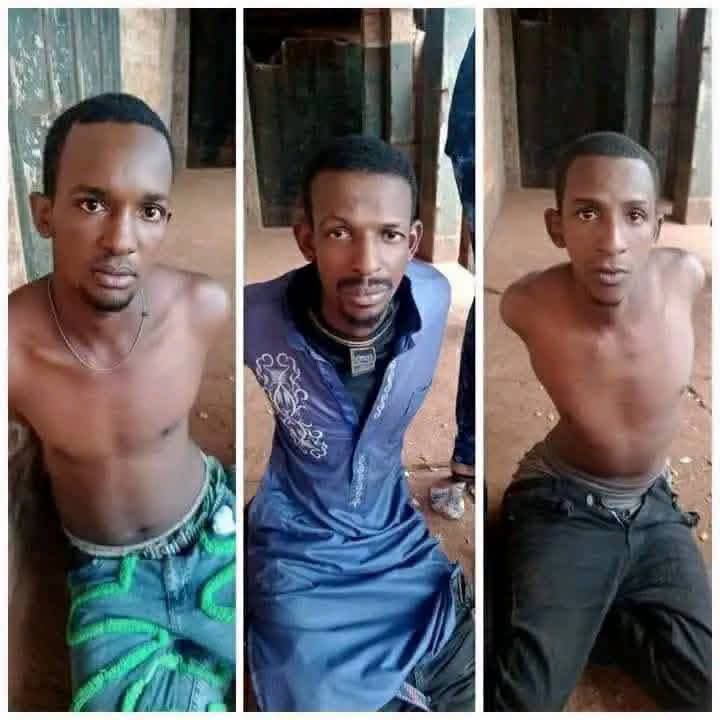
Three bandits have been arrested in Benue state after a lady who they had kidnapped and released, identified them at a motor park and raised alarm.
The k!kidnappers came to Ihotu park to board a vehicle to Makurdi and were met by the lady they had earlier kidnapped and released after collecting ransom from her relatives.
They were even using a bag they collected from the girl. The girl raised the alarm, held one inside the vehicle, and two took to their heels, but were caught.
They had a ghana-must-go bag at the back of the vehicle. N11m was found inside the bag.
Following the confirmation of their identity by another lady who was also their victim, mob gathered around with the intent to beat them up and possibly set them ablaze.
But the park manager decided to invite the police and soldiers who rescued them and took them to their station.
It was later gathered that the Benue state Governor, Rev. Father Hyacinth Alia called and said he was interested in the case which made the police to take the apprehended bandits to Makurdi, the state capital.

President Bola Tinubu Federal Government has drawn down $1.5bn from a $5bn financing facility arranged with the United Arab Emirates’ largest lender, First Abu Dhabi Bank, despite growing concerns from global financial institutions over the increasing use of complex derivative financing by African sovereigns.
Bloomberg reported on Friday that the latest drawdown represents the first tranche of a $5bn Total Return Swap facility approved by the National Assembly on March 31, 2026, and is expected to support the 2026 budget, finance infrastructure projects, and refinance existing debt obligations.
The report quoted people familiar with the transaction, who asked not to be identified because they were not authorised to speak to the media.
The report read, “Nigeria has accessed the first tranche of a $5bn derivatives deal with the United Arab Emirates’ largest lender, pressing ahead with a transaction that has been scrutinised for being opaque.
“The West African nation drew about $1.5bn in the last couple of weeks from a total return swap transaction with First Abu Dhabi Bank PJSC, according to people familiar with the transaction, who asked not to be identified because they were not authorised to speak to the media.”
The transaction comes at a time when Nigeria is facing higher borrowing costs in international capital markets, forcing the government to seek alternative financing arrangements to shore up its fiscal position and improve access to foreign exchange liquidity.
Under the arrangement, Nigeria is required to pledge Federal Government securities worth about 133 per cent of any amount drawn under the facility. This means that for the full $5bn facility, the government would have to post approximately $6.65bn worth of naira-denominated bonds as collateral.
In return, the Abu Dhabi-based lender provides dollar liquidity to the Nigerian government. The Federal Government will pay a floating interest rate benchmark plus about four percentage points, while the lender receives the returns generated by the underlying government securities.
The transaction effectively allows Nigeria to unlock immediate dollar funding without issuing new Eurobonds or taking on traditional external loans at prevailing market rates, which have become increasingly expensive for frontier economies.
The government has already indicated that the proceeds from the initial $1.5bn drawdown will be deployed to support budget implementation, fund critical infrastructure projects, and refinance costlier domestic and external debts.
However, the financing arrangement has attracted criticism from international financial institutions and market analysts over concerns about transparency and potential hidden liabilities.
In its June 2026 assessment of African sovereign debt markets, the International Monetary Fund warned that derivative financing structures such as total return swaps are often opaque and difficult for investors and creditors to monitor.
The IMF noted that such arrangements are “hard to track, hard to value in real time, and can obscure the true extent of a country’s financial obligations.”
Three days ago, Fitch Ratings warned that Nigeria’s planned $5bn financing arrangement with First Abu Dhabi Bank could increase sovereign debt risks and reduce transparency in public debt reporting.
-

 News1 year ago
Senate to speed up conclusion of Nigeria Forest Security Service Bill
-
 News11 months ago
The Many Lies Against Bashir Haske
-

 News3 years ago
Breaking: Tinubu’s authentic ministerial nominees
-
 News3 years ago
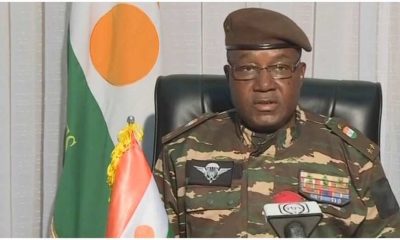
“Anytime we want to kill terrorists, President would ask us to take permission from France but they were killing our soldiers-” Niger Republic coup leader
-
 News3 years ago
“I’m leaving the Catholic church because Bishop Onah is oppressing me,” says Okunerere
-

 News3 years ago
Radio Nigeria’s veteran broadcaster Kelvin Ugwu dies three months after retirement from service
-
 News3 years ago
Dokpesi and the Gazebo Mystique
-

 News3 years ago
Tsunami: Tinubu orders dissolution of managements, boards of MDAs, to sack all Buhari’s political appointees