
News
Bill to restructure Nigeria into eight regions ready for Tinubu today


A Draft Bill’ proposing 8-regions structure for Nigeria is to be sent to President Bola Tinubu today, Friday.
A chieftain of the Yoruba socio-cultural association, Afenifere, Akin Fapohunda said the document is to be known as “A Bill for an Act to substitute the annexure to Decree 24 of 1999 with New Governance Model for the Federal Republic of Nigeria.”
The draft bill which is seeking a return to the regional form of government, with Nigeria divided into eight regions, also seeks among others, new extant laws to be cited as “The Constitution of the Federal Republic of Nigeria New Governance Model for Nigeria Act 2024.”
The draft which had gone viral some days ago was however disowned by the House of Representatives which said nothing of such was before it.
But Fapohunda who also represents the Coalition of Indigenous Ethnic Nationalities, said he would submit the draft and after seven days release it to the public.
“I am submitting my letter (draft bill) today but I will wait for seven days before releasing it to the public,” he stated.
According to him, his coalition is proposing to have the Southern region to be made up of Akwa-Ibom, Bayelsa, and Cross Rivers States and “Optional inclusions of the Annang, Effik, Ekoi, Ibibio, Oro Ohaji/Egbema in Southern Imo, the Adonia, Efemia, Ijaw, Ogoni, Bini, Ishan, Isoko, Urhobo and the Ijaw speaking people in Northern Ondo State with land contiguity.
“The South Eastern region consists of Abia, Anambra, Ebonyi, Enugu, and Imo States. The Western region comprises Lagos, Ogun, Ondo, Osun, Oyo, and Ekiti States, incorporating the Yoruba-speaking people in Kogi and the Igbomina people in Kwara State. Additional options would be the Itsekiri people of Delta State and Akoko-Edo people of Edo State to make their respective choices.”
Others include the Mid-Western Region “Made up of Edo and Delta States, possibly incorporating the Anioma people and the Eastern Middle Belt Region comprising Northern Cross River, Southern Kaduna, Southern Borno, Adamawa, Benue, Kogi, Plateau, Nasarawa and Taraba States.”
The Western Middle Belt Region comprises Southern Kebbi, parts of Kwara and Niger States while the North Eastern Region will be made up of parts of Borno, Gombe, Bauchi, Jigawa, and Yobe States.
The North Western Region, according to the Afenifere chieftain, comprises Kaduna, parts of Kebbi, Kano, Katsina, Sokoto and Zamfara States.
He added that his coalition is also proposing a two-tier government, federal and regions, with the regions at liberty to manage her affairs, “Including the creation of sub-entities, based on the stipulations that are agreed upon and embedded in their respective constitutions.”
The coalition said; “In the quest for re-configuration and downsizing, an option to consider might be to retain the present boundaries of the 36 States, as would have been adjusted, but to creatively downgrade the paraphernalia of political administration as follows:
“To introduce a new regional government framework with executive and legislative functions and bodies with the headship title of Premier.
“In the new dispensation, the present States (for example the six in the Western region) would be converted to provinces. Governance at this level shall be by Provincial Councils that integrate executive and legislative functions, with Chairman and Support Specialist Administrative Officers. The regions shall be at liberty to create provinces, subject to viability and self-sustainability.
“The present Local Government Areas are to be transformed into divisions, with divisional managers and specialist administrative officers; to operate as socio-economic development institutions. The new provinces shall also be at liberty to create divisions, subject to viability and self-sustainability.”
The coalition also proposed a new constitution to embody novelties including freedom of the regions to “Create, merge and or re-configure their sub-political units and may adopt provinces, divisions or districts as may suit their circumstances without interference from any other authority.
“Regions and sub-regional entities are to be reconfigured such as would reduce the cost of public and civil service administration to less than 20 to 30 per cent of generated revenue.
“In drafting their Constitutions, the peoples of the respective regional territories will take a cue and also dismantle any arrangement or configuration that will favour the politicians and the political class; with a focus on freeing resources for true development.
“A unicameral federal legislature comprising members that are elected at the discretion of the regions for which they would be representatives at Abuja.
“Decentralization of federal power in favour of not more than 10 regions on which there is a general national consensus, rather than the presently unwieldy number of 36 States. These old States are inconsequential indeed in being a viable unit of a truly federal system of government.”
While the coalition proposes that the Federal Government “Shall comprise not more than nine Ministries and Ministers,” it added that “The very big United States have just 15 Cabinet Ministers, while Nigeria is not even up to just a State of Texas or New York.”
It said there is the need to return to the parliamentary system of government with “built-in statutory rotation of headship among the regions.”
News
Supreme Court judgment: Wabara-led BoT takes charge of PDP, directs staff to resume at Wadata House
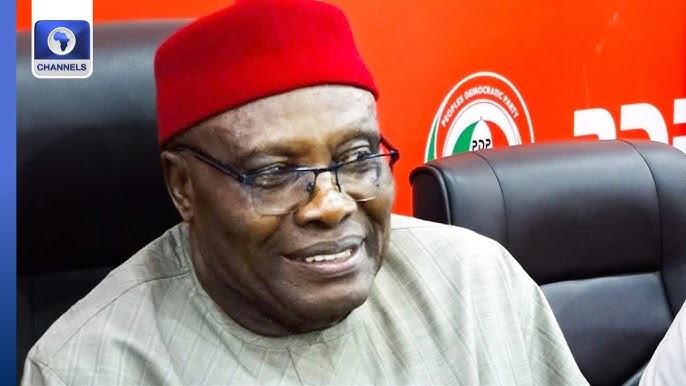
Following Thursday’s ruling of the Supreme Court, the Board of Trustees of the Peoples Democratic Party, PDP, has assumed effective charge and is expected to appoint a new caretaker committee to pilot affairs of the party.
The apex court had in its ruling, upheld judgements of the Federal high court and the court of Appeal which invalidated the November 2025 Ibadan convention as well as the expulsion of some members of the party including Sam Anyanwu and others.
By the ruling, all actions taken by the faction led by FCT Minister, Nyesom Wike, have become null and void, including the March Abuja conversation and appointment of a caretaker committee. This is in view of the fact that most of the members of the committee were among those expelled by the party.
Following the Thursday ruling by the Supreme Court, leaders and stakeholders of the PDP including governors, senators, reps members and others met in Abuja Thursday night where board of Trustees of the party took effective charge of affairs, in accordance with the party’s constitution.
Subsequently, Chairman of PDP BoT, Senator Adolphus Wabara, said the board has assumed leadership of the opposition party.
Wabara, in a statement, said the board would convene an emergency meeting of the PDP National Executive Committee(m (NEC), to appoint an interim executive to take charge of the affairs of the party.
The BoT statement reads, “It is with the utmost sense of duty and responsibility that the Board of Trustees (BoT) of the Peoples Democratic Party (PDP) assumes leadership of our great party today, Thursday, 30th April, 2026 pursuant to the empowering provisions of the Constitution of the PDP (As amended in 2017).
“This constitutional intervention of the BoT is so as not to allow any leadership vacuum at the national level of our party following judgment of the Supreme Court.
“Sadly, the Supreme Court, today delivered an unpleasant judgment against our party in which it pronounced an invalidation of the 15th to 16th November 2025 National Convention of the PDP held in Ibadan, Oyo State, which produced the Kabiru Tanimu Turaki-led National Working Committee of our Party.
“While the Supreme Court invalidated the Ibadan Convention, it also in a unanimous decision of the five justices on the panel, upheld the suspension of Senator Samuel Anyanwu, Hon. Umar Bature, Kamaldeen Ajibade as National Secretary, National Organizing Secretary and National Legal Adviser respectively from the Party.
“The implication of today’s judgment by the Supreme Court is that all actions taken by Senator Samuel Anyanwu, Hon. Umar Bature and Barr. Kamaldeen Ajibade including the appointment of Abdulrahman Mohammed as Acting National Chairman, the composition of the National Caretaker Working Committee and the conduct and outcome of the March 29th, 2026 Convention in Abuja are illegal, null and ab initio void.
“The consequential invalidation of both the Abdulrahman Mohammed-led as well as the Kabiru Tanimu Turaki-led Working Committees directly places the statutory onus of leadership of our great party on the shoulders of the Board of Trustees (BoT) as the Second Highest Organ of the Party, pursuant to the express and unambiguous provision of Section 32 (5) of the PDP Constitution (as amended in 2017).
“Against this backdrop, the BoT hereby immediately assumes responsibility of the national working leadership of the PDP as immediate constitutional remedial steps to foster genuine reconciliation, salvage, stabilize and return the party to good political health.”
Wabara added that “in the light of the foregoing an emergency meeting of the National Executive Committee (NEC), pursuant to the provisions of Section 31 of the Constitution of the PDP will be summoned to, among other things, appoint an Interim National Working Committee to take charge of the National Secretariat of our Party and pilot the affairs of the Party at the national level so as to meet all the timeline in the Electoral Act, 2026 and ensure that the PDP fields candidates and also emerged victorious in all elective positions in the 2027 general elections.
“Consequently, all staff of the PDP are hereby directed to resume at the National Secretariat of the Party under the leadership of the BoT ahead of the appointment of the Interim National Working Committee.
“The BoT commends the courage, effort and resilience of our governors, Governor Bala Mohammed and Governor Seyi Makinde, the National Assembly caucus, the National Ex-officios, the Forum of PDP State Chairmen and State chapters, the Youth and Women Wings and other organs and bodies in the PDP for standing strong for the party at this trying time.
“The BoT therefore calls on all leaders and members of the party to jettison all personal and group interests and come together as one family in the overall interest of our Party, democracy and the wellbeing of millions of Nigerians whose hope are anchored on the PDP.
“The PDP has suffered enough; the painful victims of this unfortunate episode is the Nigerian people. The time has therefore come for us to make sacrifices, sheathe our swords and embrace genuine reconciliations for lasting peace and chart a new course for our party. “

The Attorney General of the Federation and Minister of Justice, has urged the Federal High Court in Abuja to compel the Independent National Electoral Commission (INEC) to deregister five political parties, arguing that their continued existence violates constitutional provisions and undermines Nigeria’s electoral integrity.
In court filings, the Attorney General contended that unless the court intervenes, INEC would “continue to act in breach of its constitutional duty” by retaining parties that have failed to meet the minimum requirements prescribed by law.
The filing stressed that the right to associate as a political party is not absolute and must be exercised within constitutional limits. It further argued that it is in the interest of justice for the court to grant the reliefs sought by the plaintiffs.
The suit, marked FHC/ABJ/CS/2637/2026 and filed at the Abuja Judicial Division of the Federal High Court, lists the Incorporated Trustees of the National Forum of Former Legislators as the plaintiff.
The defendants include INEC as the first defendant and the Attorney General of the Federation as the second defendant, alongside five political parties: African Democratic Congress (ADC), Action Alliance (AA), Action Peoples Party (APP), Accord (A), and Zenith Labour Party (ZLP).
At the center of the issue in the case is whether INEC has a constitutional obligation to remove parties that fail to meet electoral performance thresholds set out in Section 225A of the 1999 Constitution (as amended) and reinforced by the Electoral Act 2022 and INEC’s own regulations.
The plaintiffs argue that the affected parties have persistently failed to satisfy the constitutional benchmarks required to retain their registration. These include winning at least 25 per cent of votes in a state during a presidential election or securing at least one elective seat at the national, state or local government level.
They contend that the parties performed poorly in the 2023 general elections and subsequent by-elections, failing to win seats across key tiers of government, yet continue to be recognised by INEC as eligible political platforms.
The plaintiffs maintain that this continued recognition is unlawful and undermines the integrity of Nigeria’s electoral system.
In the affidavit supporting the suit, the forum’s national coordinator, Igbokwe Raphael Nnanna, states that allowing parties that have not met constitutional requirements to remain on the register “is unconstitutional, illegal and a violation” of the governing legal framework.
The suit asks the court to declare that INEC is duty-bound to deregister such parties and to compel the commission to do so before preparations for the 2027 elections advance further.
Beyond declaratory reliefs, the plaintiffs are also seeking far-reaching orders that would bar the affected parties from participating in the next general elections or engaging in political activities such as campaigns, rallies and primaries. They further request injunctions restraining INEC from recognising or dealing with the parties in any official capacity unless and until they comply strictly with constitutional provisions.
Central to the plaintiffs’ argument is their interpretation of the law as imposing a mandatory duty on INEC. They argue that the use of the word “shall” in the Constitution leaves no room for discretion once a party fails to meet the stipulated thresholds.
In their written address, they rely on statutory provisions and judicial precedents to contend that electoral performance is an objective condition that must be enforced to maintain discipline, transparency, and accountability in the political system.
Attorney General backs plaintiff
In a notice filed pursuant to Order 15 Rule 1 of the Federal High Court (Civil Procedure) Rules, 2019, the Attorney General, who is a defendant in the suit, formally admitted the plaintiff’s case to the extent of his constitutional responsibilities.
He maintained that, as the chief law officer of the federation, he is duty-bound to defend and uphold the Constitution, including ensuring compliance with the Electoral Act and other laws governing elections in Nigeria.
The filing emphasised that the Attorney General’s role extends beyond litigation to preventive oversight, ensuring that laws are faithfully implemented to maintain public confidence in the electoral process. It described the case as a public interest litigation aimed at safeguarding democratic integrity and promoting constitutional observance.
According to the document, the Attorney General argued that citizens, including the plaintiff group, have the right to challenge constitutional breaches, particularly where electoral processes are concerned. He added that supporting such litigation aligns with his dual role as both a defender of the state and an advocate for citizens’ rights.
The submission also highlighted the broader implications of non-compliance by political parties. It argued that the continued existence of parties that fail to meet constitutional thresholds contributes to ballot congestion, increases the cost of election administration, and undermines the intent of Section 225A of the 1999 Constitution (as amended), which empowers INEC to deregister underperforming parties.
The plaintiff further contended that INEC has no residual discretion to retain parties that do not satisfy the constitutional criteria, insisting that failure to deregister them constitutes a continuing breach of constitutional duty. The suit warned that such inaction could be challenged through public interest litigation, as is the case before the court.
Additionally, the filing noted that the plaintiff, comprising former legislators, possesses the requisite standing to institute the action, having been directly involved in the enactment and oversight of Nigeria’s constitutional and electoral framework.
The Attorney General also underscored the importance of access to justice, arguing that his support for the suit would help bridge gaps faced by citizens seeking to enforce constitutional rights. He maintained that collaboration between government institutions and civic actors is essential to strengthening legal literacy, accountability, and democratic participation.
The Attorney General of the Federation is represented in the suit by a team of lawyers led by Prof. J. O. Olatoke, SAN, alongside O. J. David, U. O. Olufadi, D. O. Bamidele, V. D. Maiye, Waheed Abdulraheem and A. K. Abdulmumin, all of whom signed the court filing before the Federal High Court in Abuja.

….The Commission wants IGP to address use of excessive force by police
The Executive Secretary of the National Human Rights Commission (NHRC), Dr. Tony Ojukwu OFR, SAN, has strongly condemned the alleged extrajudicial killing of a 28-year-old Nigerian, Mene Ogidi, by a police officer, ASP Nuhu Usman, on April 26, 2026, in Efurun, Uvwie Local Government Area of Delta State.
In a statement issued in Abuja, Dr. Ojukwu described the incident as “deeply disturbing and a direct assault on human dignity, the Constitution of the Federal Republic of Nigeria, and the rule of law.”
He stressed that no Nigerian should lose their life at the hands of those sworn to protect them, reiterating that every life matters and must be protected.
According to him, “the reported action of the officer involved is condemnable, unacceptable, and completely inconsistent with the principles of justice and a civilized society.”
The statement which was signed by Hajia Fatimah Agwai Mohammed, Director, Corporate Affairs and External Linkages, quoted Ojukwu to have expressed grave concern over the recurring incidents of excessive use of force by law enforcement officers and called on the Nigeria Police Force to take urgent and decisive steps to address the issue.
He specifically urged the police authorities to subject officers deployed on special duties to periodic mental and psychological evaluations to ensure they are fit to carry arms and engage with civilians responsibly.
Dr. Ojukwu further called for the immediate disciplinary action against ASP Nuhu Usman in line with extant laws and police regulations.
He also emphasized the need for the Nigeria Police Force to fully implement the recommendations of the Commission’s Panel on Police Brutality as a necessary step toward meaningful reform and prevention of future violations.
“The Commission demands immediate arrest and a transparent investigation into the incident, dismissal of the officer involved, and swift prosecution in accordance with the law.
We hereby call for adequate compensation and justice for the family of the victim,” he stated.
He warned that justice delayed only deepens public distrust in state institutions and undermines confidence in law enforcement.
The Executive Secretary assured that the NHRC will continue to monitor the case closely and will persist in its advocacy for accountability, justice, and the protection of the fundamental rights of all Nigerians.
“Nigeria must never normalize brutality. Justice must speak louder than silence,” he concluded.
-

 News1 year ago
Senate to speed up conclusion of Nigeria Forest Security Service Bill
-

 News9 months ago
The Many Lies Against Bashir Haske
-

 News3 years ago
Breaking: Tinubu’s authentic ministerial nominees
-
 News3 years ago
“Anytime we want to kill terrorists, President would ask us to take permission from France but they were killing our soldiers-” Niger Republic coup leader
-
 News3 years ago
“I’m leaving the Catholic church because Bishop Onah is oppressing me,” says Okunerere
-

 News3 years ago
Radio Nigeria’s veteran broadcaster Kelvin Ugwu dies three months after retirement from service
-
 News3 years ago
Dokpesi and the Gazebo Mystique
-

 News3 years ago
Tsunami: Tinubu orders dissolution of managements, boards of MDAs, to sack all Buhari’s political appointees