
News
African Development Bank President wants Tinubu to address infrastructure deficit


The President of African Development Bank, AfDB, Dr. Akinwumi Adesina has said that For Nigeria’s economy to soar, President-elect, Bola Tinubu must immediately tackle economic challenges, including “low productivity, very poor infrastructure and logistics, epileptic power supply, and inadequate access to finance for small and medium size enterprises”
Adesina stated this at the inauguration lecture of the Tinubu, Shettima incoming administration, held at the International Conference Center, Abuja.
He said the President elect now has an opportunity to make history, by building a resurgent, a united and prosperous Nigeria, added that “It is Nigeria’s turn”
He stated that “Nigeria will be looking to you, as President Tinubu, on your first day in office, with hope.Hope that you will assure security, peace, and stability.Hope that you will heal and unite a fractious nation.Hope that you will rise above party lines and forge a compelling force to move the nation forward, with inclusiveness, fairness, equity, and justice. Hope that you will drastically improve the economy. Hope that you will spark a new wave of prosperity.
He urged the incoming President to bring this “hope to the present, as hope deferred makes the heart grow weary”
Mr. Adesina, emphsised that the starting point must be macroeconomic and fiscal stability, adding that. “ Unless the economy is revived and fiscal challenges addressed boldly, resources to develop will not be there” as according to him” No bird can fly if its wings are tied”
He maintained that Nigeria’s current huge fiscal deficits, estimated at 6 % of GDP, has been due to huge federal and state government expenditures, lower receipts due to dwindling revenues from export of crude oil, vandalism of pipelines and illegal bunkering of crude oil.
“According to Nigeria’s Debt Management Office, Nigeria now spends 96% of its revenue servicing debt, with the debt-to-revenue ratio rising from 83.2 percent in 2021 to 96.3 percent by 2022.
According to him “while some will argue that the debt to GDP ratio at 34% is still low compared to other countries in Africa, which is correct; Adesina said “ no one pays their debt using GDP”
“Debt is paid using revenue, and Nigeria’s revenues have been declining. Nigeria earns revenue now to service debt, not to grow.
The place to start is to remove the inefficient fuel subsidies.
For the economic expert, Nigeria’s fuel subsidies benefit the rich, not the poor, fueling their and government’s endless fleets of cars at the expense of the poor. Estimates show that the poorest 40% of the population consume just 3% of petrol.
He therefore, called on the incoming administration to tackle the subsidy issue, emphasizing that “ Fuel subsidies are killing the Nigerian economy, costing Nigeria $10 billion alone in 2022. That means Nigeria is borrowing what it does not have to if it simply eliminates the subsidies and uses the resources well for its national development”
“Rather, support should be given to private sector refineries and modular refineries to allow for efficiency and competitiveness to drive down fuel pump prices. The newly commissioned Dangote Refinery by President Buhari – the largest single train petroleum refinery in the world, as well as its Petrochemical Complex — will revolutionize Nigeria’s economy..
He also charged the incoming government to look critically at the cost of governance in Nigeria, which he said “is way too high and should be drastically reduced to free up more resources for development. Nigeria is spending very little on development”
“Today, Nigeria is ranked among countries with the lowest human development index in the world, with a rank of 167 among 174 countries globally, according to the World Bank 2022 Public Expenditure Review report.
“To meet Nigeria’s massive infrastructure needs, according to the report, will require $ 3 trillion by 2050. According to the report, at the current rate, it would take Nigeria 300 years to provide its minimum level of infrastructure needed for development.
“All living Nigerians today, and many generations to come, will be long gone by then! We must change this. Nigeria must rely more on the private sector for infrastructure development, to reduce fiscal burdens on the government.
On tax revenue, he said that much can be done to raise tax revenue, as the tax-to-GDP ratio is still low.
“This must include improving tax collection, tax administration, moving from tax exemption to tax redemption, ensuring that multinational companies pay appropriate royalties and taxes, and that leakages in tax collection are closed.
“However, simply raising taxes is not enough, as many question the value of paying taxes, hence the high level of tax avoidance. Many citizens provide their own electricity, sink boreholes to get access to water, and repair roads in their towns and neighborhoods.
These are essentially high implicit taxes.Nigerians therefore pay the highest ‘implicit tax rates’ in the world”
“Governments need to assure effective social contracts by delivering quality public services. It is not the amount collected, it is how it is spent, and what is delivered. Nations that grow better run effective governments that assure social contracts with their citizens.
“We must re-balance the structure and performance of the economy.
A very common refrain in Nigeria, with every successive government, is “we need to diversify the economy.” But is it so?
“The economy of Nigeria is one of the most diversified in Africa, with the oil sector accounting for only 15% of the GDP, and 85% is in the other sectors.
“Nigeria’s challenge is not diversification. Nigeria’s challenge is revenue concentration. This is because the oil sector accounts for 75.4% of export revenue and 50 % of all
government revenue.
“The solution, therefore, is to unlock the bottlenecks that are hampering 85% of the economy.
He said Nigeria must also shift away from import substitution approach to export-focused industrialization. Nations do not thrive through import substitution; they thrive from export- bound industrialization, adding that “ for faster growth, Nigeria must decisively fix the issue of power, once and for all.
“There is no justification for Nigeria not having enough power.
The abnormal has become normal.
Nigeria’s private sector is hampered by the high cost of power. Providing electricity will make Nigerian industries more competitive.
And it is not brain surgery.
He cited the examples of Kenya and Egypt, adding that with the support of the African Development Bank, Kenya, under President Kenyatta, was able to expand electricity access from 32% in 2013 to 75% in 2022. What an incredible achievement within 10 years!
“Today, 86% of Kenya’s economy is powered by renewable energy. And in one project – the Last Mile Connectivity Project—the Bank’s support allowed Kenya to connect over 2.3 million poor households to electricity – that is over 12 million people provided with affordable connection to grid power.
“In 2014, Egypt had electricity deficit of 6,000 megawatts, but by 2022 it had 20,000 megawatts of surplus power generation capacity. Amazing!
“I commend the Government of Nigeria on the recent commissioning of the several power projects. But there is still much to do.
He therefore advised Nigeria to invest massively in renewable energy, especially solar.
“The African Development Bank is implementing a $25 billion Desert-to-Power program to provide electricity for 250 million people across the Sahel, including the northern parts of Nigeria.
“For inclusive development, Nigeria must completely revive its rural areas. Nigeria’s rural areas are forgotten and have become zones of economic misery.
“To revive and transform these rural economies, we must make agriculture their main source of income, a business and a wealth creating sector. To be clear, agriculture is not a development sector.
He also recommended the development of Special Agro-industrial Processing Zones which he said will transform agriculture, add value for agricultural value chains and attract private sector food and agribusinesses into rural areas.
“Special agro-industrial processing zones will help turn rural areas into new zones of economic prosperity and create millions of jobs.
The African Development Bank, Islamic Development Bank and the International Fund for Agricultural Development are currently supporting the implementation a $518 million Special agro-industrial processing zones’ program in 7 states and the Federal Capital Territory.
“We are ready to help expand this to every state in the country. We are equally ready to help revamp agricultural lending institutions to help modernize the food and agriculture sector.
“The best asset of Nigeria is not its natural resources; Nigeria’s best asset is its human capital. We must invest heavily in human capital to build up the skills Nigeria needs to be globally competitive, in a rapidly digitized global economy.
“We must build world class educational institutions, and accelerate skills development in science, technology, engineering, and mathematics, as well as in ICT and computer coding, which will shape the jobs of the future.
“There is an urgent need to unleash the potential of the youth. Today, over 75% of the population in Nigeria is under the age of 35. This presents a demographic advantage. But it must be turned into an economic advantage.
“Nigeria must create youth-based wealth. We must move away from the so-called “youth empowerment programs”. Youths do not need handouts. They need investments. The current banking systems do not and will not lend to the youth. Special funds, while palliative in approach, are not systemic and are also not sustainable.
What’s needed to unleash the entrepreneurship of the youth in Nigeria are brand new financial ecosystems that understand, value, promote and provide financial instruments and platforms for nurturing business ventures of the youth at scale.
“The African Development Bank and partners including Agence Francaise de Developpement and the Islamic Development Bank launched the $618 million I-DICE program to develop digital and creative enterprises. They will create 6 million jobs and add $6.3 billion to Nigeria’s economy.
“The African Development Bank is currently working with Central Banks and countries to design and support the establishment of Youth Entrepreneurship Investment Banks. These will be new financial institutions, run by young, professional, and highly competent experts and bankers, to develop and deploy new financial products and services for businesses and ventures of young people”

Benue State Police Command has condemned the killing of the Chairman of the Miyetti Allah Cattle Breeders Association of Nigeria (MACBAN), Benue State chapter, Ardo Rabo Mohammed, and another man, Yakubu Isa, describing the attack as a senseless criminal act capable of undermining ongoing peace and security efforts in the state.
The victims were reportedly attacked by gunmen while returning from a security meeting along the Okwudu-Ogoli Road in Otukpo Local Government Area.
In a statement issued on Saturday, the Police Public Relations Officer, DSP Udeme Edet, said the Commissioner of Police, CP Cletus C.N. Nwadiogbu, condemned the killings and expressed condolences to the families of the deceased.
“The Commissioner of Police strongly condemns in its entirety the brutal killing of the Chairman of Miyetti Allah Cattle Breeders Association of Nigeria (MACBAN), Benue State chapter, Ardo Rabo Mohammed, and one Yakubu Isa, who were reportedly attacked by unknown assailants while returning from a security meeting along Okwudu-Ogoli Road, Otukpo,” the statement read.
According to the police, the command has commenced a full-scale investigation into the incident, with tactical and intelligence teams deployed to track down those responsible.
The Commissioner assured residents that the command would leave no stone unturned in ensuring the perpetrators are identified, arrested and prosecuted.
He appealed to members of the public to remain calm, avoid taking the law into their own hands, and refrain from spreading unverified information capable of escalating tensions.
The police also urged anyone with credible information that could aid the investigation to report to the nearest police station or contact the command through its emergency lines.
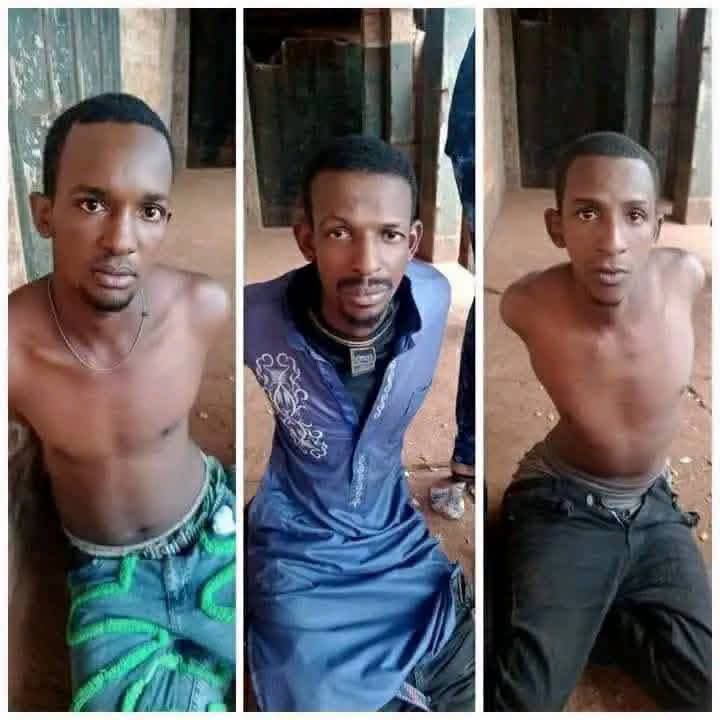
Three bandits have been arrested in Benue state after a lady who they had kidnapped and released, identified them at a motor park and raised alarm.
The k!kidnappers came to Ihotu park to board a vehicle to Makurdi and were met by the lady they had earlier kidnapped and released after collecting ransom from her relatives.
They were even using a bag they collected from the girl. The girl raised the alarm, held one inside the vehicle, and two took to their heels, but were caught.
They had a ghana-must-go bag at the back of the vehicle. N11m was found inside the bag.
Following the confirmation of their identity by another lady who was also their victim, mob gathered around with the intent to beat them up and possibly set them ablaze.
But the park manager decided to invite the police and soldiers who rescued them and took them to their station.
It was later gathered that the Benue state Governor, Rev. Father Hyacinth Alia called and said he was interested in the case which made the police to take the apprehended bandits to Makurdi, the state capital.

President Bola Tinubu Federal Government has drawn down $1.5bn from a $5bn financing facility arranged with the United Arab Emirates’ largest lender, First Abu Dhabi Bank, despite growing concerns from global financial institutions over the increasing use of complex derivative financing by African sovereigns.
Bloomberg reported on Friday that the latest drawdown represents the first tranche of a $5bn Total Return Swap facility approved by the National Assembly on March 31, 2026, and is expected to support the 2026 budget, finance infrastructure projects, and refinance existing debt obligations.
The report quoted people familiar with the transaction, who asked not to be identified because they were not authorised to speak to the media.
The report read, “Nigeria has accessed the first tranche of a $5bn derivatives deal with the United Arab Emirates’ largest lender, pressing ahead with a transaction that has been scrutinised for being opaque.
“The West African nation drew about $1.5bn in the last couple of weeks from a total return swap transaction with First Abu Dhabi Bank PJSC, according to people familiar with the transaction, who asked not to be identified because they were not authorised to speak to the media.”
The transaction comes at a time when Nigeria is facing higher borrowing costs in international capital markets, forcing the government to seek alternative financing arrangements to shore up its fiscal position and improve access to foreign exchange liquidity.
Under the arrangement, Nigeria is required to pledge Federal Government securities worth about 133 per cent of any amount drawn under the facility. This means that for the full $5bn facility, the government would have to post approximately $6.65bn worth of naira-denominated bonds as collateral.
In return, the Abu Dhabi-based lender provides dollar liquidity to the Nigerian government. The Federal Government will pay a floating interest rate benchmark plus about four percentage points, while the lender receives the returns generated by the underlying government securities.
The transaction effectively allows Nigeria to unlock immediate dollar funding without issuing new Eurobonds or taking on traditional external loans at prevailing market rates, which have become increasingly expensive for frontier economies.
The government has already indicated that the proceeds from the initial $1.5bn drawdown will be deployed to support budget implementation, fund critical infrastructure projects, and refinance costlier domestic and external debts.
However, the financing arrangement has attracted criticism from international financial institutions and market analysts over concerns about transparency and potential hidden liabilities.
In its June 2026 assessment of African sovereign debt markets, the International Monetary Fund warned that derivative financing structures such as total return swaps are often opaque and difficult for investors and creditors to monitor.
The IMF noted that such arrangements are “hard to track, hard to value in real time, and can obscure the true extent of a country’s financial obligations.”
Three days ago, Fitch Ratings warned that Nigeria’s planned $5bn financing arrangement with First Abu Dhabi Bank could increase sovereign debt risks and reduce transparency in public debt reporting.
-

 News1 year ago
Senate to speed up conclusion of Nigeria Forest Security Service Bill
-
 News11 months ago
The Many Lies Against Bashir Haske
-

 News3 years ago
Breaking: Tinubu’s authentic ministerial nominees
-
 News3 years ago
“Anytime we want to kill terrorists, President would ask us to take permission from France but they were killing our soldiers-” Niger Republic coup leader
-
 News3 years ago
“I’m leaving the Catholic church because Bishop Onah is oppressing me,” says Okunerere
-

 News3 years ago
Radio Nigeria’s veteran broadcaster Kelvin Ugwu dies three months after retirement from service
-
 News3 years ago
Dokpesi and the Gazebo Mystique
-

 News3 years ago
Tsunami: Tinubu orders dissolution of managements, boards of MDAs, to sack all Buhari’s political appointees