News
How Saint Obi was humiliated in marriage, denied access to his children, died a lonely man


As narrated by Zik Zulu Okafor
His social life was blunted. Perhaps by his reticent disposition.His persona, two dimensional. To a distant public, he was upscale and cool. His manly bearing spoke loud. His onscreen image ironically amplified some idiosyncrasies; heroics, romantic adventures and traits that did not gel with the mortal privacy that eerily define his quiet and lonely life.
Saint Obi, real name, Obinna Nwafor, was shy, almost bordering on timidity and insecurity. He cherished the pleasantly tranquil interractions among a few friends. He would vanish at any outburst that could upset the poise of such small meetings. As he repeatedly told me, he just wanted to live a cool, quiet and fulfilled life.
But, has he lived this cool and fulfilled life he envisioned ? I have my doubts.
I tell Saint’s story here with painful tears in my eyes; because he was a star, a super star whose life turned out a gleam of irony .
Yet, it was this stardom that fetched him his much professed financially strong and powerful wife . And their wedding, that solemn ritual of love, would drastically alter the cause of his life and tragically yank him off the creative community that threw him up for the wife to capture and indeed conquer.
Their marriage was at best a dramatisation of love. It was quick. He barely told us that he found a wife. Then, the marriage happened. It was something of a mystique, only those involved understood the histrionics that played out . None of us who were his closest pals, who walked with him through the crucible to the crest of his career in Nollywood, was invited. The distance between us and the guy I admirably called Saint of the Storm had begun. This gulf would widen with each year. We saw him perhaps once in a year after this marriage.
And life actually seemed to have given him a fair shake of the dice. He dressed well, drove big cars and even his skin, in literal lingo, spelt wellness.
The Saint would be blessed with three beautiful children. But not one occasion were his friends in Nollywood invited for christening or birthday. We were told that his wife was of the topmost hierachy in telecom giant, MTN . But even if their celebrations were designed to be a rendezvous of the elites of the technocracies that his wife chiefly belonged, you expected that Saint would reach out to a few of his fellow creatives, for even if they would herald his small beginnings, there could be no tinge of shame to it because we all have our journeys and our stories. And even at that, the actor or cineaste in Nollywood is by no means poor.
But more tragic is the fact that his marriage did not only take away Obinna from his friends, it took him away from Nollywood. Saint stopped acting, absconded from his career and perhaps his calling.
It would seem prognostic now. Yes, because I recall leaving my house in Lagos Mainland for his massive office in Lekki, Victoria Island, Lagos. It was about six years ago. There, I demanded to know why my friend abandoned our industry. He told me with his usual shy expressions that he wanted to focus on some other businesses and also to work behind the camera. Because his visage was unconvincing to me, I told him in stark terms, that whatever his new vision and pursuits, he must not abandon the trade that made him who he was.
It took another three years for Saint to return to his homies. But when he did, some of the deeply disappointed ones sniggered behind him. This was because the simmering rumours of cracks in his marriage had hit home. And though secretive in his ways, he knew it was time to open up. And he did. “I do not know why my wife’s siblings see me as a gold digger. They confront me, harass and fight me in my own matrimony. And my wife did nothing to stop them. I work hard, I earn my money. I have never depended on my wife”, he lamented, eyes blurred with tears. You could tell he was in deep pain. By the next visit, the Saint returned with a deep cut from knife on his left eye. His wife’s brothers, he said, scaled the wall fence of their house to attack him. They were captured by hidden closed-circuit television, CCTV, installed for surveillance and security, he revealed.
He reported them at the police station and subsequently acquired a gun to defend himself. This effectively marked the beginning of the end of his marriage and perhaps Saint Obi’s long walk to a sad end. He moved out of his marital home to a new house to begin the reconstruction of his destiny, alone without his wife and worse still without his three beautiful children.
Meanwhile, his wife went to the police to defend her siblings using her financial power to manipulate the cause of justice, Saint stated unequivocally. The wife also sued for divorce, not in Lagos, but in Ogun state. As Saint put it, “It was to make the journey difficult for me. But I will not bend neither will I break. I will fight with my last blood to take custody of my children. They love me and they know it will be hard for me to live without them.The divorce is not an issue. My marriage has long been over”, he said with a mix of courage and a quaky heart that betrayed his distress.
About mid last year, however, Obinna took ill. But he told no one. He simply became scarce. He was in and out of hospital, we would later learn. He sold two of his three big SUVs to take proper care of his health and to acquire six camry cars he’d use for Uber. But his vanishing health continued unabated. He seemed to have a premonition of his own passing as he wept repeatedly about not seeing his children. He emaciated. Life took a grim picture. When I saw him by chance in January 2023, the dude called Saint looked 15 years older than his age. His macho cut had shrunk. His fat wallet was gone. What was left was only his fat will. His eyes seemed lost in their socket. This would be the last time I would see him.
Saint snuck out of Lagos to hang in with his sister in Jos. He told no one.
But a month ago, in April precisely, the once delightful actor who brought joy to many a home broke his icy silence. He called our mutual friend in US to give him a devastating message. He was on a deathbed, he said and wanted our friend to pray for him. “It’s not looking good, pray, pray for me”, he appealed passionately.
His next call came on May 1, 2023. This time to his mentor, the man who made him a star with his productions, Zeb Ejiro, OON. He told him with a wavering voice that he had had three surgeries but was still in hospital in Jos. He averred again that his situation was not looking good, that he is also in a deep pain, distressed that he could not see his children. But still he begged him not to tell anyone about his ailment. Such was the life of this creative hermit, a lonely trouper.
I was the first to hear the news of his death late on Sunday, May 7. Having confirmed it, I called Zeb Ejiro. “I have a very bad news my brother, Zeb”, I began.
“What is it, what is it, Zik Zulu?”, he asked anxiously. “A big star has fallen in Nollywood”. Zeb broke down in tears. I hadn’t said who it was. But sobbing helplessly now, he said, “Don’t tell me it is Saint Obi”.
Sadly, Zeb was right.
May his soul find peace.
*Zik Zulu Okafor is a veteran journalist, a film producer and a former President of Association of Movie Producers of Nigeria (AMP).
This piece also serves as a tribute to the late movie star, Obinna Nwafor, popularly known as Saint Obi, who was a bossom friend of the house.
NB: First published by the frontier with a different title

Benue State Police Command has condemned the killing of the Chairman of the Miyetti Allah Cattle Breeders Association of Nigeria (MACBAN), Benue State chapter, Ardo Rabo Mohammed, and another man, Yakubu Isa, describing the attack as a senseless criminal act capable of undermining ongoing peace and security efforts in the state.
The victims were reportedly attacked by gunmen while returning from a security meeting along the Okwudu-Ogoli Road in Otukpo Local Government Area.
In a statement issued on Saturday, the Police Public Relations Officer, DSP Udeme Edet, said the Commissioner of Police, CP Cletus C.N. Nwadiogbu, condemned the killings and expressed condolences to the families of the deceased.
“The Commissioner of Police strongly condemns in its entirety the brutal killing of the Chairman of Miyetti Allah Cattle Breeders Association of Nigeria (MACBAN), Benue State chapter, Ardo Rabo Mohammed, and one Yakubu Isa, who were reportedly attacked by unknown assailants while returning from a security meeting along Okwudu-Ogoli Road, Otukpo,” the statement read.
According to the police, the command has commenced a full-scale investigation into the incident, with tactical and intelligence teams deployed to track down those responsible.
The Commissioner assured residents that the command would leave no stone unturned in ensuring the perpetrators are identified, arrested and prosecuted.
He appealed to members of the public to remain calm, avoid taking the law into their own hands, and refrain from spreading unverified information capable of escalating tensions.
The police also urged anyone with credible information that could aid the investigation to report to the nearest police station or contact the command through its emergency lines.
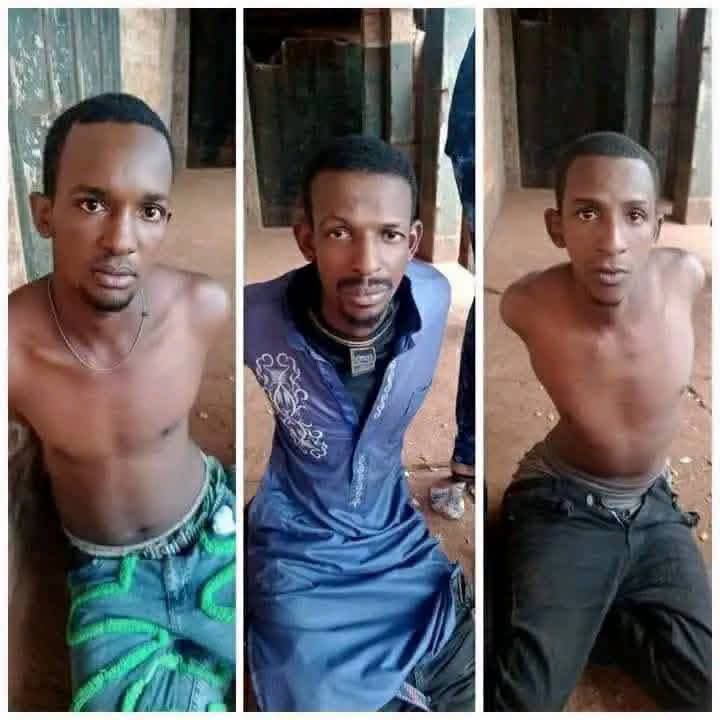
Three bandits have been arrested in Benue state after a lady who they had kidnapped and released, identified them at a motor park and raised alarm.
The k!kidnappers came to Ihotu park to board a vehicle to Makurdi and were met by the lady they had earlier kidnapped and released after collecting ransom from her relatives.
They were even using a bag they collected from the girl. The girl raised the alarm, held one inside the vehicle, and two took to their heels, but were caught.
They had a ghana-must-go bag at the back of the vehicle. N11m was found inside the bag.
Following the confirmation of their identity by another lady who was also their victim, mob gathered around with the intent to beat them up and possibly set them ablaze.
But the park manager decided to invite the police and soldiers who rescued them and took them to their station.
It was later gathered that the Benue state Governor, Rev. Father Hyacinth Alia called and said he was interested in the case which made the police to take the apprehended bandits to Makurdi, the state capital.

President Bola Tinubu Federal Government has drawn down $1.5bn from a $5bn financing facility arranged with the United Arab Emirates’ largest lender, First Abu Dhabi Bank, despite growing concerns from global financial institutions over the increasing use of complex derivative financing by African sovereigns.
Bloomberg reported on Friday that the latest drawdown represents the first tranche of a $5bn Total Return Swap facility approved by the National Assembly on March 31, 2026, and is expected to support the 2026 budget, finance infrastructure projects, and refinance existing debt obligations.
The report quoted people familiar with the transaction, who asked not to be identified because they were not authorised to speak to the media.
The report read, “Nigeria has accessed the first tranche of a $5bn derivatives deal with the United Arab Emirates’ largest lender, pressing ahead with a transaction that has been scrutinised for being opaque.
“The West African nation drew about $1.5bn in the last couple of weeks from a total return swap transaction with First Abu Dhabi Bank PJSC, according to people familiar with the transaction, who asked not to be identified because they were not authorised to speak to the media.”
The transaction comes at a time when Nigeria is facing higher borrowing costs in international capital markets, forcing the government to seek alternative financing arrangements to shore up its fiscal position and improve access to foreign exchange liquidity.
Under the arrangement, Nigeria is required to pledge Federal Government securities worth about 133 per cent of any amount drawn under the facility. This means that for the full $5bn facility, the government would have to post approximately $6.65bn worth of naira-denominated bonds as collateral.
In return, the Abu Dhabi-based lender provides dollar liquidity to the Nigerian government. The Federal Government will pay a floating interest rate benchmark plus about four percentage points, while the lender receives the returns generated by the underlying government securities.
The transaction effectively allows Nigeria to unlock immediate dollar funding without issuing new Eurobonds or taking on traditional external loans at prevailing market rates, which have become increasingly expensive for frontier economies.
The government has already indicated that the proceeds from the initial $1.5bn drawdown will be deployed to support budget implementation, fund critical infrastructure projects, and refinance costlier domestic and external debts.
However, the financing arrangement has attracted criticism from international financial institutions and market analysts over concerns about transparency and potential hidden liabilities.
In its June 2026 assessment of African sovereign debt markets, the International Monetary Fund warned that derivative financing structures such as total return swaps are often opaque and difficult for investors and creditors to monitor.
The IMF noted that such arrangements are “hard to track, hard to value in real time, and can obscure the true extent of a country’s financial obligations.”
Three days ago, Fitch Ratings warned that Nigeria’s planned $5bn financing arrangement with First Abu Dhabi Bank could increase sovereign debt risks and reduce transparency in public debt reporting.
-

 News1 year ago
Senate to speed up conclusion of Nigeria Forest Security Service Bill
-
 News11 months ago
The Many Lies Against Bashir Haske
-

 News3 years ago
Breaking: Tinubu’s authentic ministerial nominees
-
 News3 years ago
“Anytime we want to kill terrorists, President would ask us to take permission from France but they were killing our soldiers-” Niger Republic coup leader
-
 News3 years ago
“I’m leaving the Catholic church because Bishop Onah is oppressing me,” says Okunerere
-

 News3 years ago
Radio Nigeria’s veteran broadcaster Kelvin Ugwu dies three months after retirement from service
-
 News3 years ago
Dokpesi and the Gazebo Mystique
-

 News3 years ago
Tsunami: Tinubu orders dissolution of managements, boards of MDAs, to sack all Buhari’s political appointees