
News
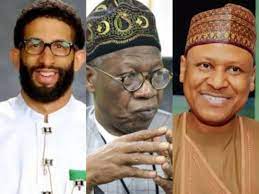
As Malagi, Ngelale depart from Lai Mohammed’s infamy

By Farooq Kperogi
The Information and National Orientation Minister, Mohammed Idris Malagi, and the Special Adviser to the President on Media and Publicity, Ajuri Ngelale, started their jobs by inaugurating a refreshing and applaudable departure from the primitive information management strategies of their predecessors. But can they sustain the moral high ground they signposted in their initiatory speeches?
On his first day in office on August 1, Ngelale took deserved and carefully targeted potshots at the rude and crude informational tactics of his predecessors. “Gone forever, by the grace of God, are the days when government spokesmen and women would speak down to Nigerians, would use condescending language with Nigerians, and would display some form of institutional arrogance toward Nigerians,” he said. “That will NOT be tolerated under my leadership.”
His message resonated with a broad band of Nigerians, especially on social media, because since the return of civilian rule in 1999, Nigerians have come to associate incivility, crudity, arrogance, and insults with the job of presidential spokesmanship. To have a presidential spokesman disavow this template of relating with Nigerians is pleasantly surprising.
For his part, Malagi, in what seemed like a veiled dig at his immediate predecessor, assured Nigerians that lies and propaganda would no longer be instruments of information management. “This time around, a process of restoring popular confidence and trust in government and its policies shall not lie in the domain of propaganda,” he said. “In other words, the era of relying on propaganda to propagate government programmes is now over.”
This is music to the ears, especially coming after Lai Mohammed whose entire career as Minister of Information and Culture was defined by a bewilderingly extravagant fondness for willful and easily falsifiable lies. Lai’s first name doesn’t just share an uncanny phonemic kinship with “lie”; he actually embodied lies in the most audaciously disreputable way imaginable.
All government information managers lie, but Lai’s lies were unmatched in their coarseness, brazenness, vulgarism, and disdain for the intelligence of Nigerians, which once caused me to wonder if he was the victim of a psychiatric disorder called “pseudologia fantastica” or “mythomania,” that is, chronically compulsive lying that causes liars to believe their own lies. A successor who repudiates this reputation is worthy of our attention.
I have written several past columns on the ineffectiveness of lies, intimidation, insults, and propaganda as means of official communication. In a February 28, 2015, column titled “Why Nigerian Politicians Now Prefer American Public Relations Firms,” for example, I wrote:
“Nigeria’s political public relations is crude, vulgar, and intellectually impoverished. No one who desires to change the hearts and minds of people should rely on it. Nigeria’s brand of political public relations, for the most part, does no more than attract enemies, scare away potential converts, and ossify negative opinions about candidates.
“It consists in barbarous, impulsive, sophomoric insults against real and imagined political opponents—and cloying, hagiographic defense of principals. It lacks nuance, is childish, and seems unconcerned with logic and persuasion.
“The performance of Reuben Abati and Doyin Okupe (who in fact describes himself as an ‘attack lion’)—and several others before them—in the defense of their bosses and the demonization of their bosses’ real and imagined political enemies is a classic example of the kind of primitive political public relations that holds sway in Nigeria. In this kind of political public relations, not only ‘political enemies’ come under heavy fire; facts, truth, and logic also become casualties.”
As spokesmen for Olusegun Obasanjo, Doyin Okupe and Femi Fani-Kayode trafficked in what I called an “unprecedented display of ill breeding and rudeness to our elders” and everyday Nigerians and “reckless and irresponsible juvenile bravado.”
Although Olusegun Adeniyi was urbane, responsible, polite, and guarded in the performance of his job as Umaru Musa Yar’adua’s spokesman, the ease with which he defended the obvious lies and fraud of the administration, especially in the last days of Yar’adua when governance basically ceased, made it difficult to take him seriously.
Then Reuben Abati came and started the trend of inventing group slurs for critics of the government. He infantilized and pathologized critics of Goodluck Jonathan as “collective children of anger.”
Femi Adesina built on Abati’s collective slurring of critics. One of Adesina’s most notable “achievements” was the invention of a vacuous, unimaginative, and idiotic insult for critics of Muhammadu Buhari. He called them “wailing wailers.”
As I pointed out in past columns, “Wailing Wailers” is a historically positive term because it is one of the earliest names of the reggae band formed by Bob Marley, Peter Tosh, and Bunny Wailer in Jamaica. The band took the world by storm with the irresistibly lyrical force and anti-imperialist content of its music. It betrays a spectacular creativity deficit to insult your opponents with a term of esteem.
Outside its creative use as the name of a music band, “wailing wailer” is an unintelligent waste of words. It’s akin to saying “writing writers” or “singing singers.” It takes unbelievably remarkable stupidity to think that “wailing wailer” or “wailer” is an insult, but it bespeaks an even more astonishing height in the ignorance index to hurl it at an opponent and imagine you have done something great.
Most importantly, though, why should a presidential spokesperson who is paid from the public purse vituperate all critics of a government with a crude slur? What does that achieve?
Well, I can tell you what it achieves. It creates a condition psychologists call reactance. Reactance occurs when people are motivated to persist in or double down on an opinion or course of action that caused them to be threatened with insults.
For example, I didn’t set out wanting to be a Buhari critic. In fact, like previous presidents, I wanted him to succeed for the benefit of the entire country. When I started calling out his missteps in 2015 in the most sympathetic ways possible, I got unwarrantedly violent pushback from people who thought Buhari was worthy only of worshipful admiration and not even the mildest censure for even his most obvious infractions.
The Buhari Media Center (BMC) was created to attack, smear, and libel me for merely daring to call out Buhari at a time when most people were scared of pointing out his weak points. But instead of cowing me, BMC’s attacks emboldened me and activated a motivational state of reactance that compelled me to reveal things about Buhari that I probably would have kept under wraps had BMC minions not set out to serially defame me for exercising my right to comment on the government.
Most critical, independent, self-aware people react the same way if their freedom of thought or action is violated with threats, insults, or other tools of emotional blackmail. In other words, it turns even fence-sitters into sworn enemies and hardens the opposition of opponents. The fact that Malagi and Ngelale appear to appreciate this elemental truth in persuasion and information management is admirable.
To my utter embarrassment, I had no knowledge of Ngelale until his appointment by Tinubu. I now know that he is a young man in his 30s (making him probably the youngest presidential spokesperson since 1999) who earned a political science degree from the University of Kansas in the United States in 2011 and had worked as Buhari’s Senior Special Assistant on Public Affairs (where he defended many indefensible things).
Perhaps, his youth, transnational experience, and awful experiences in the Buhari regime have helped to shape his new approach to interfacing with Nigerians.
Malagi’s position doesn’t surprise me. As I wrote in a casual May 18, 2022, article when he ran for APC’s governorship nomination in Niger State, I have known Malagi since the late 1990s when I worked for the Weekly Trust. He is by far the best credentialed minister of information that Nigeria has had in recent memory.
After teaching at a college of education for years, he ventured into public relations, advertising, marketing, and finally publishing. Apart from being the publisher of the Abuja-based Blueprint newspaper, he is also the proprietor of WE 106.5 FM Abuja, was general secretary of the Newspaper Proprietors’ Association of Nigeria (NPAN) and has been a major player in the Nigerian Institute of Public Relations (NIPR).
So, unlike past ministers of information, Malagi has deep intellectual and experiential familiarity with both public relations and journalism. Of course, this is no guarantee that he will succeed—or be better than his predecessors. Power both changes and reveals who people are. I know of no one who has remained the same after stepping foot in the corridors of power. I’ll be pleasantly shocked if Malagi is different.
For all you know, the praiseworthy words of Malagi and Ngelale may be no more than the ephemeral whispers of honeymoon sweet nothings. But the fact that they are unprecedented should invite us to pay attention and monitor how their actions match their words.
*Kperogi is a Professor of Journalism and Emerging Media at Kennesaw State University, Georgia, United States, and a notable columnist

Benue State Police Command has condemned the killing of the Chairman of the Miyetti Allah Cattle Breeders Association of Nigeria (MACBAN), Benue State chapter, Ardo Rabo Mohammed, and another man, Yakubu Isa, describing the attack as a senseless criminal act capable of undermining ongoing peace and security efforts in the state.
The victims were reportedly attacked by gunmen while returning from a security meeting along the Okwudu-Ogoli Road in Otukpo Local Government Area.
In a statement issued on Saturday, the Police Public Relations Officer, DSP Udeme Edet, said the Commissioner of Police, CP Cletus C.N. Nwadiogbu, condemned the killings and expressed condolences to the families of the deceased.
“The Commissioner of Police strongly condemns in its entirety the brutal killing of the Chairman of Miyetti Allah Cattle Breeders Association of Nigeria (MACBAN), Benue State chapter, Ardo Rabo Mohammed, and one Yakubu Isa, who were reportedly attacked by unknown assailants while returning from a security meeting along Okwudu-Ogoli Road, Otukpo,” the statement read.
According to the police, the command has commenced a full-scale investigation into the incident, with tactical and intelligence teams deployed to track down those responsible.
The Commissioner assured residents that the command would leave no stone unturned in ensuring the perpetrators are identified, arrested and prosecuted.
He appealed to members of the public to remain calm, avoid taking the law into their own hands, and refrain from spreading unverified information capable of escalating tensions.
The police also urged anyone with credible information that could aid the investigation to report to the nearest police station or contact the command through its emergency lines.

Three bandits have been arrested in Benue state after a lady who they had kidnapped and released, identified them at a motor park and raised alarm.
The k!kidnappers came to Ihotu park to board a vehicle to Makurdi and were met by the lady they had earlier kidnapped and released after collecting ransom from her relatives.
They were even using a bag they collected from the girl. The girl raised the alarm, held one inside the vehicle, and two took to their heels, but were caught.
They had a ghana-must-go bag at the back of the vehicle. N11m was found inside the bag.
Following the confirmation of their identity by another lady who was also their victim, mob gathered around with the intent to beat them up and possibly set them ablaze.
But the park manager decided to invite the police and soldiers who rescued them and took them to their station.
It was later gathered that the Benue state Governor, Rev. Father Hyacinth Alia called and said he was interested in the case which made the police to take the apprehended bandits to Makurdi, the state capital.

President Bola Tinubu Federal Government has drawn down $1.5bn from a $5bn financing facility arranged with the United Arab Emirates’ largest lender, First Abu Dhabi Bank, despite growing concerns from global financial institutions over the increasing use of complex derivative financing by African sovereigns.
Bloomberg reported on Friday that the latest drawdown represents the first tranche of a $5bn Total Return Swap facility approved by the National Assembly on March 31, 2026, and is expected to support the 2026 budget, finance infrastructure projects, and refinance existing debt obligations.
The report quoted people familiar with the transaction, who asked not to be identified because they were not authorised to speak to the media.
The report read, “Nigeria has accessed the first tranche of a $5bn derivatives deal with the United Arab Emirates’ largest lender, pressing ahead with a transaction that has been scrutinised for being opaque.
“The West African nation drew about $1.5bn in the last couple of weeks from a total return swap transaction with First Abu Dhabi Bank PJSC, according to people familiar with the transaction, who asked not to be identified because they were not authorised to speak to the media.”
The transaction comes at a time when Nigeria is facing higher borrowing costs in international capital markets, forcing the government to seek alternative financing arrangements to shore up its fiscal position and improve access to foreign exchange liquidity.
Under the arrangement, Nigeria is required to pledge Federal Government securities worth about 133 per cent of any amount drawn under the facility. This means that for the full $5bn facility, the government would have to post approximately $6.65bn worth of naira-denominated bonds as collateral.
In return, the Abu Dhabi-based lender provides dollar liquidity to the Nigerian government. The Federal Government will pay a floating interest rate benchmark plus about four percentage points, while the lender receives the returns generated by the underlying government securities.
The transaction effectively allows Nigeria to unlock immediate dollar funding without issuing new Eurobonds or taking on traditional external loans at prevailing market rates, which have become increasingly expensive for frontier economies.
The government has already indicated that the proceeds from the initial $1.5bn drawdown will be deployed to support budget implementation, fund critical infrastructure projects, and refinance costlier domestic and external debts.
However, the financing arrangement has attracted criticism from international financial institutions and market analysts over concerns about transparency and potential hidden liabilities.
In its June 2026 assessment of African sovereign debt markets, the International Monetary Fund warned that derivative financing structures such as total return swaps are often opaque and difficult for investors and creditors to monitor.
The IMF noted that such arrangements are “hard to track, hard to value in real time, and can obscure the true extent of a country’s financial obligations.”
Three days ago, Fitch Ratings warned that Nigeria’s planned $5bn financing arrangement with First Abu Dhabi Bank could increase sovereign debt risks and reduce transparency in public debt reporting.
-

 News1 year ago
Senate to speed up conclusion of Nigeria Forest Security Service Bill
-

 News11 months ago
The Many Lies Against Bashir Haske
-

 News3 years ago
Breaking: Tinubu’s authentic ministerial nominees
-
 News3 years ago
“Anytime we want to kill terrorists, President would ask us to take permission from France but they were killing our soldiers-” Niger Republic coup leader
-
 News3 years ago
“I’m leaving the Catholic church because Bishop Onah is oppressing me,” says Okunerere
-

 News3 years ago
Radio Nigeria’s veteran broadcaster Kelvin Ugwu dies three months after retirement from service
-
 News3 years ago
Dokpesi and the Gazebo Mystique
-

 News3 years ago
Tsunami: Tinubu orders dissolution of managements, boards of MDAs, to sack all Buhari’s political appointees