
News
ACCI, others conclude practitioners’ certification programme on business and human rights in Africa

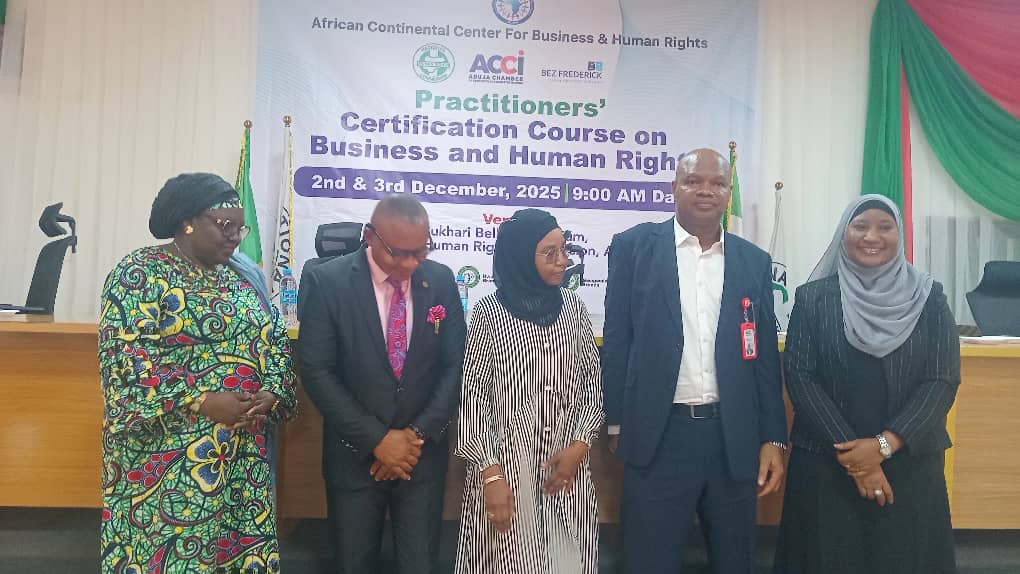
A two-day intensive practitioners’ certification course on Business and Human Rights, has been concluded in Abuja with 118 participants drawn from 11 African countries and representatives from Belgium and the Netherlands in attendance.
Organized by African Continental Centre for Business and Human Rights (ACCBHR), in partnership with Nigeria’s National Human Rights Commission (NHRC), and the Abuja chamber of Commerce (ACCI), the event marked the first professionally accredited BHR certification course to be delivered in West Africa.
According to Sir Agadaidu C. Jideani, ACCI Director General, the course was structured around the three pillars of the UN Guiding Principles on Business and Human Rights (UNGPs), Protect, Respect, and Remedy; and combined high-level theoretical grounding with practical, Africa-specific implementation tools.
Participants who were mainly from Nigeria, Ghana, Kenya, South Africa, Uganda, and Côte d’Ivoire, included legal practitioners, in-house counsel, compliance and sustainability officers from extractive and financial-sector companies, senior government regulators, members of national human rights institutions, the UNDP and civil society specialists.
The event opened on the first day with a keynote address by the Executive Secretary of the National Human Rights Commission (NHRC) Dr. Tonny Ojukwu, SAN and a welcome address by the President of the Abuja Chamber of Commerce/Leader of the Organized Private Sector in the Nigerian Capital-Abuja, Chief Emeka Obegolu, SAN.
The two speakers identified the need for strengthening the intersection between ethical business conduct and respect for human rights. They underscored the growing convergence between mandatory human rights and environmental due diligence (mHREDD) regimes and emerging African frameworks.
Barrister Chris Ugwuala delivered the foundational session, tracing the evolution of the BHR field from the 1970s draft UN Code of Conduct through to the 2011 UNGPs and subsequent National Action Plans (NAPs). Particular emphasis was placed on Nigeria’s 2022–2026 National Action Plan on Business and Human Rights, one of the most advanced in Africa, and its alignment with the OECD Guidelines for Multinational Enterprises.
Mrs. Pwamdundi Oko, subject matter expert and desk officer Business and Human Rights at the National Human rights Commission of Nigeria (NHRC) provided a detailed dissection of the Nigerian NAP’s four thematic pillars and cross-cutting obligations, candidly addressing implementation gaps, resource constraints, and the absence of binding legislative backing to date. Her session triggered robust discussion on the role of national human rights institutions as NAP coordinators in resource-constrained environments.
The afternoon concluded with a highly interactive skills-building workshop led by ACCI Director General, himself, a Human Rights Governance, Risk and Compliance Specialist. Participants worked in sectoral groups (extractives, agribusiness, finance, and manufacturing) to map salient human rights risks and design basic human rights due diligence processes using open-source tools adapted to low-capacity settings. Sir Agabaidu led the participants through the establishment and operationalization of a Business and Human Rights Compliance and Implementation Program.
Day 2 of the event opened with a sharp focus on the often-neglected third pillar with Hauwa Kaka Usman, Registrar-General of the Nigeria Chamber of Commerce Dispute Resolution Centre (NCCDRC), presenting a groundbreaking proposal for the NCCDRC to be formally recognised as a non-judicial grievance mechanism under Pillar III of the UNGPs.
Participants engaged in a mock mediation of a community–investor land-rights dispute, demonstrating the practical viability of industry-led remedial ecosystems.
Oyetola Muyiwa Atoyebi SAN delivered a masterclass on climate change litigation and corporate climate accountability, analysing landmark tort-based cases, and recent South African proceedings, alongside the accelerating wave of greenwashing and climate-washing claims. The session explored how African jurisdictions might adapt these precedents in the absence of dedicated climate statutes.
Professor Ibe Ifeakandu of the Nigerian Institute of Advanced legal Studies, examined modern slavery and forced labour risks in African supply chains, drawing on recent UK and Australian Modern Slavery Act reporting data involving Nigerian and Ghanaian exporters. The presentation concluded with practical guidance on conducting heightened due diligence in tier-2 and tier-3 supplier relationships.
The final substantive session, led by environmental rights specialist Mr. Napoleon Eyenaba of the UNDP, mapped the fast-evolving HREDD landscape: the EU Corporate Sustainability Due Diligence Directive (CSDDD), the proposed ECOWAS Directive, South Africa’s emerging companies’ amendment bill, and ongoing legislative discussions in Kenya and Nigeria. Participants received comparative compliance checklists and transition timelines.
Participants were later divided into three working groups for practical exercises on the three pillars of Business and Human Rights and scenario-based exercises. A certification Exam and practical exercises have been shared with the participants to complete at home in an open book manner before certification certificates would be issued by the organizers to the successful candidates.
In his closing remarks, ACCI boss, Sir Agabaidu Jideani, announced that the organizers will work together to integrate successful participants into a national BHR practitioners’ roster to support NAP implementation monitoring and multi-stakeholder advisory processes.
The Abuja certification course arrives at a pivotal moment: African states and companies face simultaneous pressure from incoming European due diligence laws, rising investor ESG expectations, and an expanding domestic litigation risk environment. By creating a cohort of certified African practitioners conversant with both global standards and local realities, the ACCBHR, NHRC and the ACCI, have laid critical groundwork for contextualised, effective implementation of the UNGPs across the continent.
The Centre has confirmed that the programme will be rolled out in East Africa (Nairobi) and Southern Africa (Johannesburg) in 2026, with advanced modules on supply-chain due diligence and climate-related human rights impacts already in development.
As mandatory HREDD moves from Brussels to African statute books, initiatives such as this signal that the continent is not merely reacting to global norms but is actively shaping competent, home-grown responses, led by the Nigerian National Human Rights Commission.

The Supreme Court of Nigeria will on Thursday, deliver judgments in two cases involving the leadership crises rocking the African Democratic Congress and the Peoples Democratic Party.
According to information on the official website of the court, the matters, listed under “Political Appeals”, have been added to the cause list for Thursday, April 30, 2026.
While judgment in the ADC matter, marked SC/CV/180/2026, has been fixed for 2 pm, there is no time yet for that if the PDP.

President Bola Tinubu has written the Senate, seeking the screening and subsequent confirmation of fifteen nominees to the National Human Rights Commission (NHRC).
The letter was read by the President of the Senate, Senator Godswill Akpabio.
The letter seeks the reconstitution of the commission’s board in line with statutory provisions with the list comprising nominees from diverse professional backgrounds, including the media and legal sectors.
Among the nominees are the President, Nigeria Guild of Editors and Editor, Vanguard Newspapers, Mr. Eze Anaba; and Dr. Salamatu Hussaina Suleiman, who has been proposed as chairman of the board.
The Executive Secretary of the Commission, Dr. Anthony Ojukwu (SAN) is to retain his position as the Chief Executive Officer.
Other nominees include Mrs Roseline Tasha, Ambassador Adam Yubak Baku, ACG Felix Lawrence, Mr. Edmund Chinonye, Mr. Chinonye Obiaku (SAN), Oluwakemi Asiwaju Okere-Odo, Professor Adedeji Ogunji, Kingsley Chidozie, Mohammed Adelodu, Maupe Ogun Yusuf, and Otunba Francis Meshioye as members.
Also nominated are Patience Patrick and Hawwa Ibrahim, listed as members.
The President said the nominations were made pursuant to Section 2(3) of the National Human Rights Commission (Establishment) Act, 2010, which empowers him to constitute the board subject to Senate confirmation.
He explained that the reconstitution of the board was necessary to enhance the commission’s institutional capacity and enable it to more effectively discharge its mandate to promote and protect human rights across the country.
If confirmed, the new board is expected to play a critical role in reinforcing the NHRC’s oversight functions, particularly at a time of heightened concerns over rights protection and accountability in Nigeria.
Following the presentation of the request, the Senate referred the nominations to its Committee on Judiciary, Human Rights and Legal Matters for screening and report within two weeks.

The Economic and Financial Crimes Commission, EFCC, has revealed that it investigated the founder of Streams of Joy International, Pastor Jerry Eze, for six months over suspected money laundering before clearing him.
Ola Olukoyede, chairman of the Commission, disclosed this on Wednesday while speaking at the Jerry Eze Foundation Business Grant Award Ceremony in Abuja.
According to him, the probe was triggered by intelligence reports and petitions after the commission observed large inflows of foreign currencies into the cleric’s domiciliary account.
“We work by intelligence, we work by petitions. At some point, I saw there was an account, a domiciliary account. Dollars, pounds were dropping in like raindrops, from Colombia, from America, from Sri Lanka, even from Togo.
“I said who is this man? Yes, I’ve been hearing about his name, I’ve seen his face a couple of times. I never bothered about what he was doing. I knew he was a pastor.
“So they said this one pastor of streams of joy, go and investigate him. So we went to the investigation. We combed the books,” Olukoyede stated.
The EFCC boss said he subsequently invited Eze for questioning after preliminary findings were compiled by investigators.
He added that upon meeting the cleric and reviewing the findings of the investigation, the commission found no wrongdoing.
“So he came to my office. He told me what happens and all of that, and how the money came, what he does, how he has been helping people, and all of that.
“I said, you know what, I didn’t call you here to explain to me. We have already done our work. I called you here to commend you,” he stated.
The remark drew applause from the audience, as Eze, who was present at the event, acknowledged the commendation.
He noted that the commission has a responsibility not only to investigate financial crimes but also to recognise individuals found to have acted with integrity.
The EFCC chairman, however, stated that the agency would continue to monitor financial activities where necessary, stressing that its preventive mandate remains critical in tackling corruption.
-

 News1 year ago
Senate to speed up conclusion of Nigeria Forest Security Service Bill
-

 News9 months ago
The Many Lies Against Bashir Haske
-

 News3 years ago
Breaking: Tinubu’s authentic ministerial nominees
-

 News3 years ago
“Anytime we want to kill terrorists, President would ask us to take permission from France but they were killing our soldiers-” Niger Republic coup leader
-

 News3 years ago
“I’m leaving the Catholic church because Bishop Onah is oppressing me,” says Okunerere
-

 News3 years ago
Radio Nigeria’s veteran broadcaster Kelvin Ugwu dies three months after retirement from service
-
 News3 years ago
Dokpesi and the Gazebo Mystique
-

 News3 years ago
Tsunami: Tinubu orders dissolution of managements, boards of MDAs, to sack all Buhari’s political appointees