
News
JEWEL OF THE CROWN: JONATHAN’S STRENGTH TO TURN THE 2027 TIDE

By Hon. Dahiru Yusuf Yabo
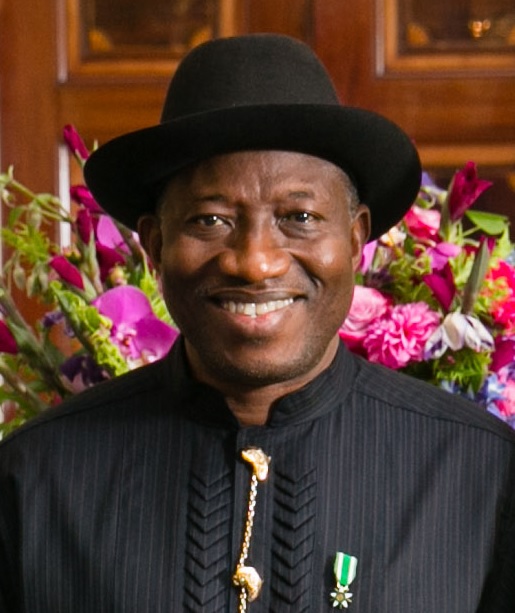
In the complex political pyramid of Nigeria heading toward 2027, one reality stands firm — the Presidential Candidate remains the jewel of the crown. It is the single factor capable of redefining alliances, reviving hope, and restoring the fading balance between North and South. At the heart of this dynamic stands Dr. Goodluck Ebele Jonathan, whose quiet strength and enduring credibility have once again become the greatest fear of the ruling class.
South: Reclaiming the Emotional Geography
In a straight Jonathan versus Tinubu contest, the three southern geopolitical zones present a clear electoral advantage for Jonathan.
The South-South remains his unshakable bastion — emotionally, politically, and historically tied to his leadership era that promoted inclusion and dignity.
The South-East views him as a trusted ally who gave the region recognition, ministerial balance, and infrastructural fairness, unlike the symbolic neglect of recent years.
In the South-West, while Tinubu may command traditional roots, the socio-economic backlash of his government, coupled with rising disillusionment among intellectuals, professionals, and youth, could grant Jonathan a minimum of 25% or more — a figure strong enough to upset the ruling APC’s southern monopoly.
This pattern suggests that the South, long divided by ambition and propaganda, may rediscover unity under a familiar and humbler face — one that offers not power for its own sake, but peace and recovery.
North: A Renewed Covenant of Trust
In the North, a new political psychology is unfolding. The fear and resentment once engineered against Jonathan have faded under the weight of insecurity, poverty, and unkept promises. From Sokoto to Borno, from Kano to Bauchi, there is a quiet nostalgia for the Jonathan years — years when Nigeria, though imperfect, still held moral direction and collective dignity.
Both Muslims and Christians in the North increasingly view Jonathan as a moderate unifier, not an adversary. His humility and post-office composure have earned him trust across divides. Many Northern leaders now admit privately that the nation’s moral compass tilted downward after his exit. Hence, if Jonathan stands on the ballot in 2027, the North is likely to vote for peace over pride, and stability over sentiment.
APC’s Fear and Judicial Preemption
The APC’s judicial panic to bar Jonathan from contesting the 2027 Presidential Election — even before his declaration — is a political confession. It reveals a deep-seated fear that Jonathan’s return could dismantle the fragile regional alliances that brought Tinubu to power. It also exposes APC’s awareness that, in an open field of fairness, Tinubu cannot survive a Jonathan challenge.
Their preemptive legal maneuver is therefore not about constitutionality but insecurity of legitimacy. For a ruling party that promised renewed hope, the desperation to silence an opponent before the race begins shows that its so-called strength lies in manipulation, not confidence.
The Crown Jewel of Balance
Dr. Goodluck Jonathan today represents more than a politician — he embodies a national conscience. His potential return to the ballot symbolizes a moral and generational correction to Nigeria’s present imbalance. Between religion and ethnicity, between arrogance and humility, between noise and reason — Jonathan stands as the bridge of moderation.
Should he choose to run, 2027 may not just be an election year — it could be the rebirth of Nigeria’s democratic equilibrium, where power returns to merit, and leadership regains humanity. In the Political Pyramid 2027, therefore, Jonathan is the crown jewel capable of turning the tide, reviving trust, and restoring faith in the idea of one Nigeria.
Dahiru Yusuf Yabo
Political & Security Analyst
RED-LINE 2027

Benue State Police Command has condemned the killing of the Chairman of the Miyetti Allah Cattle Breeders Association of Nigeria (MACBAN), Benue State chapter, Ardo Rabo Mohammed, and another man, Yakubu Isa, describing the attack as a senseless criminal act capable of undermining ongoing peace and security efforts in the state.
The victims were reportedly attacked by gunmen while returning from a security meeting along the Okwudu-Ogoli Road in Otukpo Local Government Area.
In a statement issued on Saturday, the Police Public Relations Officer, DSP Udeme Edet, said the Commissioner of Police, CP Cletus C.N. Nwadiogbu, condemned the killings and expressed condolences to the families of the deceased.
“The Commissioner of Police strongly condemns in its entirety the brutal killing of the Chairman of Miyetti Allah Cattle Breeders Association of Nigeria (MACBAN), Benue State chapter, Ardo Rabo Mohammed, and one Yakubu Isa, who were reportedly attacked by unknown assailants while returning from a security meeting along Okwudu-Ogoli Road, Otukpo,” the statement read.
According to the police, the command has commenced a full-scale investigation into the incident, with tactical and intelligence teams deployed to track down those responsible.
The Commissioner assured residents that the command would leave no stone unturned in ensuring the perpetrators are identified, arrested and prosecuted.
He appealed to members of the public to remain calm, avoid taking the law into their own hands, and refrain from spreading unverified information capable of escalating tensions.
The police also urged anyone with credible information that could aid the investigation to report to the nearest police station or contact the command through its emergency lines.
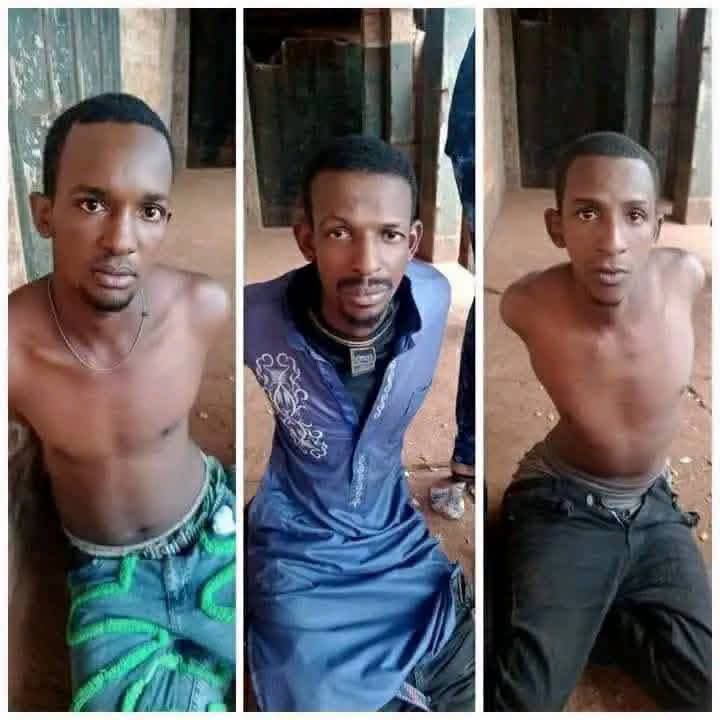
Three bandits have been arrested in Benue state after a lady who they had kidnapped and released, identified them at a motor park and raised alarm.
The k!kidnappers came to Ihotu park to board a vehicle to Makurdi and were met by the lady they had earlier kidnapped and released after collecting ransom from her relatives.
They were even using a bag they collected from the girl. The girl raised the alarm, held one inside the vehicle, and two took to their heels, but were caught.
They had a ghana-must-go bag at the back of the vehicle. N11m was found inside the bag.
Following the confirmation of their identity by another lady who was also their victim, mob gathered around with the intent to beat them up and possibly set them ablaze.
But the park manager decided to invite the police and soldiers who rescued them and took them to their station.
It was later gathered that the Benue state Governor, Rev. Father Hyacinth Alia called and said he was interested in the case which made the police to take the apprehended bandits to Makurdi, the state capital.

President Bola Tinubu Federal Government has drawn down $1.5bn from a $5bn financing facility arranged with the United Arab Emirates’ largest lender, First Abu Dhabi Bank, despite growing concerns from global financial institutions over the increasing use of complex derivative financing by African sovereigns.
Bloomberg reported on Friday that the latest drawdown represents the first tranche of a $5bn Total Return Swap facility approved by the National Assembly on March 31, 2026, and is expected to support the 2026 budget, finance infrastructure projects, and refinance existing debt obligations.
The report quoted people familiar with the transaction, who asked not to be identified because they were not authorised to speak to the media.
The report read, “Nigeria has accessed the first tranche of a $5bn derivatives deal with the United Arab Emirates’ largest lender, pressing ahead with a transaction that has been scrutinised for being opaque.
“The West African nation drew about $1.5bn in the last couple of weeks from a total return swap transaction with First Abu Dhabi Bank PJSC, according to people familiar with the transaction, who asked not to be identified because they were not authorised to speak to the media.”
The transaction comes at a time when Nigeria is facing higher borrowing costs in international capital markets, forcing the government to seek alternative financing arrangements to shore up its fiscal position and improve access to foreign exchange liquidity.
Under the arrangement, Nigeria is required to pledge Federal Government securities worth about 133 per cent of any amount drawn under the facility. This means that for the full $5bn facility, the government would have to post approximately $6.65bn worth of naira-denominated bonds as collateral.
In return, the Abu Dhabi-based lender provides dollar liquidity to the Nigerian government. The Federal Government will pay a floating interest rate benchmark plus about four percentage points, while the lender receives the returns generated by the underlying government securities.
The transaction effectively allows Nigeria to unlock immediate dollar funding without issuing new Eurobonds or taking on traditional external loans at prevailing market rates, which have become increasingly expensive for frontier economies.
The government has already indicated that the proceeds from the initial $1.5bn drawdown will be deployed to support budget implementation, fund critical infrastructure projects, and refinance costlier domestic and external debts.
However, the financing arrangement has attracted criticism from international financial institutions and market analysts over concerns about transparency and potential hidden liabilities.
In its June 2026 assessment of African sovereign debt markets, the International Monetary Fund warned that derivative financing structures such as total return swaps are often opaque and difficult for investors and creditors to monitor.
The IMF noted that such arrangements are “hard to track, hard to value in real time, and can obscure the true extent of a country’s financial obligations.”
Three days ago, Fitch Ratings warned that Nigeria’s planned $5bn financing arrangement with First Abu Dhabi Bank could increase sovereign debt risks and reduce transparency in public debt reporting.
-

 News1 year ago
Senate to speed up conclusion of Nigeria Forest Security Service Bill
-
 News11 months ago
The Many Lies Against Bashir Haske
-

 News3 years ago
Breaking: Tinubu’s authentic ministerial nominees
-
 News3 years ago
“Anytime we want to kill terrorists, President would ask us to take permission from France but they were killing our soldiers-” Niger Republic coup leader
-
 News3 years ago
“I’m leaving the Catholic church because Bishop Onah is oppressing me,” says Okunerere
-

 News3 years ago
Radio Nigeria’s veteran broadcaster Kelvin Ugwu dies three months after retirement from service
-
 News3 years ago
Dokpesi and the Gazebo Mystique
-

 News3 years ago
Tsunami: Tinubu orders dissolution of managements, boards of MDAs, to sack all Buhari’s political appointees